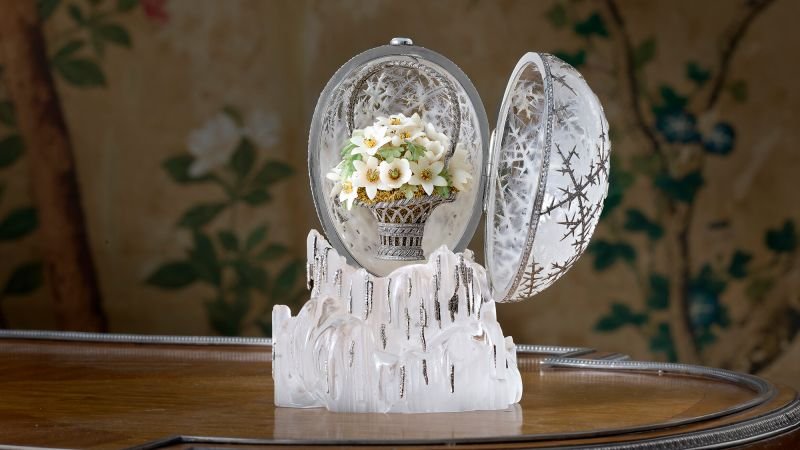
One of the last Faberge eggs in private hands sold for £22.9 million ($30.2 million) with fees on Tuesday, breaking its own record as the most expensive work by the Russian jeweler ever to appear at auction.
Commissioned by Tsar Nicholas II in 1913 as a gift for his mother, the Winter Egg went to an undisclosed buyer after a 3-minute bidding battle at Christie’s auction house in London. The record amount slightly exceeds Christie’s pre-sale estimate of £20 million ($26 million).
The astronomical price tag reflects the increasing rarity of the House of Fabergé’s Imperial Eggs, none of which have been seen at auction for more than 23 years. The historic St. Petersburg Jewelry House made only 50 of them, and the Winter Egg is one of only seven left in private hands. Others are either missing or owned by institutions or museums.
The bejeweled eggs were produced for Nicholas II and his predecessor Alexander III, who presented them as Easter gifts to family members between 1885 and 1916. Each took about a year to design and produce, with the Tsar usually ordering the ornate items immediately after the latest delivery.
Ahead of Tuesday’s sale, Margo Oganesyan, head of Christie’s Fabergé and Russian artwork department, described the Winter Egg as “the most spectacular, artistically inventive and unusual” of the 50.
“Most of them are based on historical styles — Rococo or Neoclassicism — but the Winter Egg is an object in its own genre,” he told CNN by phone, adding, “The design is timeless — it’s very modern.”
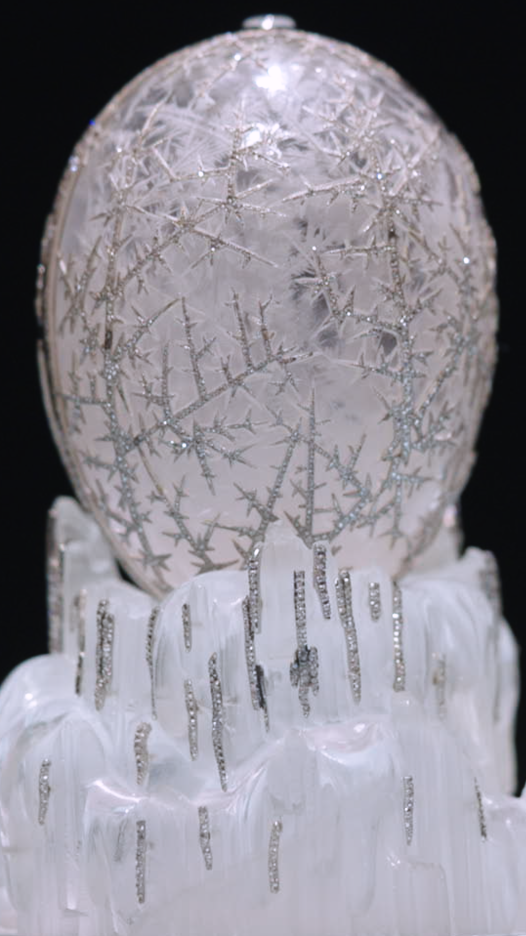
Made primarily of rock crystal, or clear quartz, the Winter Egg was designed to resemble a block of frosted ice. Its exterior features a snowflake motif made of platinum and 4,500 rose-cut diamonds. Inside is one of Fabergé’s signature “surprises”: a small hanging basket filled with wooden anemones made of white quartz, nephrite and garnet.
The design of the Winter Egg was – unusually for the time – the work of a female jeweler, Alma Pihl. Legend says that Pihl, niece of Fabergé’s chief jeweler Albert Holmström, came up with the idea when she saw ice crystals forming on the window sill of her workshop bench.
According to invoices published by Christie’s, Nicholas II bought it for 24,600 rubles, the third highest amount ever charged for a work by Faberge.
According to Kieran McCarthy, co-managing director of Wartsky, a British antique jewelery dealer specializing in the work of Peter Carl Fabergé, the Winter Egg’s price tag reflects the craftsmanship required to “transform precious materials into a moment of nature”.
Thousands of diamonds are so small they have “no intrinsic value,” he said in a call with CNN before the auction. “The value comes entirely in his artistic expression and his use of Frost to create this brilliant idea.”
“It’s like holding a piece of ice in your hand,” he said.

The Winter Egg passed through several private collections after the overthrow of the imperial government of Nicholas II during the Russian Revolution of 1917. It was one of the treasures sold by the Bolsheviks to raise funds for their new Soviet state, and was purchased by Vartsky in the late 1920s or early 1930s for only £450 (about $30,000 in today’s money). It was held in various private British collections before disappearing in 1975.
The egg resurfaced in 1994, when it was valued at more than 7.2 million Swiss francs (then $5.6 million) at Christie’s in Geneva. This set a new auction record for a Fabergé egg – which was broken again in New York in 2002, when it sold for $9.6 million.
This was the last time an Imperial egg appeared at auction, although in 2007 a jeweled egg made by Faberge for a member of the Rothschild banking family was auctioned for more than £8.9 million (then about $18.5 million). In 2015, an anonymous American man purchased a long-lost Imperial Egg (estimated by some experts to be worth £20 million or $33 million at the time) at a flea market for just $14,000, although it has not yet appeared at auction.
The Winter Egg was part of a wider sale of around 50 other House of Faberge objects – including bejeweled pendants, decorative boxes and whimsical miniatures – which were put up for auction by an unnamed royal. Christie’s, known for protecting the privacy of its clients, has described the objects as coming only from the “royal collection”.
In a statement after the sale, Oganesian said the new record “confirms the enduring importance” and “confirms the rarity and brilliance of what is widely regarded as one of Fabergé’s finest creations, both technically and artistically. This was an extraordinary and historic opportunity for collectors to acquire a work of unparalleled importance.”
<a href=