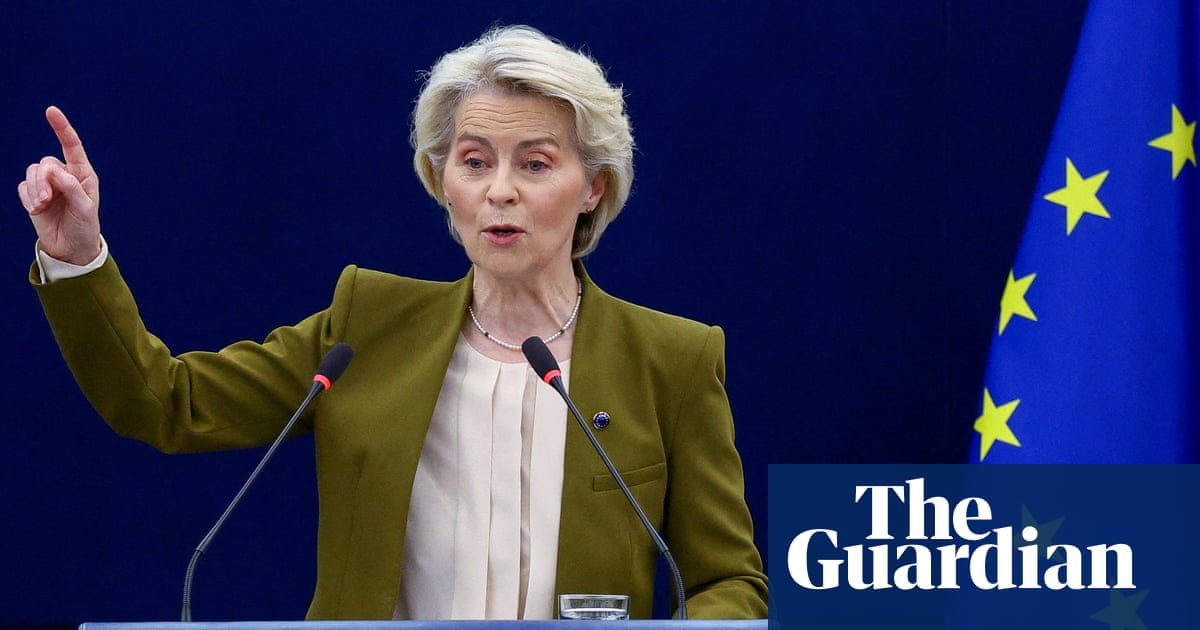
The European Parliament has said that children under 16 should be banned from using social media unless their parents decide otherwise.
MEPs passed a resolution on the age restriction with a large majority on Wednesday. Although not legally binding, it increases pressure for European legislation amid growing concern about the dangers to children’s mental health from uncontrolled Internet access.
The European Commission, which is responsible for initiating EU legislation, is already studying Australia’s world-first social-media ban for people under 16, which is due to take effect next month.
In a speech in September, Commission President Ursula von der Leyen said she would monitor Australia’s implementation of the policy. He also spoke out against “algorithms that prey on children’s vulnerabilities with the express purpose of creating addiction” and said that parents feel powerless against “the tsunami of big tech flooding their homes.”
Von der Leyen promised that a panel of experts would be set up by the end of the year to advise on the best approach to protecting children.
There is a growing interest in restricting children’s access to social media and smartphones. An expert report commissioned by French President Emmanuel Macron last year said children should not be allowed to use smartphones until the age of 13 and social media such as TikTok, Instagram and Snapchat until the age of 18.
Danish Social Democrat MEP Christel Schaldemos, who drafted the proposal, told reporters that politicians needed to take action to protect minors: “It’s not just a matter of parents. Society also needs to step up and ensure that platforms are a safe place for minors, but only if they are above a certain age.”
Their report called for disabling by default addictive features on Internet platforms when used by minors, such as infinite scrolling (endless content as the user scrolls), videos that play automatically, excessive push notifications and rewards for repeated use of a site.
The resolution states that “addictive design features are often embedded in the business models of platforms, especially social media”. An earlier draft of the Scaldemoz report cited a study that said one in four children and youth displayed “problematic” or “dysfunctional” use of smartphones – behavioral patterns that reflect addiction. The proposal states that children must be 16 before they can access social media, although parents can give consent from the age of 13.
The White House is urging the EU to roll back its digital laws and some supporters of the social media ban have apparently voted in this context. At a meeting in Brussels on Monday, Howard Lutnick, the US Commerce Secretary, said EU rules on tech companies needed to be more “balanced” in exchange for lower US steel and aluminum tariffs.
Referring to Lutnik’s visit, Stéphanie Yon-Courtin, a French MEP from Macron’s party, said Europe was not “a regulatory colony”. “Our digital laws are not for sale. We will not step back from protecting children because some foreign billionaire or big tech tells us to,” he said in a statement after the vote.
The European Union is already attempting to protect Internet users from online harms such as disinformation, cyberbullying and illegal content through its Digital Services Act. But the proposal says the law has shortcomings and could do more to protect children from online exploitation, such as addictive design features and financial incentives to become influencers.
Shaldemoz said the act, which she co-authored, was strong “but we can go further especially in the areas of addictive design features and harmful dark pattern practices where we are not so specific, not so precise”.
After newsletter promotion
Dark patterns refer to app or website design features meant to influence decision making, such as countdown timers to encourage users to make purchases, or annoying requests to turn on location trackers and notifications.
Shaldemos’s proposal was adopted by 483 MEPs and 92 opposed with 86 abstentions.
Eurosceptic MEPs criticized the plan, saying it would be an exaggeration if the EU banned social media use for minors. “Decisions about children’s access should be taken as close to families as possible – in the member states, not in Brussels,” said Kosma Złotowski, a Polish member of the Group of European Conservatives and Reformists.
The resolution was passed just a week after the Commission announced a delay in changes to its Artificial Intelligence Act and other digital laws to lighten regulation on companies in the name of “simplification”.
Schaldemoz said she appreciated the need not to legislate too much, but added, “There is a desire to do more when it comes to the protection of children and our children in the EU”.
<a href