Europe’s struggle to keep pace with the US and China in technology and digital innovation from artificial intelligence to semiconductor production to cloud computing has been blamed for the continent’s sluggish economic growth and apparently bleak prospects.
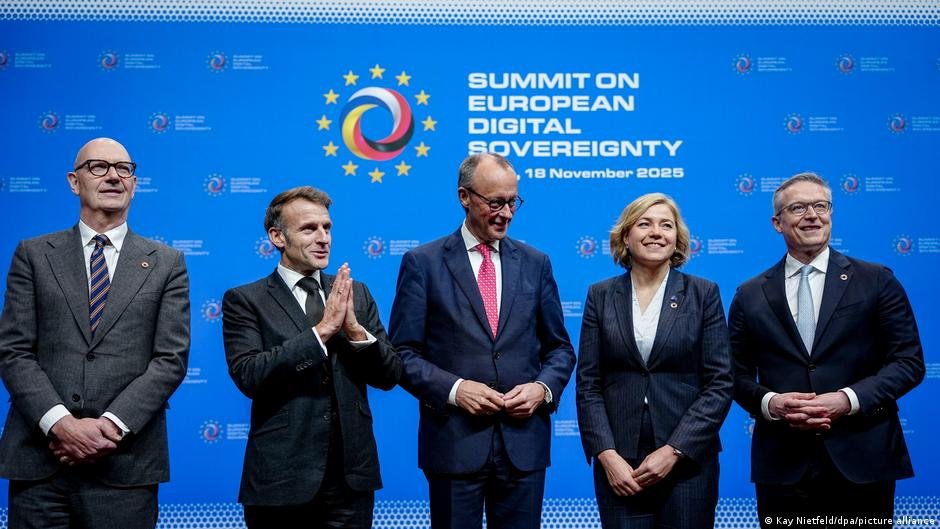
The Berlin gathering, titled “Summit on European Digital Sovereignty”, focused on the risks of reliance on China and the US for increasingly critical infrastructure.
Merz said, “Digital sovereignty has costs, but digital dependence has even higher costs,” while Macron said he did not want Europe to become a client, or “vassal”, of the US or China.
“We obviously want to design our own solutions,” he said.
made in China
One of the areas where Europe is particularly dependent on China is on the infrastructure it uses from companies like Huawei and ZTE for its telecommunications networks.
“They had very few competitors and alternatives, and most of the alternatives are much more expensive,” Ilaria Mazzocco, deputy director of the trustee chair in Chinese trade and economics at the Center for Strategic and International Studies, told DW.
However, according to a report from Bloomberg, it appears that the European Commission is considering ways to force EU member states to phase out Huawei and ZTE from their networks.
“Dependency came about because for a long time European governments have viewed China primarily in commercial terms,” Richard Youngs, senior fellow in the Democracy, Conflict and Governance Program at Carnegie Europe, told DW. “They are now recalibrating with board security considerations in mind.”
In 2020, the European Commission made a recommendation that member states take measures to prevent “high-risk vendors” from being involved in their new 5G internet networks. However, this was not made a legal requirement.
Bloomberg reports that Commission Vice President Hanna Virkkunen now wants to turn that recommendation into a legal requirement. A spokesperson for the European Commission told DW they could not comment on possible next steps regarding the ‘5G toolbox,’ as the recommendations made in 2020 are called. However he said he “urged” member states to implement the recommendations because “the lack of swift action puts the entire EU at clear risk.”
The EU’s readiness to crack down on Huawei was exemplified in its decision earlier this year to ban Huawei lobbyists from meeting with European Commission officials.
This followed an investigation into alleged corruption in the European Parliament, which may have benefited the Chinese firm.
Now, it appears Chancellor Merz is preparing the ground. “We have decided within the government that wherever possible, we will replace components, for example, in 5G networks, with components that we produce ourselves,” he said at a recent business conference in Berlin. “And we will not allow any Chinese components into the 6G network.”
6G is a proposed sixth generation of mobile communications technology and is expected to be implemented by the 2030s.
german business daily Handelsblatt The German government has agreed to implement stricter laws to make it easier to remove components that pose security risks, the report said, adding that it had already agreed to remove some Huawei and ZTE products from sensitive networks last year.
So far, 22 member states have created a regulatory framework to allow sanctions to be imposed on high-risk suppliers of 5G equipment, while 13 have used these legal powers to ban those they consider high-risk suppliers. Germany was particularly reluctant to do so until 2024 due to its desire to maintain strong commercial ties with Beijing.
The true meaning of technological sovereignty?
Richard Youngs states that current European efforts to achieve “technological sovereignty” are complicated by the fact that European governments have different expectations of the concept.
“Some people focus primarily on the competitiveness angle, others on the security angle, others on developing a public interest model of digital technology,” he said. “The security element is really legitimate, but competitiveness is probably the strongest driving force at present.”
While Chinese companies such as Huawei and ZTE were previously seen as reliable and affordable suppliers of components for European networks, the rapidly evolving geopolitical relationship between the EU and China has exposed potential vulnerabilities and dependencies.
“The German inclination is currently part of a broader EU tightening towards China, which is partly due to US pressure,” Youngs says. “This is not just about digital issues, but about a broader geostrategic shift, and it is important to look at it in that light.”
Security officials have long warned about components containing potentially spying or disabling devices. Huawei and ZTE have strongly denied those suggestions, but a 2017 Chinese security law, known as the “National Intelligence Law of the People’s Republic of China,” obliges organizations and companies to gather intelligence information when requested. The US banned Huawei in 2019.
difficult conversation
The European Commission is now apparently ready to take a tougher stance on Huawei and ZTE, considering the potential consequences for Europe of excluding them.
German Finance Minister Lars Klingbiel is visiting China this week and the topic of potentially excluding Chinese technology from German telecommunications networks will certainly come up, especially after Merz’s comments last week.
“Beijing won’t like this,” Mazzocco says. “I think it would be very damaging for Huawei. And Huawei is a very important company for Beijing at this point.”
She says China views Europe as weak and divided and will target it accordingly. “Beijing’s expectation would be that Europe would bow to any pressure,” she says.
If Europe imposes legal sanctions on Huawei and ZTE, the focus will shift more firmly to viable alternatives.
Member states could look to domestic European companies such as Finland’s Nokia and Sweden’s Ericsson to help develop new networks, but the costs would be far higher than those offered by Chinese rivals – a tough sell at a time when many European governments are stuck with high levels of public debt and struggling to boost sluggish growth.
“It’s really up to Europe to come up with a plan to make sure it doesn’t cave to pressure and put in place regulations that it can realistically enforce and then withstand any pressure from China,” Mazzocco says. “It’s going to be tough.”
Like many other factors in Europe’s quest to achieve a new birth of technological sovereignty and innovative independence, the answer will lie in the gap between rhetoric and action.
Edited by: Rob Mudge
This article was updated on November 21 to include a comment from the European Commission
<a href