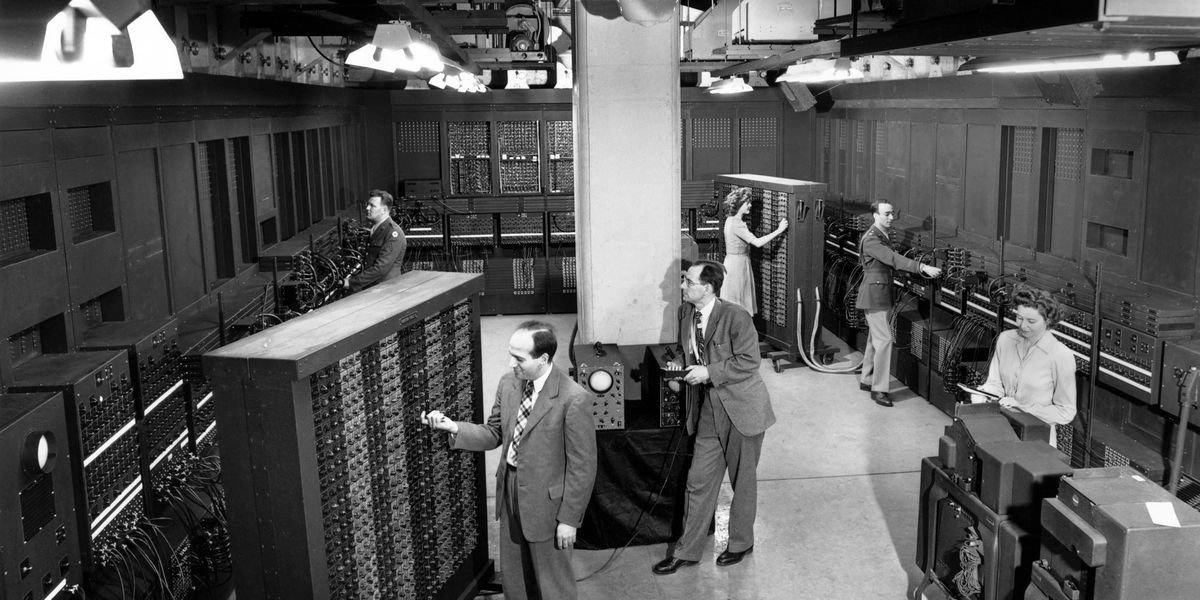
On February 15, 1946, the ENIAC, developed at the Moore School of Electrical Engineering at the University of Pennsylvania in Philadelphia, was publicly demonstrated for the first time. Although primitive by today’s standards, ENIAC’s purely electronic design and programmability was a breakthrough in computing at the time. ENIAC made high-speed, general-purpose computing practical and laid the foundation for today’s machines.
On the eve of its unveiling, the US War Department issued a news release describing it as a new machine that “is expected to revolutionize the mathematics of engineering and transform many of our industrial design methods.” Without a doubt, electronic computers have transformed practically every other field, including engineering and mathematics as well as politics and spirituality.
The success of ENIAC launched the modern computing industry and laid the foundation for today’s digital economy. Over the past eight decades, computing has evolved from a niche scientific endeavor to an engine of economic growth, the backbone of billion-dollar enterprises, and a catalyst of global innovation. Computing has given rise to a series of innovations and developments such as stored programs, semiconductor electronics, integrated circuits, networking, software, the Internet and distributed large-scale systems.
Inside ENIAC
The impetus for developing ENIAC was the need for faster calculations during World War II. The US Army wanted to produce comprehensive artillery firing tables for field gunners to quickly determine settings for a specific weapon, target and conditions. It took “human computers” several days to calculate the tables by hand, and the mechanical machines available were too slow to keep up with the demand.
In 1942 John Mauchly, associate professor of electrical engineering at Penn Moore School, suggested using vacuum tubes to speed up computer calculations. Following his theory, the US Army Ballistic Research Laboratory, which was responsible for providing artillery settings to troops in the field, asked Mauchly and his colleagues J. Presper Eckert and Adele Katz hired Goldstein to work on a new high-speed computer. Eckert was a laboratory instructor at Moore, and Goldstein became one of ENIAC’s programmers. It took him a year to design ENIAC and 18 months to build it.
The computer contained approximately 18,000 vacuum tubes, which were cooled by 80 air blowers. More than 30 meters long, it filled a 9 m x 15 m room and weighed approximately 30 kg. It consumed as much electricity as a small city.
Programming the machine was difficult. The ENIAC did not have stored programs, so to reprogram the machine, operators manually reconfigured cables with switches and plugboards, a process that took several days.
By the 1950s, large universities had either purchased or built their own machines to compete with ENIAC. Schools included Cambridge (EDSAC), MIT (Whirlwind), and Princeton (IAS). Researchers use computers to model physical phenomena, solve mathematical problems, and perform simulations.
After nearly nine years of operation, ENIAC was officially decommissioned on October 2, 1955.
ENIAC in Action: Making and Remaking the Modern ComputerA book by Thomas Haigh, Mark Priestley and Crispin Ropp, Describes the design, manufacturing and testing processes and its subsequent use in life. The book outlines the complex relationships between ENIAC and its designers, as well as its revolutionary approach to computer architecture.
In the early 1970s, there was a dispute over who invented the electronic computer and who would be assigned its patent. In 1973, Judge Earl Richard Larson of the U.S. District Court in Minnesota ruled in Honeywell. V Sperry Rand claims that Eckert and Mauchly did not invent the automated electronic digital computer, but rather derived their theme from a computer prototyped by John Vincent Atanasoff and Clifford Berry in 1939 at Iowa State College (now Iowa State University). This decision provided legal recognition to Atanasoff as the inventor of the first electronic digital computer.
IEEE’s ENIAC milestone
In 1987 the IEEE designated ENIAC as an IEEE Milestone, citing it as “a major advance in the history of computing” and saying that the machine “established the practicality of large-scale electronic digital computers and strongly influenced the development of modern, stored-program, general-purpose computers.”
A commemorative milestone plaque is displayed at the Moore School at the entrance to the classroom where ENIAC was constructed.
“The ENIAC legacy ushered in the computer age, transforming not only science and industry but also education, research, and human communication and interaction.”
A paper on the machine, published in 1996 IEEE Annals of the History of Computing and available in the IEEE Xplore Digital Library, a valuable source of technical information.
“ENIAC’s Second Life“ An article published in History in 2006 covers a lesser-known chapter of the machine’s history, detailing how it evolved from a static system – configured and reconfigured through laborious cable plugging – into the precursor of today’s stored-program computers.
A classic history paper on ENIAC was published in December 1995 IEEE Technology & Society Magazine.
ieee Inspiring Technology: 34 Breakthroughs The book, published in 2023, has an ENIAC chapter.
Women behind ENIAC
According to the book, the most notable aspect of the ENIAC story is the important role played by women. Proving Ground: The Untold Story of the Six Women Who Programmed the World’s First Modern Computer, Highlighted in an article in institute. There were no “programmers” at that time; Only plans existed for computers. Six women, known as the ENIAC 6, became the machine’s first programmers.
ENIAC 6 was composed of Kathleen Antonelli, Jean Bartik, Betty Holberton, Marlene Meltzer, Francis Spence, and Ruth Teitelbaum.
Penn professor Mitch Marcus said in a 2006 PhillyVoice article, “These six women figured out what it took to run this computer, and they did really incredible things.” Marcus teaches in Penn’s Department of Computer and Information Sciences.
In 1997 all six female programmers were inducted into the Women in Technology International Hall of Fame in Los Angeles.
Two other women contributed programming. Goldstein wrote ENIAC’s five-volume manual, and Clara Dahn von Neumann, John von Neumann’s wife, helped train programmers and debug and verify their code.
To honor the women of ENIAC, the IEEE Computer Society established the annual Computer Pioneer Award in 1981. Eckert and Mauchly were among the first recipients of the award. Bartik was awarded the prize in 2008. Nominations are open to all professionals regardless of gender.
An ENIAC Replica
Last year a group of 80 autistic students ages 12 to 16 from PS Academy Arizona in Gilbert recreated the ENIAC using 22,000 custom parts. It took about six months for the students to assemble.
A ceremony was held in January to showcase his creation. The full-scale replica features actual-size panels made of layered cardboard and wood. Although all electronic components are simulated, they are not electrically active. The machine, illuminated by hundreds of LEDs, is accompanied by a soundtrack that simulates the deep rumble of ENIAC’s transformer and the rhythmic clicking of relays.

This machine printed and tabulated the answers to the problems solved by ENIAC.
Bateman/Getty Images
“Every major unit, accumulator, function table, initiator and master programmer is present and placed exactly where it was on the original machine,” said Tom Burick, the teacher who led the project, at the event.
The replica, which is still on display at the school, is expected to be moved to a more permanent location in the near future.
ENIAC’s legacy
The significance of ENIAC is both technical and symbolic. Technically, it marked the beginning of the series of innovations that created today’s computational infrastructure. Symbolically, it forced governments, armies, universities and industry to consider computing as a tool for improvements and innovative applications that were previously impossible. It marked a tectonic shift in the way humans approach problem-solving, modeling, and scientific reasoning.
The ENIAC legacy ushered in the computer age, transforming not only science and industry but also education, research, and human communication and interaction.
As Eckert said, “There are two eras in the history of computers: before ENIAC and after ENIAC.”
The remarkable evolution of computer hardware over the past 80 years has been driven by advances in programming languages – the essential drivers of computing.
From the manual rewiring of the ENIAC to the orchestration of intelligent, distributed systems, programming languages have continually evolved to make computers more powerful, expressive, and accessible.
Predictions for computing in the coming decades
The evolution of computing will continue along multiple trajectories, from generalization to specialization (for AI, graphics, security, and networking), from monolithic system design to modular integration, and from solely performance-focused metrics to an emphasis on energy efficiency and sustainability as primary objectives.
Increasingly, security will be built into hardware by design. Computing paradigms will expand beyond traditional deterministic models to adopt probabilistic, approximate, and hybrid approaches for some tasks.
They will usher in a new era of evolution computing and a new class of applications.
From articles on your site
Related articles on the web
<a href