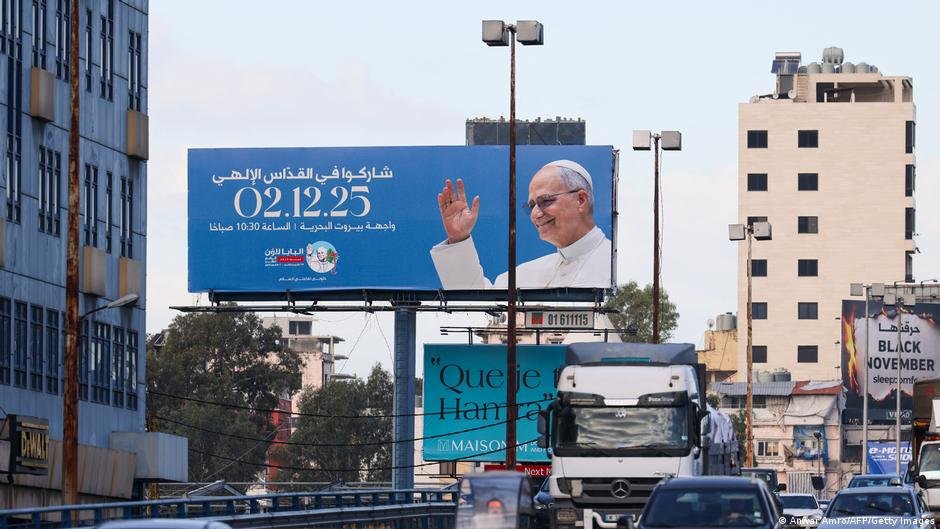
In this way, American-born leaders of the Catholic Church further the international reach of their predecessors. Today, papal travel is considered an essential part of the office and “it is difficult to imagine it without it,” church historian Jörg Ernesti said in a conversation with DW.
There are high expectations about what kind of approach Pope Leo will take on his first trip abroad and how he will differentiate himself from his predecessors. In Türkiye, the Pope intends to visit the capital Ankara and the city of Istanbul. He will also travel to Iznik, about 100 kilometers to the southeast, where the first ecumenical council of the Universal Church was convened 1700 years ago.
In Lebanon, the itinerary includes the capital, Beirut, as well as several smaller pilgrimage sites in the north of the country. At the end of his visit, Pope Leo will stop for silent prayer at the port of Beirut, where the 2020 explosion devastated entire districts, killing about 200 people and shaking the country to its core.
At one time many Christians lived in Türkiye and Lebanon
A century ago, Christians were a significant portion of the population in both countries. In Türkiye, about one-third of the inhabitants belonged to the Christian Church, while in Lebanon the figure was more than half. Today, less than 1% of Turks identify as Christian, and in Lebanon, the presence has declined to about 30%.
Türkiye will soon become the first country other than Italy to welcome five popes, reflecting its deep ties to early Christian history. Important traditions and some early Christian communities exist in the Asian region of Türkiye.
In Istanbul, once called Constantinople, Greek Orthodox Patriarch Bartholomew, now 85, serves as the spiritual leader of global Orthodoxy. Their church has endured restrictions imposed by the Turkish state for decades. Following the example of John Paul II (1979), Benedict XVI (2006), and Francis (2014), Leo has chosen to arrive in late November, deliberately aligning his visit with the feast of the Apostle Andrew on 30 November. For the Orthodox, Andrew holds importance equal to that of the Apostle Peter in Western Christianity.
‘Restricted religious freedom’
Church historian Ernesti believes that Türkiye offers “maximum, restricted religious freedom”. Its impact has been greatest on the Greek Orthodox Church, which has been “severely diminished” since the expulsion of Greeks from Constantinople and Asia Minor a century earlier. As a result, the worldwide patriarchy has been limited in its role.
The visit has special significance as the Pope’s first visit to a country long shaped by Islam. “Many people in the Islamic world, especially in Türkiye, feel honored that their first trip abroad is for them,” Jesuit Felix Körner told DW.
Korner, one of the most prominent Catholic scholars of Islam, speaks Turkish and spent several years teaching in Turkey. He believes that “Christian-Islamic dialogue has recently acquired an exciting new dynamism.” In many countries, a new generation of young Muslims has grown up with an acute awareness that their political leaders exploit religion – particularly Islam – “as a means of supporting unjust systems, sometimes brutally, to maintain power.”
Pope ‘Soft Power’
For them, Körner explains, Pope Leo symbolizes “an alternative form of religious presence”. He shows that faith can exert influence “through soft power”—through exemplary conduct, living witness, kind words, or diplomacy—rather than through “hard power, state authority, violence, or corruption.” As a result, Korner believes that many of his Muslim acquaintances have found new hope that religion can be practiced in ways that go beyond politicization.
For Pope Leo, the Lebanon leg of his visit is of particular importance, shaped by the country’s remarkable religious diversity. Long defined by the coexistence of multiple religions and the absence of a state religion, Lebanon today counts more than 60% of its population as Sunni or Shia Muslims, while about 30% are Christians from various churches. Smaller Druze and Alawite communities also form part of the mosaic. Yet the balance is tense: Hezbollah, the Shia movement backed by Iran, remains a powerful and disruptive political force.
Ernesti explains how Lebanon’s political system is formally designed to allocate power among representatives of its different religions, according to a fixed proportional system. For this reason, the Vatican sees Lebanon as “a testing ground for the success of coexistence between people of different religions.”
In terms of Christian-Islamic dialogue, Körner hopes Pope Leo will seek reconciliation with Islam in a different way than his predecessor Francis. “Pope Francis’ approach was one of friendship,” explains Korner. He emphasized empathy and promoted dialogue through shared experiences and strong relationships with Muslim partners. This sentiment marked his travels in the Islamic world, particularly his 2019 visit to Abu Dhabi, which was crowned by the signing of a globally recognized document of understanding.
According to Korner, Pope Leo shares many of the same priorities, hopes and values as Francis. However, their styles are markedly different: “Much more structured, careful, thoughtful.” As Korner says, “Leo is a canon lawyer, and that’s a big advantage. He will give lasting vitality to this growing understanding between Muslims and Christians by strengthening and building lasting structures.”
Körner believes it is appropriate that, after a courageous Pope like Francis, a very different kind of religious leader is stepping forward – one “who will shape this legacy into forms that promise genuine stability” and, in doing so, open the way to deeper cooperation between religions.
This article was originally written in German.
While you’re here: Every Tuesday, DW editors provide insight into what’s happening in German politics and society. You can sign up for the weekly email newsletter, Berlin Briefing, here.
<a href