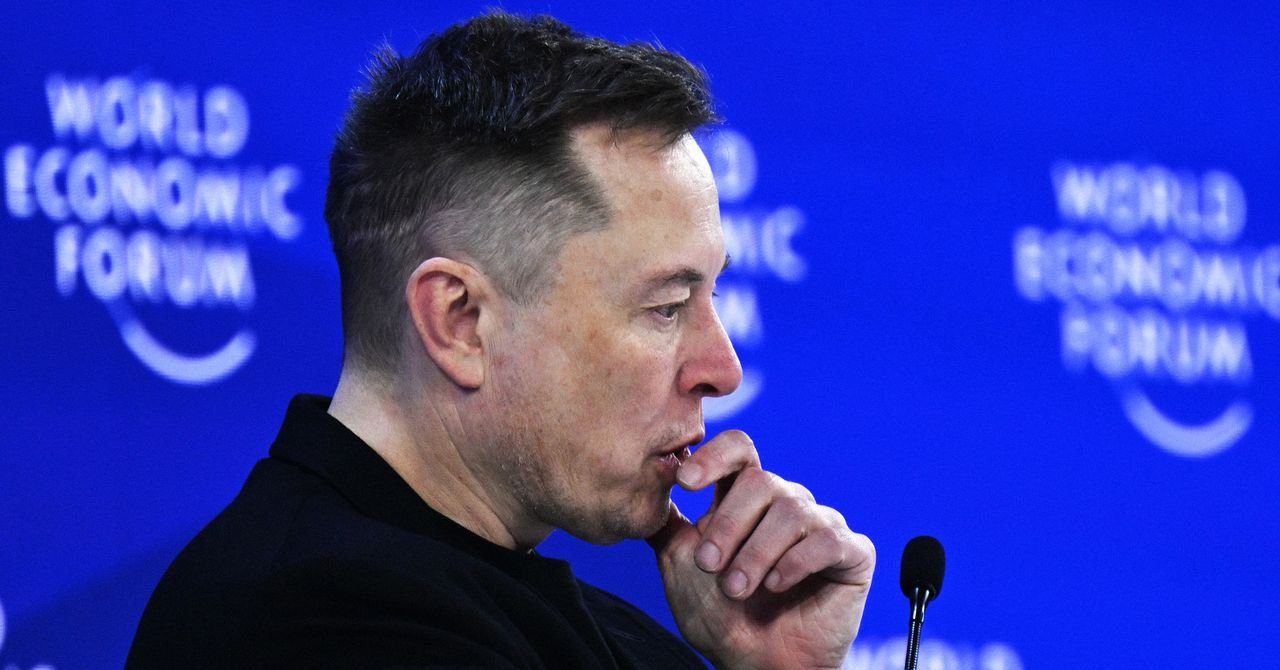
Over the years, Musk has made many bizarre predictions — about self-driving cars, about space exploration, about brain chips, about robotics — that haven’t come true. The Tesla CEO and former manager of the so-called government efficiency department seems at least a little self-aware. During a surprise appearance and his debut at the World Economic Forum in Davos, Switzerland, on Thursday, he said something like a mission statement: “Generally speaking, for the sake of quality of life, it is better to err on the side of being optimistic and wrong than to be pessimistic and right.”
Yet, when one’s companies have a hand in so many industries – autos and robotics (Tesla), space travel and telecommunications (SpaceX), social media (X), artificial intelligence (XAI), infrastructure (The Boring Company), and neurotechnology (Neuralink) – even unexpected predictions can alter global markets. Here are some of the predictions Musk made on Thursday:
Aliens don’t exist (probably)
Elon Musk started his Davos speech by chatting with friend and BlackRock CEO Larry Fink, in which he discussed his values and made a few jokes about aliens. “We have 9,000 satellites out there, and not once have we had to fly around an alien spacecraft,” Musk said. “We need to recognize that life and consciousness are extremely rare and that we may be the only ones.”
Humanoid robots will change human life—and be available for sale in 2027
Musk started making promises about the company’s humanoid robot Optimus in 2021. Recently, he said that Tesla – now rebranded as a robotics and autonomy company – will build thousands of Optimus robots in 2025. But the company is reportedly still struggling to get work from Optimus. That didn’t stop Musk from repeating some of his most far-reaching claims at Davos about how the product would change human life forever.
“If we have ubiquitous AI that is essentially free, or close to it, and ubiquitous robotics, you will have an explosion, an expansion of the global economy that is truly beyond all precedent,” Musk said. What does that mean for you? Billions of robots powered by artificial intelligence will surpass humans and “fulfill all human needs”, he said. “You won’t be able to think of anything to ask a robot at a certain point, there will be such an abundance of goods and services.”
But first, of course, Tesla has to start selling the Optimus, which Musk said will happen late next year.
Robotaxis will be “very widespread” in the US by 2027
In 2025, after years of self-driving promises, Tesla finally launched a limited robotaxi service in Austin, Texas, albeit with a human safety monitor sitting at each passenger seat. This didn’t stop Musk from claiming that most of the US population would have access to robotaxis by the end of that year.
Now, in 2026, Musk is moving toward the goalpost again. He said Thursday that his company’s robotaxis “will be very widespread in the US by the end of this year.” If history is a guide, it won’t happen – but the company will Is is working on launching robotaxi services in states with some looser regulations, including Arizona, Florida and Nevada.
Human aging is a “very solvable problem”
Musk acknowledged that he has not spent much time investigating human aging. But he predicted that a solution would emerge. “When we figure out what causes aging, we’ll find that it’s incredibly obvious,” he said. Get it, Silicon Valley fellas.
SpaceX will complete a fully reusable rocket this year
SpaceX has been working on its reusable rocket platform Starship for a decade, and in those years, it has missed several of Musk’s big space deadlines. He predicted in 2020 that a manned Mars mission would be launched by 2024. He said Starship would reach orbit by 2022, although the company didn’t take the wraps off until last year.
At Davos, Musk reiterated a promise from last year: that Starship would be fully reusable by the end of this year, cutting the cost of space travel by “a factor of 100” and eventually allowing space freight to compete with airplane freight prices. SpaceX has recently conducted successful test flights, but launching a fully reusable rocket may be difficult until later this year.
AI will become smarter than a human this year and smarter than all of humanity in 2035
Musk has been deeply involved in the development of AI and deeply concerned about its meaning for years. (See: OpenAI, its founders, and their ongoing lawsuit against Microsoft.) At Davos, Musk once again mentioned his desire to avoid a Terminator-like future. But he also hinted that it was coming. “At the rate at which AI is progressing, I think we’ll have AI that is smarter than any human this year, and not smarter than next year,” he said. By 2035, it will be “smarter than all of humanity collectively”.
In general, whether Musk gets this right depends on definitions. What does “smart” mean? This month, Nvidia CEO Jensen Huang said he doesn’t believe researchers are even close to creating what he calls a “God AI.” technology is good at different tasks, but doing Everything? “That ‘someday’ is probably on biblical scales, on galactic scales,” Huang said.
<a href