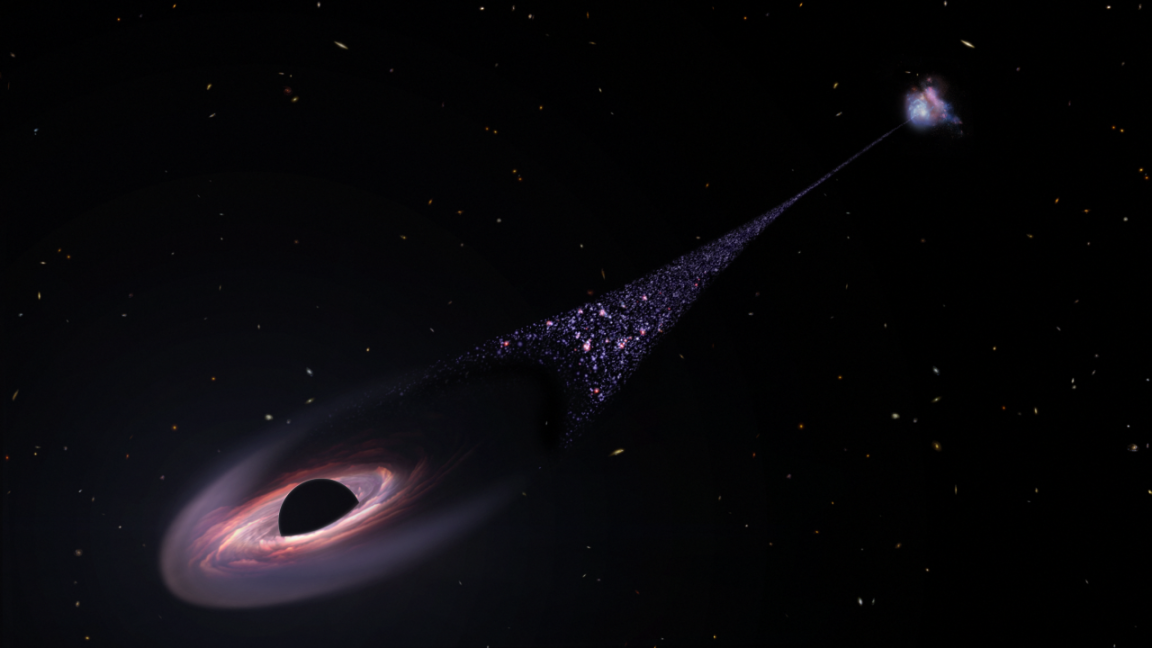
Preliminary analyzes showed that if the points were indeed supermassive black holes, they would have to be almost as massive as their host galaxies, accounting for between 10 and 100 percent of their total mass. The problem was that the dots appeared at very high redshifts, meaning astronomers saw them as they were when the universe was about 1 billion years old. The discovery of a “supermassive” black hole in a 1-billion-year-old universe as massive as its entire galaxy raised the question of how something could grow so big, so fast – we had no answer.
But then Rusakov and his colleagues started noticing strange things in the JWST data. “You typically expect other signals, like X-rays, from supermassive black holes, and we didn’t see those signals,” says Rusakov. The lack of X-rays did not eliminate the oddities.
wide lines
Since black holes cannot be observed directly, astronomers measure their mass by observing the gas orbiting around them. As the gas swirls into the black hole, it heats up and begins to glow. The gravity of a supermassive black hole pulls that gas at incredible speeds, sending the material traveling at thousands of kilometers per second. This motion broadens through what is known as the Doppler effect, where light from gas moving toward an observer on Earth is blue-shifted, and light from gas moving away is redshifted, spreading the spectral lines into a wide, flat shape. By measuring the width of these lines, we calculate the velocity of the gas and, by extension, the mass of the black hole.
In the case of the Little Red Dots, the lines appeared incredibly broad, leading to those staggering mass estimates. However, the shape of the lines looked strange. It was not a typical rounded bell-curve, but a sharp triangle sitting on top of broad, wing-like tails.
<a href