How to Advocate for Climate Change Action
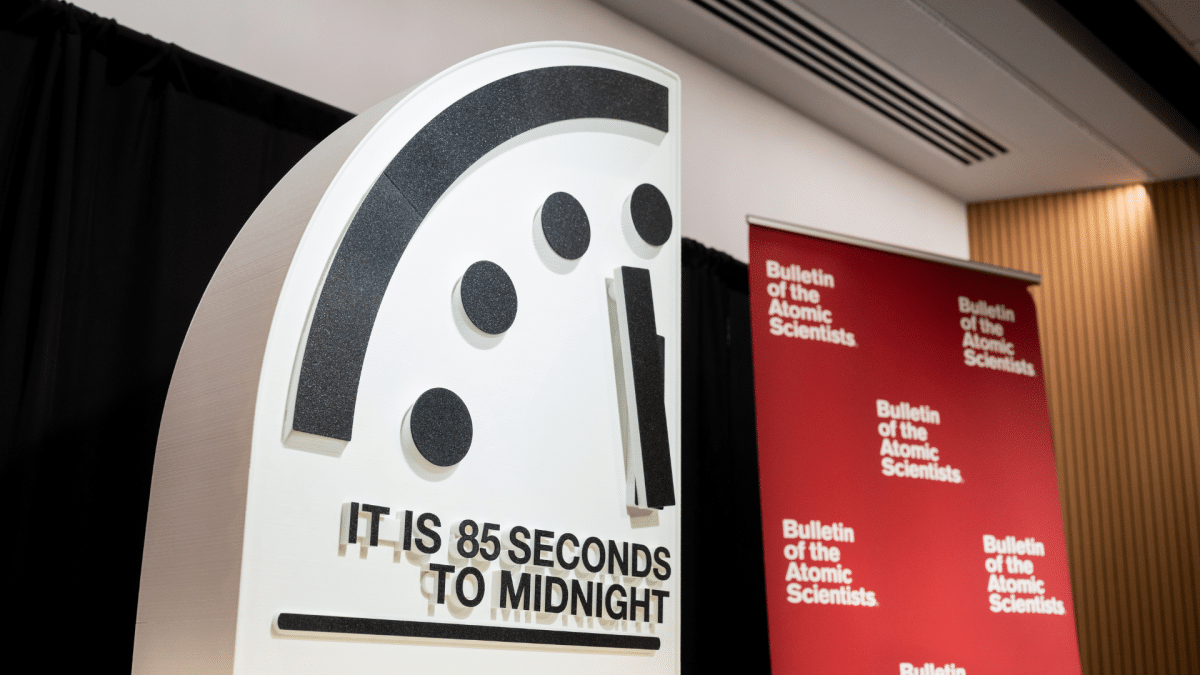
The Bulletin of the Atomic Scientists announced the new timing of the Doomsday Clock on Tuesday, saying powerful countries like the US have not only failed to act since last year’s warning, but have actively worsened the situation. The Doomsday Clock was set 89 seconds before midnight in January 2025, the closest time ever set at that time. This week’s announcement now takes it four seconds closer to disaster.
“Russia, China, the United States and other major countries have become increasingly aggressive, adversarial and nationalistic,” said the bulletin’s statement, written by editor John Mecklin. “Hard-won global understandings are breaking down, exacerbating a winner-take-all great power competition and undermining international cooperation critical to reducing nuclear war, climate change, biotechnology abuses, the potential threat of artificial intelligence, and other apocalyptic threats.”
Why has the doomsday clock been brought forward?

Credit: Bulletin of the Atomic Scientists
The Doomsday Clock has been moved forward due to a worrying combination of threats that have increased over the past year. The bulletin states that there are “no reassuring nuclear developments” in 2025, instead nuclear risks are becoming increasingly common. There is a risk of escalation of many conflicts involving nuclear powers, such as the war between Russia and Ukraine, while there is a lack of global leadership regarding nuclear issues.
Meanwhile, climate change continues to threaten the planet, with greenhouse gases reaching new highs as the Trump administration cuts emissions and ends support for environmental science. Biological threats have also increased on several fronts, not only because of the ongoing concern that such agents could be weaponized, but also because of a loss of confidence in public health officials and “the rapid disintegration and degradation of the US public health infrastructure, expertise, and capacity.”
“Disruptive technologies” also pose a significant threat, with the bulletin warning of the dangers posed by AI. Reliance on AI in critical sectors such as the military is a concern, especially given the risk of hallucinations in such large language models, as well as the potential for such technology to develop new pathogens. However, the most immediate threat is the rapid, prolific spread of misinformation and disinformation caused by AI chatbots and deepfakes.
mashable light speed
“Without facts, there is no truth. Without truth, there is no trust. And without them, the radical collaboration we demand right now is impossible,” said Maria Ressa, co-founder and CEO of Rappler and 2021 Nobel Peace Prize laureate.
“We are living through an information silo – the crisis behind all crises – powered by extractive and predatory technology that spreads lies faster than facts and profits from our divisions. We cannot solve problems whose existence we cannot agree on. We cannot cooperate across borders when we cannot even share the same facts. Nuclear threats, climate collapse, AI risks: none can be addressed without rebuilding our shared reality.”
The bulletin attempted to minimize the destruction by making some recommendations about what could be done to push back the clock. These primarily include engaging the US in appropriate dialogue with other countries, establishing international guidelines for nuclear arsenals and technological development. He also called on Congress to “reject President Trump’s war on renewable energy” and encourage a reduction in fossil fuel use. Unfortunately, this does not seem possible as per the current situation.
What is doomsday clock?
Established by the nonprofit Bulletin of the Atomic Scientists in 1947, the Doomsday Clock is a symbol showing how close we are to a global apocalypse caused by humans. It is said that the disaster appears at midnight of the Doomsday Clock, with the probability of such a disaster increasing as it approaches.
Doomsday is determined by the Bulletin’s Science and Security Board each year in consultation with its sponsoring board. Although nuclear weapons were its primary concern when the Clock was created, the Board now also takes into account other developments such as climate change, disruptive technologies, and biological threats.
Initially set at seven minutes before midnight, Doomsday has been moved back and forth depending on global events. The longest distance since midnight is 17 minutes, set in 1991 after the US and the Soviet Union signed the Strategic Arms Reduction Treaty amid the end of the Cold War.
The Bulletin of the Atomic Scientists was established in late 1945 following the atomic bombings of Hiroshima and Nagasaki.
<a href