
 getty images
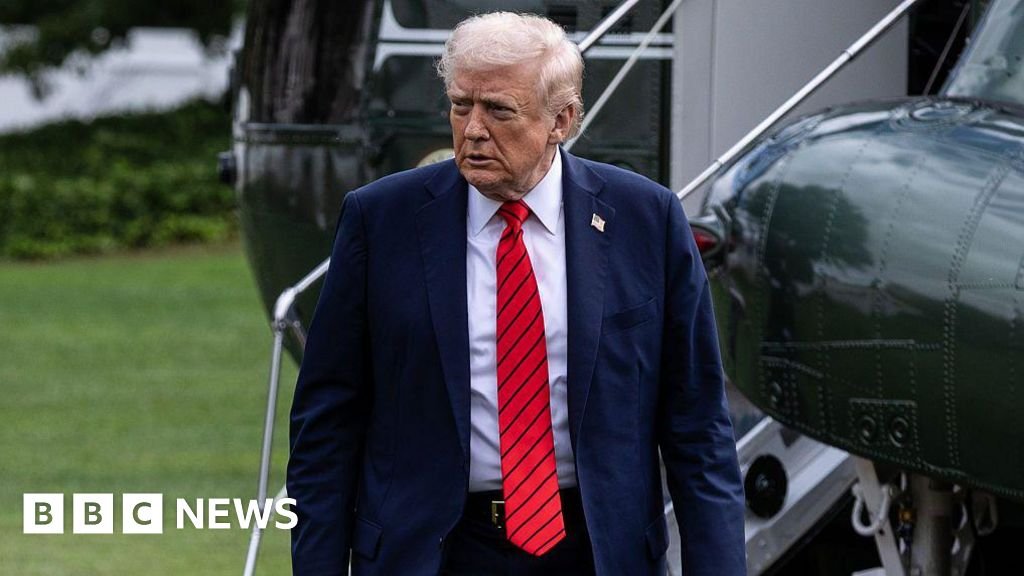
US President Donald Trump “remains in excellent health” after undergoing an “extensive executive physical examination”., According to his White House physician.
Capt. Sean Barbabella issued a memo Monday saying advanced imaging of the 79-year-old president’s heart and abdomen came back “completely normal.”
They wrote that the President had an MRI during a physical examination in October “because men in his age group benefit from a thorough evaluation of heart and abdominal health”.
The release comes as Democrats, including Minnesota Governor Tim Walz, are emphasizing the scan results amid concerns about Trump’s age in his second term.
In his memo, Barbella wrote that there was no evidence of impaired blood flow or abnormality from arterial narrowing in Trump’s heart or major vessels.
The doctor said that overall, Trump’s cardiovascular system “represents excellent health”.
Similarly, the doctor, a US Navy emergency physician who served in Iraq and Afghanistan, said that the results of Trump’s abdominal imaging showed that “everything evaluated is working within normal limits with no serious or chronic concerns”.
The doctor called the scan “standard” for an “executive physical” for someone of Trump’s age.
The White House had previously declined to explain why Trump had an MRI during a physical examination in October or say which part of his body was scanned.
Aboard Air Force One on Sunday, Trump told reporters that “I’m fine” with releasing the MRI results.
When asked by a reporter what part of the body the MRI examined, Trump said, “I have no idea. It was just an MRI – what part of the body? It wasn’t the brain, because I did a cognitive test and I passed it.”
Trump underwent his annual physical in April.
In October, he said he had an MRI at Walter Reed National Military Medical Center during a visit to the White House, described as part of his “routine annual checkup.”
Trump said at the time that the MRI was “absolutely fine.”
In the memo, Barbabella said the purpose of the MRI was preventive, “to identify problems early, confirm overall health, and ensure he maintains long-term vitality and function”.
White House press secretary Carolyn Leavitt read Barbabella’s memo during a news briefing on Monday.
“I think this is quite an extension in an effort to be transparent,” Levitt said. “The President promised it last night and we delivered on it today.”
Two outside physicians who reviewed the memo told the BBC that MRIs were “generally not standard” for preventive care.
But some people opt for testing that falls outside standard age-based guidelines, says Dr. Carla Parisinotto, a geriatrician at the University of California, San Francisco.
Similarly, Dr. Jeffrey A. Linder, chief of general internal medicine at Northwestern University Feinberg School of Medicine, says the memo does not specify whether an MRI or CT scan was performed, making it difficult to know what exactly was done.
Linder says routine anatomic imaging — whether MRI or CT — is generally discouraged in asymptomatic patients because the potential risks outweigh the benefits.
And even for executive physicals — which cater to busy professionals and include many additional tests — he says it’s still unusual for that imaging to come back “completely normal” without coronary calcification.
Trump has been seen with swollen ankles and a bruise on his right hand and has been seen dozing off during meetings.
In July, the White House said he had been diagnosed with chronic venous insufficiency, a vein condition that can result in swelling of the legs.
<a href