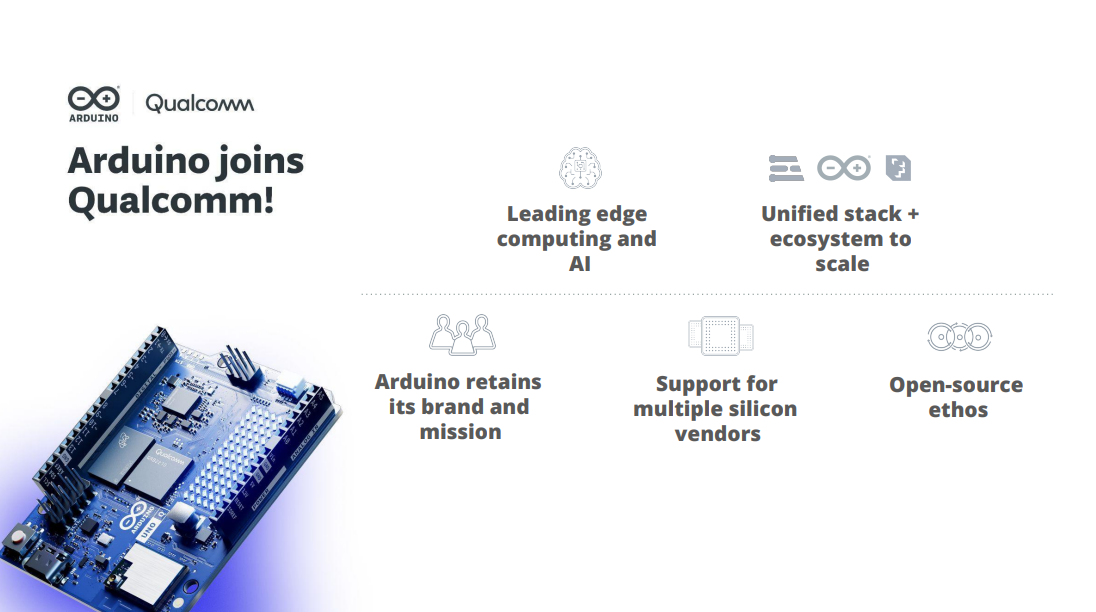
Six weeks ago, Qualcomm acquired Arduino. The maker community immediately worried that Qualcomm would eliminate the open-source ethos that has made Arduino the lingua franca of hobby electronics.
This week, Arduino published updated terms and conditions and a new privacy policy, which has apparently been rewritten by Qualcomm’s lawyers. The changes confirm the community’s worst fears: Arduino is no longer an open commons. It is becoming just another corporate platform.
Community discussions on manufacturer forums and sites reveal what’s at stake, what Qualcomm did wrong and what can still be saved.
what changed?
The new terms read like standard corporate boilerplate: mandatory arbitration, data integration with Qualcomm’s global ecosystem, export controls, AI usage restrictions. For any other SaaS platform, this would be unremarkable.
But Arduino is not SaaS. It is the foundation of the creator ecosystem.
The most alarming change is that Arduino now explicitly states that using their platform does not give you any patent licenses. You can’t even argue that there is an implication.
This means that Qualcomm could potentially make a patent claim against your projects if you built them using Arduino tools, Arduino examples, or Arduino-compatible hardware.
And here are the disconnected, baffling producers. Arduino’s IDE is licensed under the AGPL. Their CLI is GPL v3. Both licenses explicitly require that you can reverse engineer the software. But Qualcomm’s new terms explicitly prohibit reverse engineering “platforms.”
What’s really going on?
The community is trying to find out what Qualcomm’s real intentions are. Are these terms poorly advocated by SaaS lawyers applying their standard template to cloud services, not realizing that Arduino is different? Or is Qualcomm testing how much they can survive before the community revolts? Or is this the first step towards shutting down the ecosystem they just purchased?
Some people say that “platform” may only mean Arduino’s cloud services (Forums, Arduino Cloud, Project Hub), not the IDE and CLI that everyone actually uses.
If this is true, Qualcomm needs to say so clearly and in clear language. Because the maintainers of the library may be wondering whether contributing to the Arduino repo puts them at legal risk. And hardware manufacturers are questioning whether it’s still safe to advertise “Arduino-compatible”.
Why does Adafruit’s alarm matter?
Adafruit has been vocal about the risks of this acquisition. Some people dismiss Adafruit’s criticism as selfish. After all, they sell competing hardware and promote CircuitPython. But it reminds me of who Adafruit is.
Adafruit has been the moral authority on open hardware for decades. He’s made his living proving that you can build a successful business on open principles. When they sound the alarm, it’s not about competition, it’s about principle.
What they are not saying is that Qualcomm bought Arduino. That’s because Qualcomm’s lawyers fundamentally don’t understand what they’ve bought. Arduino was not valuable because it was just a microcontroller company. It was valuable because it was a common commodity. And you can’t impose an enterprise legal framework without destroying a commons.
Adafruit gets this. He has built his entire business on this. Therefore there is weight in his criticism.
Qualcomm doesn’t seem to understand this
Qualcomm probably thought they were buying an IoT hardware company with a loyal user base.
They were not. He bought the manufacturer’s IBM PC.
The value of Arduino was never just the hardware. Their boards have been obsolete for years. Their pricing is standard.
Arduino IDE is the language of hobby electronics.
Millions of manufacturers learned from it, even as they moved on to other hardware. ESP32, STM32, Teensy, Raspberry Pi Pico – none of these are Arduino hardware, but they all work with the Arduino IDE.
There are thousands of libraries called “Arduino libraries”. The tutorial assumes Arduino. University courses teach Arduino. When you search “how to read a sensor”, the answer comes back to Arduino code.
This is the ecosystem over which Qualcomm’s lawyers have left legal uncertainty.
If Qualcomm’s lawyers start claiming control over the IDE, CLI, or core libraries under restrictive terms, they will poison the entire manufacturer ecosystem. Even people who never purchase Arduino hardware depend on the Arduino software infrastructure.
Qualcomm didn’t just buy one company. He bought a commons. And now they are unknowingly taking steps that are destroying what makes it valuable.
What should manufacturers do?
There is something of a stir among people leaving the Arduino environment behind. But Arduino IDE alternatives like PlatformIO and VSCode are by no means beginner-friendly. If the Arduino IDE goes away, there is a bigger problem.
I remember when HyperCard died. There were options, but none were that easy. I don’t think I really coded again for about 20 years until I picked up the Arduino IDE (see figure).
If something happens to the Arduino IDE, even if its development stops or becomes cumbersome, there is no replacement for that easy onboarding. We will lose many promising new creators because the first steps became too difficult.
Institutional knowledge is at risk
But leaving Arduino behind isn’t easy. The success of the platform depends on two decades of accumulated knowledge, such as countless Arduino tutorials, blogs and school courses on YouTube; Open-source libraries that depend on Arduino compatibility; Projects in production using Arduino tooling; and university programs built around Arduino as a teaching platform.
All of these are dependent on the Arduino being open and accessible.
All that knowledge becomes useless if Qualcomm decides to discontinue the open Arduino IDE in favor of a locked-down “Arduino Pro” platform, or if they start asserting patent claims, or if uncertainty forces contributors to leave the ecosystem.
It’s like going behind Wikipedia’s paywall. The value isn’t just the content, it’s the trust it takes to remain accessible. The value of Arduino isn’t just the code, it’s the belief that the commons will be open.
That trust is gone now. And once lost it is difficult to get back.
Why did this happen (but it doesn’t excuse it),
Let’s be fair to Qualcomm, their lawyers were doing their job.
When you acquire a company, you standardize legal terms; Add mandatory arbitration to limit class action risk; Integrate data systems for compliance and auditing; Add export controls as you sell to defense contractors; Prohibit reverse engineering as it is in the template.
For most acquisitions, it’s just good corporate hygiene. And Arduino, now part of a megacorp, faces more liabilities than it would have as an independent entity.
But here’s what Qualcomm’s lawyers missed: Arduino is not a typical acquisition. The community is not the customer base, it is the general community. And you can’t apply an enterprise SaaS legal framework to the Commons without destroying what makes it valuable.
This is tone-deafness, not malice. But the result is the same. A community that used to trust Arduino no longer does.
Understanding why it happened doesn’t excuse it, but it can suggest what needs to happen next.
What should have happened and how to save it still
Qualcomm dropped legal boilerplate on the community with zero context and let people figure out the contradictions themselves. This is how you destroy trust overnight.
Qualcomm should have announced the changes earlier. They should have given the community not hours, but weeks, to understand what was changing and why. They should have used simple language explanations and not just legal documents.
Qualcomm can fix things by clearly building an open ecosystem. They should clearly state that the terms apply to Arduino Cloud services, and that the IDE, CLI, and core libraries remain under their existing open source licenses.
We will need concrete commitments, such as which repos will remain open, which licenses will not change, what is protected from future acquisition decisions. Right now we have vague corporate talk about “supporting the community.”
In fact, they can even create some structural security by putting the IDE, CLI, and core libraries in a foundation that Qualcomm can’t unilaterally control (think of the Linux foundation model).
Ultimately, Qualcomm may want to establish some form of community governance with real representation and real power over the devices the community depends on.
The acquisition has taken place. Legal integration is probably inevitable. But how it’s done determines whether Arduino will survive as a Commons or end up as just another Qualcomm subsidiary.
What will happen next?
Arduino may be the toolset that made hobby electronics accessible to millions. But that maker community made Arduino what it became. Qualcomm’s acquisition has thrown that legacy into doubt. Whether through legal confusion, corporate tone-deafness, or deliberate strategy, community trust has been broken.
The next few months will reveal whether this was a stumble or a strategy. If Qualcomm issues clarification, moves the repo to some sort of governance, and explicitly protects the open toolchain, perhaps this can be saved. If they remain silent, or worse, if IDE development slows down or license terms become more stringent, that’s a signal to look for alternatives.
The question is not whether the open hobby electronics maker community will survive. This is what Arduino does.