In March 2024 the DESI collaboration dropped a bomb on the cosmological community: scant but important evidence that dark energy is weakening over time. This was a surprising result given years of painstaking analysis. It’s not a bullet-proof outcome, but it doesn’t have to be to make our lives more interesting.
I know I’m late to the party discussing this. And that’s okay, because 1) there’s a lot to unpack in a result like this and I wanted to take my time, and 2) it’s not likely this result will be modified or updated any time soon, so we have plenty of room to play with it.
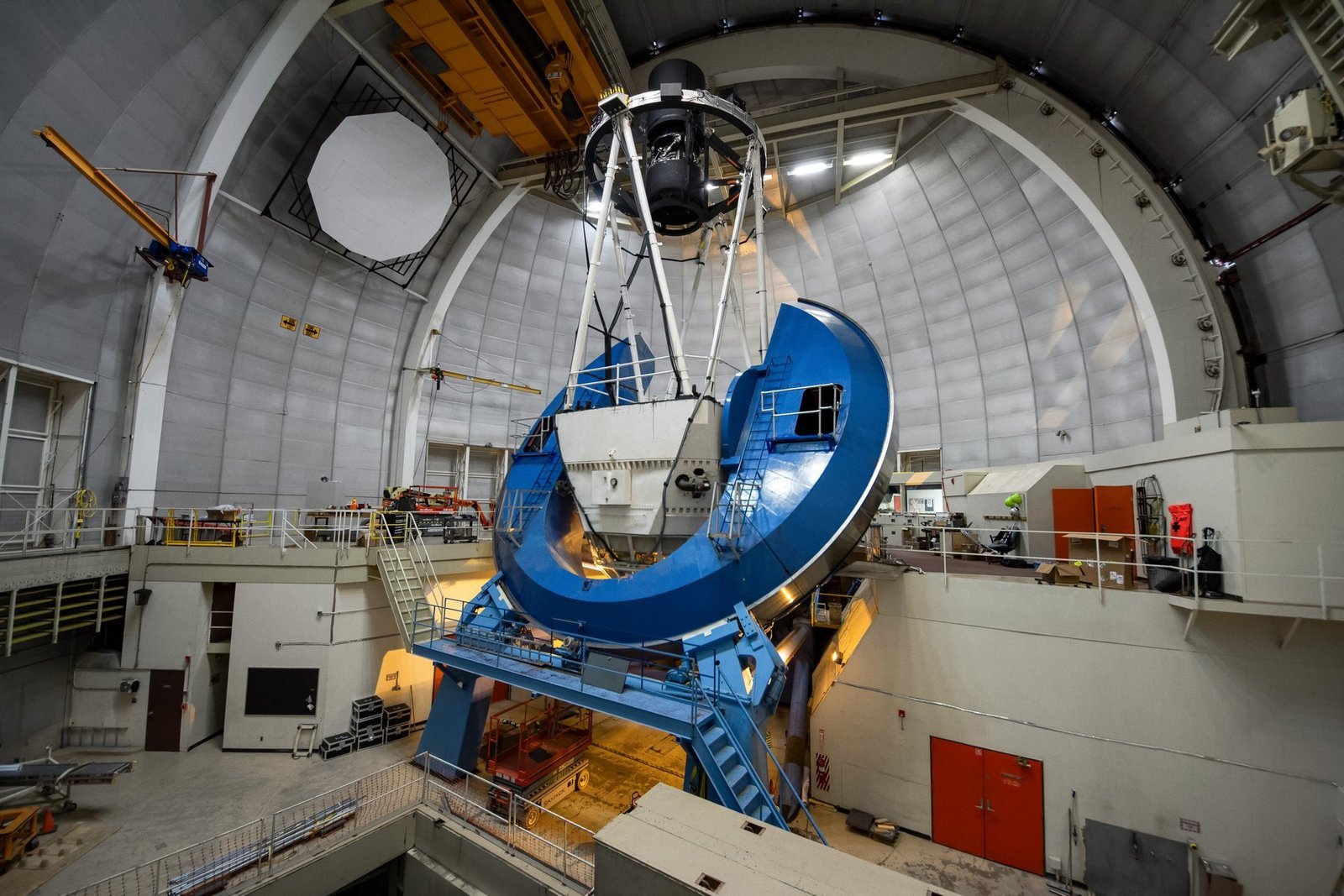
Let’s start with the results themselves and how they got there. DESI stands for Dark Energy Spectroscopic Instrument. It is a nearly 4-meter telescope mounted on Kitt Peak in southeastern Arizona. This is a galaxy survey, and to complete this survey they have 5,000 robotically controlled fiber optic cables underneath the telescope. Each night, the telescope selects a patch of the sky for observation, robots install fiber optic cables to align with the positions of galaxies within that patch, and the instrument records detailed information for each one. Then they do the same thing the next night, and then the next night, and then the next night.
So far they have collected a catalog of more than 13 million galaxies, providing the largest and most comprehensive survey of the positions of galaxies in history. And they’re not even done! They are aiming for 50 million galaxies once the survey is complete.
And let me tell you, those robotically controlled fiber optic cables are a huge game changer. In many ways DESI is the successor to an earlier survey, the Sloan Digital Sky Survey. That survey had a similar setup, except that instead of robots to move all that fiber every night, they had to use graduate students. Maybe cheaper, but still less efficient. (Note that I was never one of those unlucky “volunteers” but I’ve heard horror stories.)
Sure, the DESI survey accounts for less than 1% of all the galaxies in the universe’s observable volume, but it’s still quite large. So what do you do with a map of a good portion of the entire universe?
I’m glad you didn’t ask, because I’d be happy to answer. Arrangements of galaxies on very large scales tell us a lot about the universe. And one of the key things used in this new DESI analysis is a feature of the large-scale universe that goes by the unnatural but super stupid name of baryon acoustic oscillations, or BAO for short.
Check it out. A long time ago the universe was much smaller, hotter and denser than it is today. If you’re ever asked what the Big Bang Theory is, that’s it in a nutshell. In fact, billions of years ago, when the universe was only a few million years old, it was so hot and dense (for those of you keeping score at home, millions of times smaller than its current volume and thousands of degrees hotter) that all matter was packed together as an energetic plasma. It is the same state of matter as the sun or the body of lightning, and it literally fills the universe.
Like any dense substance, there were sound waves – pressure waves that spread across the universe. Many of these sound waves were produced by the competition between gravity and radiation. Dense clumps of matter will try to collapse under their own gravity, but then those clumps will heat up and the radiation they emit will push them back out.
This see-sawing effect continued back and forth until the plasma cooled so much that light went out. This meant that the radiation could no longer play the game, and the back-and-forth sound waves got stuck in the middle of the swing. Wherever they were, they served as a source of additional gravity, a shell with slightly higher density.
In fact we even have pictures of these features, which are baryon acoustic oscillations (or “super hot sound waves” if you prefer). When this process stopped, the light emitted is still present and we can take pictures of it. It’s called the cosmic microwave background, and a decade ago when a group of my friends were plugging in their fiber optic cables, I was a member of the Planck collaboration, a satellite set up to map the microwave background.
These balls of excess matter didn’t just go away. They stuck around, and over billions of years gradually more material accumulated on those shells than in the surrounding areas. Today, we see the imprint of BaO as a sphere of matter approximately 800 million light-years across.
The cool thing about all this is that the circles are called standard rulers. We know how big the spheres should be – it’s a relatively simple calculation to take the images seen in the microwave background to their size at the present time. And we can compare that expected value to how big they appear on the sky. And how big they appear in the sky depends on cosmology: on the properties, history, and evolution of the universe.
The new discovery is that the BAO shells found by DESI are slightly off. Their size does not exactly match our usual picture of cosmology. And they seem to fit better with a picture of a universe where dark energy is evolving.
But what exactly is dark energy, and why is it so interesting that it might evolve?