editor’s Note:This article is a light-hearted and educational exploration of orbital mechanics; No one is seriously proposing that we leave criminals or anyone in the sun. Well, not that we know of.
We live in changing times. Whereas we once playfully threw villains to the lions, we now want to throw them into the sun.
It seems simple enough. The Sun is incredibly huge, its gravity enough to hold the planets in their orbits for billions of years. how hard can it be?
Well, this may be harder than you think.
fire away
The obvious way to set someone on fire in the sun is the direct approach, as shown in South Park Season 1. Point a rocket toward the sun and fire. But can it work?
For launch the rocket will have to reach a speed of more than 11 kilometers per second [6.8 miles per second] So that it does not get stuck while revolving around the Earth. OK—we can send our rocket 20 km away [12.4 miles] per second for good measure. what happens next?
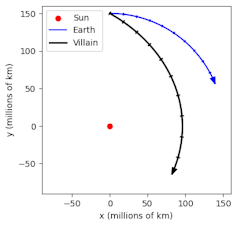
To be honest, the results are disappointing. It’s not even close: we miss the Sun by about 100 million km [62 million miles]But why? This is because we launched from Earth, traveling a distance of 30 km around the Sun [18.6 miles] per second.
michael brownby CC
As a result, when our rocket takes off from Earth, it is traveling faster around the Sun than it is traveling toward the Sun. First the rocket approaches the Sun. But the rocket’s speed and gravity around the Sun result in an elliptical orbit that misses the Sun entirely.
Pointing a rocket directly at the Sun and hitting it would require immense speed – enough to slow the Earth’s own momentum, making it almost irrelevant to hitting the Sun. Exactly how fast? If we travel 7,000 km. fire rockets at [4,350 miles] per second or so, then we eventually collide with the Sun. Bingo—the villain is gone. But achieving such amazing speeds is simply beyond our current technology. Is there any other way?
going sideways
Since our fight is really with the Earth’s motion, let’s deal with that directly. Instead of trying to launch directly at the Sun, let’s launch a rocket to counter the Earth’s motion.
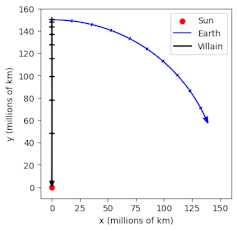
To do this, we will have a rocket that will exit low Earth orbit at 32 km [19.8 miles] per second, traveling in the direction opposite to the Earth’s motion. If the Sun were overhead, the rocket would be traveling almost horizontally to the east.
michael brownby CC
Once the rocket leaves Earth’s proximity, its speed relative to the Sun will drop to almost zero. At this point the Sun’s gravity will essentially pull the rocket (and the villain aboard) inward.
Considering that it is a journey of 150 million km [93.2 million miles]The journey will take approximately 10 weeks – plenty of time for our villain to contemplate his sins before his fiery destruction.
Would any sun do this?
Although countering the Earth’s motion and falling into the Sun is more practical than our first approach, there is a big problem.
The fastest spacecraft ever to leave Earth was New Horizons, which was launched in 2006. Its speed was 16.26 km. [10.1 miles] per second after launch: much less than what we need to counter the Earth’s motion and fall into the Sun.
In fact, New Horizons used Earth’s momentum and the kick provided by its rocket to hurl itself past Jupiter, Pluto, and out of the Solar System entirely. Due to Earth’s orbital speed, it would actually take less fuel to launch a (suitably qualified) person from our solar system toward another star rather than directly toward our Sun.
However, the distance to the nearest stars is 200,000 times the distance to the Sun. Thus travel time is measured in millennia, and hitting the target would be an unprecedented feat of celestial navigation.
it’s about the journey
So is shooting someone in the sun out of reach? Yes and no.
It is true that current rockets cannot attain speed for direct travel into the Sun. But if we send a spacecraft to the solar system, we can use planetary flybys for an auxiliary push.
Interplanetary spacecraft have used planetary flybys to gain and lose momentum while orbiting planets. For example, Parker Solar Probe has used flybys of Venus to lower its orbit too close to the Sun’s surface.
We can use the same process to get our villain to the Sun. We can launch them into an orbit that will take them past the planets. With each planetary flyby their orbit is reshaped by gravity, which propels our villains on the next flyby and takes them closer and closer to the Sun.
It will be a long journey – over years and many millions of kilometers – but eventually our villain will have to face his destiny.
Michael JI Brown, Associate Professor in Astronomy, Monash University. This article is republished from The Conversation under a Creative Commons license. Read the original article.