
Fiona Harvey
Brazil’s running of Cop30 has been unorthodox from the start, with an insistence that effectively there was little to negotiate at this “conference of the parties” and that some of the biggest items – the roadmap to climate finance, the transition away from fossil fuels, and above all a response to the national climate plans that were supposed to be submitted ahead of this Cop – were not even to be on the agenda.
The hosts have continued with their unusual approach: the Cop president has let it be known he wants to wrap up the most difficult issues at a ministerial meeting on Wednesday, gavel through the deal, and then allow the less contentious issues to be processed on Thursday and Friday.
This would be the opposite of the usual Cop format, in which routine issues are dispensed with first and the final hours are an almost fisticuffs affair when ministers wrangle over their intractable differences – usually over money and responsibility for emissions cuts – late into the night.
Gavelling through a “Belem political package” on Wednesday may be the aim – in practice, nations are still so wide apart on the key issues that it is vanishingly unlikely. The “big four” issues have been known since the start of this Cop, when they were decanted out of the agenda and into special “presidency consultations” on the first official day.
They are: finance, transparency, trade and a response to the inadequacy of the national climate plans.
Finance is a perennial issue at Cops and last year developing countries were frustrated when their developed counterparts agreed only $300bn of the promised $1.3 trillion in climate finance annually by 2035 would come directly from rich country coffers. So some developing country groupings have proposed discussions on Article 9.1 of the Paris agreement, which requires developed countries to provide finance to the poor world. Rich countries see this as an attempted bear trap, to wrap them into a model of climate finance based on the 1992 division of countries (under the UN Framework Convention on Climate Change, parent treaty to the 2015 Paris agreement) into developed and developing, which they argue no longer applies as countries such as Saudi Arabia, Qatar and United Arab Emirates have grown rich on their oil wealth, and high-performing economies such as South Korea and Singapore have GDP per capita higher than EU member states.
Trade is likewise contentious as China and many developing countries have been angered by the EU’s green tariff. The carbon border adjustment mechanism (CBAM) places a charge on imports of high-carbon goods such as steel, when they come from jurisdictions with weak controls on carbon. China argues that the EU’s carbon price is too high, and poorer countries are worried that they are being unfairly caught up in the row and will be penalised. Though the EU’s CBAM has been the lightning rod for discontent, there are many trade disparities in the developing world: some poor countries levy tariffs on imports of green goods, such as renewable energy components. The EU argues that the UNFCCC is not the arena in which to raise or settle trade issues.
Transparency refers to the question of the biennial transparency reports that countries must submit to the UN under the Paris agreement, showing how they are cutting or curbing their greenhouse gas emissions, and how they are providing or using climate finance. Many countries dislike having to disclose detailed information, regarding the “measurement, reporting and verification” as a potential infringement of national sovereignty, but without such data it is impossible to judge how the world is progressing on the Paris targets.
The most important of the “big four” issues is the response to the NDCs. Under the Paris agreement, parties must produce NDCs – national plans on greenhouse gas emissions, also showing measures to meet them and finance needs – on a five-year cycle. This year was delivery year for the third round of NDCs: the first, presented at Paris, would have led to warming of about 3.6C; the second, at Glasgow in 2021 to about 2.8C; and the current round, still being submitted by some countries at Cop30, would cook the planet to about 2.5C.
The question of how these inadequate proposals can be reconciled with the Paris agreement goal of limiting global temperature rises to 1.5C above pre-industrial levels – which has already been breached for two years, but could still be held to in the longer term according to optimistic estimates – is now one of the defining issues for Cop30. So far, the text suggests more negotiations, coming back next year, or encouraging countries to do better. All of these are weak.
Finally, Brazil has had to bow to pressure from the more than 80 countries that want to see a “transition away from fossil fuels” to be on the agenda for Cop30. A draft “mutirao decision” including some potential wording on the issue was released on Tuesday, containing several potential options for such wording. The countries that refuse to accept any mention of the phaseout – which was committed to at Cop28 in 2023 but has been under attack since – are likely to make their views known on Wednesday. Fresh drafts will be prepared, and Brazil’s stated intention of moving to a final draft that has whittled down the options to a single pathway by the end of Wednesday are certainly optimistic.
Correa do Lago is hosting heads of delegation, and facilitating shuttle diplomacy among the competing nations and regional and special interest groupings in Belem. President Lula’s arrival in Belem is supposed to galvanise the talks – he and the UN secretary-general Antonio Guterres, who is also in town, will use their charm and influence to try to bridge disagreements and broke deals among the conflicting parties.
Brazil’s changes to the Cop format may help to produce movement, but at the end this process always comes down to the same basic formula: countries meeting in windowless rooms hashing out the details of potential compromises, and – when it goes right – surrendering some of their perceived short term national interest to the common good.
Key events

Damian Carrington
Climate disinformation is one of the biggest barriers to climate action, writes environment editor Damian Carrington. As Eva Morel, at QuotaClimat, told him recently: “Facts are the foundation of trust, which in turn underpins law, and ultimately, democracy.”
Here at Cop30, Eliza Morgera, UN special rapporteur on human rights and climate change, said, contrary to the Brazilian organiser’s slogan, “This is not yet the ‘Cop of Truth’.”
“It is now well-established by independent research that there have been six decades of climate disinformation and obstruction by the fossil fuel industry, who had the knowledge that their activities would cause climate change and decided not to release that to the public.
“Instead they invested in a very complex series of strategies to keep the public away from the truth about fossil fuels being the main cause of climate change.
“Climate disinformation, in and of itself, can be a violation of human rights to information, to science and to participate in decision making processes. The six decades of climate disinformation mean all our efforts to protect human rights in the context of climate change have been undermined and continue to be undermined.
“So states must first of all inform the public about the fossil fuel industry’s deliberate contributions to the planetary crisis and to climate disinformation. Second, we need to ensure in every space that we have access to accurate science based information on the need to de-fossilise our economies (and) make sure we ban fossil fuel advertising, including sponsorships.” (The city of The Hague and The Guardian, for example, have already done this.)
“People also need to know also about the health impacts from the fossil fuel industry. Medical (experts) indicate that every single organ in our bodies is negatively harmed by fossil fuels. Even if we don’t live near fossil fuel operations, we are all harmed by air pollution and plastics in every part of our bodies.”
The fact that it took 28 annual Cop climate meetings to mention fossil fuels is the result of those decades of disinformation and obstruction, Morgera said. Cops also attract large numbers of fossil fuel lobbyists.
“Having much clearer rules of conflict of interest is crucial, similar to what we’ve seen at the World Health Organisation for the tobacco industry, because the playbooks are the same. This is not yet the ‘Cop of Truth’.”
You can read more here in a recent interview with Morgera by my colleague Nina Lakhani, in which Morgera calls for criminal penalties against those peddling disinformation.
Cop30 has seen 15 nations sign theDeclaration on Information Integrity on Climate Change, including Germany and Belgium. The UK has not signed up. “It is very disappointing,”said Bob Ward, at the London School of Economics. “The UK is currently being bombarded by climate misinformation from the US, including the interview with Donald Trump on GB News at the weekend when he claimed climate change is a hoax. The UK needs to take action against rampant climate misinformation.”
Dharna Noor
Dharna Noor here, taking over from my colleague Matthew to bring you live updates from Cop30 in Belém! Stay tuned for more coverage from the ground.
Overnight we published a piece on the extent of lobbying by big agriculture at this Cop by my colleague Nina Lakhani.
Now we have had an update from Hazel Healy, editor in chief at DeSmog, which worked with the Guardian on the investigation. Writing from the Blue Zone at Cop30 Healy says:
This year in Brazil, food lobbyists are everywhere. We see them on panels in the UN’s Blue Zones, they have a whole other tented, air conditioned parallel event space called the Agrizone just around the corner, and refurbished mansions scattered around the city are holding exclusive events.
This lobby often goes under the radar. Pressure groups have purposefully neutral names like Protein Pact – an initiative of the Meat Institute, which represents 95 per cent of US livestock producers. (DeSmog knows who they are because we mapped all the groups in the lead up to this summit and counted the number of lobbyists, with The Guardian.)
Now, if the food and farming business were coming here in good faith, that would be OK – the UN needs big polluters to get on board with tackling the climate crisis, right?
But this is not what we are seeing. Trade groups, particularly those that represent the animal farming sector (meat, dairy, feed), who are lobbying here, do one of two things, usually both at once: insist they are the “solution” to climate change, and demand public money for technological fixes that peer-reviewed science shows cannot deliver the scale of reductions needed.
They are really successful (and they will say so themselves) at keeping food emissions out of the spotlight.
This translates into countries still not having plans to tackle food sector emissions in their climate plans (Only 16 out of 54 countries reviewed by the OECD have specific emissions-reduction targets for agriculture in their NDCs).
It means there is still no independent roadmap to chart a pathway for agriculture towards sustainability that industry progress (or lack of) can be measured against (like you have for fossil fuelled industries like transport).
Away from Cop30 England and Arsenal footballer Beth Mead has taken a stand on the climate crisis. Writing for the Guardian the Euro 2025 winner warns that the changing climate threatens the future of the global game.
Jonathan Watts
‘Why do we need to prove that we’re afraid in order to be taken seriously?’
Five youths from around the world will call for a COP for children in the Belém conference centre today in recognition that this generation is among the most vulnerable to the climate crisis.
They will tell stories in the Blue Zone of how their lives are affected by rising temperatures and ever more extreme weather, then make a demonstration in the corridors of the conference centre.
The organisers of the event say children represent one-third of the world’s population. Three-in-four of them live in the Global South, which is bearing the brunt of droughts, floods, storms and heatwaves.
At least 5.9 million children could fall into poverty by 2030 as a result of the climate crisis and 242 million students have already had their classes disrupted by extreme climate events say the São Paulo-based Alana Institute, which describes itself as a social and environmental impact organization that promotes and inspires a better world for children.
“We call for a COP for Children, in which we have for the first time a bold decision on child sensitive language,” they say. “Therefore, we urge Parties to include children as a primary consideration, as referred to in Article 3 of the UN Convention on the Rights of the Child, by addressing the disproportionate impacts of climate change on children and relevant policy solutions in national planning and implementation processes.”
Earlier this week, the institute arranged a three-generation exchange between 40 children and adolescents with leaders such as Mary Robinson, Ana Lucia Villela and Hindou Oumarou Ibrahim. One 11-year-old named Vicente asked the elders: “Why do we need to prove that we’re afraid in order to be taken seriously?“
João Paulo Amaral, of the institute said: “If this is the COP of Inclusion, we cannot leave one-third of the world population behind. We need this COP to consider children as a primary consideration, as their health and life are at risk. Let’s remember, every adult was a child and a safer climate for children is a safer climate for all.”
WaterAid climate campaigners are at the Cop30 conference and earlier this week handed in an open letter calling on governments to place water at the heart of their climate plans.
Samia Anwar Rafa, a youth WaterAid campaigner from Bangladesh said:
I want to see more climate financing flowing into communities who are the most vulnerable to climate impacts. Like in Bangladesh, where we’re experiencing the harsh realities of climate change with severe cyclones, prolonged droughts and increasingly salty drinking water
Frequently left out of the COP process and often unable to follow its progress, these communities suffer the worst impacts of floods, droughts, and unsafe water access.
This week, we need to make decisions that are felt around the world – from Belem to Bangladesh. We don’t want to just see empty promises, we need to see delivery now.
Barkat Bin Saïda Matazaky, a WaterAid Young Climate Leader from Madagascar said:
Water connects us, sustains us, yet too often it fails to reach everyone equally. From my perspective, in Madagascar, there are communities whose survival, health, and livelihoods would depend entirely on reliable access to clean water.
“Climate risks are intensifying: some regions face severe droughts while others experience devastating floods. Without proper coordination, investments remain fragmented, and vulnerable communities risk being left behind.
Damian Carrington
Mother Earth is watching over Cop30. “I am taking care to watch over all the decisions taken here about me,” she told the Guardian. The blessing card she presented said: “Knowing the powerful impact my thoughts can have on others and the environment, I choose to create a positive mindset.”
This beautiful vision is in everyday life Nazaré Oliveira, an indigenous woman from Belém, and a descendant of the Potyguar people. She is part of the international spiritual organisation Brahma Kumaris, led by women and which uses meditation to emphasise the concept of identity as souls rather than bodies and the idea that humanity and nature are one.

Damien Gayle
The militarisation of the space around Cop30 has been “confusing and disappointing”, Mexican climate activist Maria Reyes has said.
Speaking at the Climate Justice Hub at the UN climate summit, Reyes, who campaigns with the Alliance of Non-Governmental Radical Youth (Angry), told the Guardian.
This is my fifth COP. I’ve been around since COP26 in Glasgow and this has been the most militarised COP I’ve attended. We had really high expectations because I’m from Latin America, and this is also the Latin American COP – apart from the Amazonian and the Brazilian Cop.
So we had really high expectations of also being able to demonstrate, protest and exercise our right to the civic space. But we have encountered heavy militarisation and a heavy crackdown on civil society protesting outside the venue.
So it’s been very confusing and disappointing because the last three COPs have happened in countries where the civil society cannot protest and cannot mobilise outside. And mobilising is a fundamental right for exercise in civic space.
Responding to the intervention by Simon Stiell, the UNFCCC chief executive, whose letter to the Brazilian authorities seemed to be the trigger for the increase in security measures around the Hangar Conference Centre in Belém since last week, Reyes said:
I think it’s very disconcerting. Like it was definitely a very racist letter where the UN seems to want to inflict power over the autonomous territory of Brazilian authorities.
But Reyes said she was hopeful that the tensions between the host country, the UN and civil society could have a positive outcome. She said:
I think this is a confrontation that is needed. What’s happening in between civil society, the military and the UN, it’s a reflection of the tension that exists within this space. So I hope for this COP that the United Nations authorities and the Brazilian authorities open their eyes and they realise that what they are doing, what they are inflicting with the militarisation of COP is completely opposite of what they have been preaching in the last three years.
Brazil knew that they wanted to host this COP since three years ago, probably even earlier. So the way that they are responding to it does not show that they were ready to receive all this flow of international civil society. So my hope is that they can release, relax the heavy militarization that they’re putting in the space and allow us to use the civic space to demonstrate.
For more on China’s position at this Cop my colleagues Fiona Harvey and Jonathan Watts had this story overnight
Carbon Brief has a roundup of news from Cop30 including this, from Politico, on China’s top envoy criticising EU targets and Trump’s “bad example.”
China’s climate envoy Liu Zhenmin has told Politico at Cop30 that the EU and other developed countries should achieve net-zero before 2040. However, China and the EU “could step up their cooperation” on climate issues, Liu is described as saying, according to the outlet. He also states that the absence of the US “really creates a very bad example”, but stresses there is “no real replacement” for the US in fighting climate change, the outlet adds.
Todd Stern, former US climate envoy, tells the Shanghai-based news outlet the Paper that the participation of some US Democrat leaders at COP30, “while it may not have the same impact as the personal involvement of the US president, it is still very important and sufficient to demonstrate to the world: the US has not abandoned climate action; it remains ‘all in’”.
Li Shuo, director of the China Climate Hub at the US-based Asia Society Policy Institute, says that “oversimplifying Beijing as a climate laggard could mean reali(s)ing too late that Chinese companies have already far outpaced their Western counterparts in the clean-tech sector”, Deutsche Welle reports.
Fiona Harvey
Brazil’s running of Cop30 has been unorthodox from the start, with an insistence that effectively there was little to negotiate at this “conference of the parties” and that some of the biggest items – the roadmap to climate finance, the transition away from fossil fuels, and above all a response to the national climate plans that were supposed to be submitted ahead of this Cop – were not even to be on the agenda.
The hosts have continued with their unusual approach: the Cop president has let it be known he wants to wrap up the most difficult issues at a ministerial meeting on Wednesday, gavel through the deal, and then allow the less contentious issues to be processed on Thursday and Friday.
This would be the opposite of the usual Cop format, in which routine issues are dispensed with first and the final hours are an almost fisticuffs affair when ministers wrangle over their intractable differences – usually over money and responsibility for emissions cuts – late into the night.
Gavelling through a “Belem political package” on Wednesday may be the aim – in practice, nations are still so wide apart on the key issues that it is vanishingly unlikely. The “big four” issues have been known since the start of this Cop, when they were decanted out of the agenda and into special “presidency consultations” on the first official day.
They are: finance, transparency, trade and a response to the inadequacy of the national climate plans.
Finance is a perennial issue at Cops and last year developing countries were frustrated when their developed counterparts agreed only $300bn of the promised $1.3 trillion in climate finance annually by 2035 would come directly from rich country coffers. So some developing country groupings have proposed discussions on Article 9.1 of the Paris agreement, which requires developed countries to provide finance to the poor world. Rich countries see this as an attempted bear trap, to wrap them into a model of climate finance based on the 1992 division of countries (under the UN Framework Convention on Climate Change, parent treaty to the 2015 Paris agreement) into developed and developing, which they argue no longer applies as countries such as Saudi Arabia, Qatar and United Arab Emirates have grown rich on their oil wealth, and high-performing economies such as South Korea and Singapore have GDP per capita higher than EU member states.
Trade is likewise contentious as China and many developing countries have been angered by the EU’s green tariff. The carbon border adjustment mechanism (CBAM) places a charge on imports of high-carbon goods such as steel, when they come from jurisdictions with weak controls on carbon. China argues that the EU’s carbon price is too high, and poorer countries are worried that they are being unfairly caught up in the row and will be penalised. Though the EU’s CBAM has been the lightning rod for discontent, there are many trade disparities in the developing world: some poor countries levy tariffs on imports of green goods, such as renewable energy components. The EU argues that the UNFCCC is not the arena in which to raise or settle trade issues.
Transparency refers to the question of the biennial transparency reports that countries must submit to the UN under the Paris agreement, showing how they are cutting or curbing their greenhouse gas emissions, and how they are providing or using climate finance. Many countries dislike having to disclose detailed information, regarding the “measurement, reporting and verification” as a potential infringement of national sovereignty, but without such data it is impossible to judge how the world is progressing on the Paris targets.
The most important of the “big four” issues is the response to the NDCs. Under the Paris agreement, parties must produce NDCs – national plans on greenhouse gas emissions, also showing measures to meet them and finance needs – on a five-year cycle. This year was delivery year for the third round of NDCs: the first, presented at Paris, would have led to warming of about 3.6C; the second, at Glasgow in 2021 to about 2.8C; and the current round, still being submitted by some countries at Cop30, would cook the planet to about 2.5C.
The question of how these inadequate proposals can be reconciled with the Paris agreement goal of limiting global temperature rises to 1.5C above pre-industrial levels – which has already been breached for two years, but could still be held to in the longer term according to optimistic estimates – is now one of the defining issues for Cop30. So far, the text suggests more negotiations, coming back next year, or encouraging countries to do better. All of these are weak.
Finally, Brazil has had to bow to pressure from the more than 80 countries that want to see a “transition away from fossil fuels” to be on the agenda for Cop30. A draft “mutirao decision” including some potential wording on the issue was released on Tuesday, containing several potential options for such wording. The countries that refuse to accept any mention of the phaseout – which was committed to at Cop28 in 2023 but has been under attack since – are likely to make their views known on Wednesday. Fresh drafts will be prepared, and Brazil’s stated intention of moving to a final draft that has whittled down the options to a single pathway by the end of Wednesday are certainly optimistic.
Correa do Lago is hosting heads of delegation, and facilitating shuttle diplomacy among the competing nations and regional and special interest groupings in Belem. President Lula’s arrival in Belem is supposed to galvanise the talks – he and the UN secretary-general Antonio Guterres, who is also in town, will use their charm and influence to try to bridge disagreements and broke deals among the conflicting parties.
Brazil’s changes to the Cop format may help to produce movement, but at the end this process always comes down to the same basic formula: countries meeting in windowless rooms hashing out the details of potential compromises, and – when it goes right – surrendering some of their perceived short term national interest to the common good.
And while we are looking at industry lobbyists and their impact on Cop30 my colleague Nina Lakhani wrote this piece over night on big agriculture’s presence at these negotiations.
Damian Carrington
Big oil is still trotting out the climate denial trope that “the climate has always changed” here at Cop30..
TotalEnergies chief executive Patrick Pouyanne was confronted by a Greenpeace campaigner, after speaking on a panel.
The encounter was reported by AFP:
The Greenpeace activist demanded the fossil fuel industry compensate victims of extreme weather events.
“There have been cyclones in the Caribbean for decades,” Pouyanne retorted.
When told they were “accelerating,” he replied: “I am not a scientist.”
“I am not a meteorologist,” Pouyanne said when asked by AFP about science showing hurricanes are becoming more intense.
“I simply observe that, unfortunately, there were (cyclones), there are still (cyclones) and there will be more.”
Russia’s Cop30 negotiator also sought to ignore the clear and present dangers of the climate crisis: “If we start living without fossil fuels, even people in (rich nations) will suffer, believe me.”
As we wait for things to swing into action in Belem my colleague Damian Carrington says protesters were out in force around Cop30 conference centre as he made his way in this morning – including one group holding a sign that read “we’ll be less activist if you’ll be less shit” – a fairly direct challenge to those inside the venue as negotiations resume.
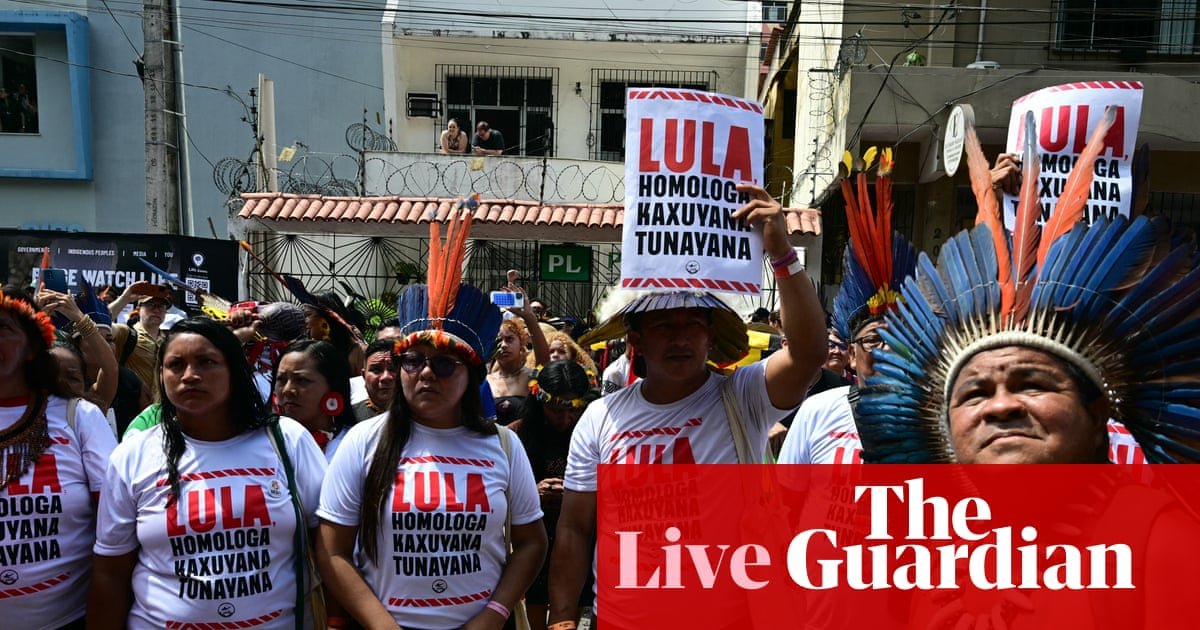
Brazilian president Luiz Inácio Lula da Silva is due to fly back to Belém on Wednesday as momentum surged behind efforts to include a roadmap for phasing out fossil fuels and ending deforestation as one of the key outcomes of Cop30.
More than 80 countries have put their weight behind moves to plot a path out of the era of coal, oil and gas, though they face strong resistance from petrostates and other major economies in the remaining few days of the negotiations.
The task now for Lula will be to persuade China and India to back the proposal, and to get support from the European Union to provide extra finance. Only then will this historical political mandate be possible.
The Brazilian presidency of COP30 insists the global talks will end as scheduled on Friday, but with other key topics, including finance and trade, also unresolved, this will require huge breakthroughs. It would also break a sequence of COP overruns stretching back more than 20 years.
Observers have been encouraged that the main negotiating text is relatively “clean”, which means that, compared to previous years, there are fewer brackets denoting areas of disagreement.
A transition away from fossil fuels was not included in the agenda for this conference, but Lula has spelled out in three previous speeches here in Belém that he wants a roadmap to be among the results. The return of this global south figurehead will add impetus to the negotiations and could help to secure support from China, a Brics ally whose president Xi Jinping has stressed support for the COP presidency and multilateral decision making.
A roadmap for eliminating the main source of the emissions that are heating the world could potentially constitute significant progress, but the devil will be in the detail. Some advocates fear the current wording is too vague to be effective. They want it to have measurable goals and clear action plans.
For this to have any chance of success, Cop30 will also have to move forward on the vexed issue of finance. Wealthy industrialised economies, which are most to blame for climate breakdown, have agreed to help developing countries with the energy transition and adapt to the already dire consequences of climate breakdown. But the commitments so far have fallen short of what is needed and many of the promised funds have yet to materialise.
The need for urgent action has been made apparent by the presence of indigenous leaders and scientists and at the conference. Forest people have spelled out how their territories have suffered from devastating droughts in recent years, as well as land invasions and illegal mining. Climatologists have warned that the Amazon and other biomes are fast degrading towards a point of no return that would have dire global consequences.
If Belém can encourage nations to fulfill their promises, this situation would look a less less bleak. This morning, a new analysis by Climate Action Tracker coalition revealed the
the rate of global heating could be cut by a third in the next decade if governments simply honoured their existing commitments to triple the amount of renewable energy generated by 2030, double global energy efficiency by the same date, and make substantial cuts to the powerful greenhouse gas methane.
The Brazilian hosts of Cop30 have described this as the “action summit.” Over the next three – or more – days, we will find out how much it can deliver.
Good morning, it is Matthew Taylor here and I will be hosting the liveblog for the next few hours, keeping across all the latest developments from Cop30 in Brazil.