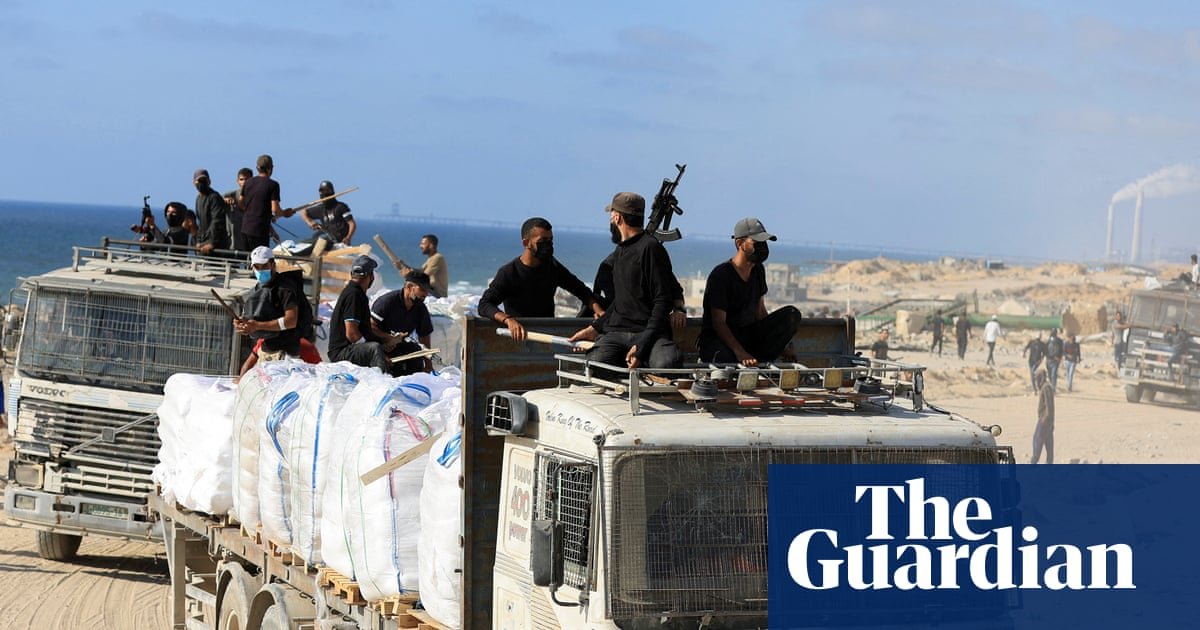
A historian who spent more than a month in Gaza at the end of the year says he saw “absolutely solid” evidence that Israel supported looters who attacked aid convoys during the conflict.
Jean-Pierre Fillieu, a professor of Middle East studies at France’s prestigious Sciences Po university, entered Gaza in December, where he was hosted by an international humanitarian organization in the southern coastal region of al-Mawasi.
Israel has barred international media and other independent observers from Gaza but Filiu was able to avoid strict Israeli scrutiny. He eventually left the area shortly after a second short-term ceasefire during the war came into force in January. His eyewitness account, A Historian in Gaza, was published in French in May and in English this month.
In the book, Filliou describes Israeli military attacks on security personnel guarding aid convoys. This, he writes, allowed looters to seize vast quantities of food and other supplies meant for desperately needy Palestinians. According to international humanitarian agencies, parts of Gaza were at risk of famine at the time.
UN agencies told the Guardian at the time that law and order across Gaza had deteriorated since Israel began targeting police officers guarding aid convoys. Israel views the police in Gaza, which has been run by Hamas since 2007, as an integral part of the militant Islamic organization.
In his book, Filliou describes an incident that, according to him, occurred very close to where he lived in al-Mawasi, which was considered a “humanitarian zone” where hundreds of thousands of people were displaced from their often destroyed homes, when, after weeks of continuous attacks on their convoys by local criminals, militias and desperate civilians, the United Nations decided to test a new itinerary that aid officials hoped would prevent looting. Will be able to.
Filiu says sixty-six trucks carrying flour and hygiene kits headed west from the Israeli checkpoint at Kerem Shalom, a corridor along the Egyptian border, and then north on the main coastal road. Hamas was determined to take over the security of the convoy and recruited powerful local families along its route to provide armed guards. However, the convoy immediately came under fire.
Filliou writes, “It was a night and I was… a few hundred meters away. And it was very clear that the Israeli quadcopters were supporting the robbers in attacking local security (teams).”
Filliou says that Israeli forces “killed two local notables as they sat in their car, armed and ready to protect the convoy”, and twenty trucks were looted, although the UN considered the loss of one third of the convoy a relative improvement on the looting of almost all previous loads, according to Filliou.
Filliou said, “(Israel’s) rationale at the time was to discredit Hamas and the UN… and to allow (Israel’s) clients, the looters, to either redistribute the aid to expand their own support networks or make money by reselling it to get some cash and therefore not be exclusively dependent on Israeli financial support.”
Israeli officials denied the allegation. A military spokesman said that in the incident described by Filliou, an Israeli Air Force aircraft “delivered a precision strike on a vehicle carrying armed militants who were planning to transfer humanitarian aid to Hamas storage units and violently capture an aid truck in the area of Deir al-Balah.”
The spokesperson said, “The attack was carried out to ensure terrorists were protected from harm to the aid. The IDF continues to work against the Hamas terrorist organization and is making every possible effort to minimize harm to uninvolved civilians. The IDF … will continue to act in accordance with international law to enable and facilitate the transfer of humanitarian aid to the residents of the Gaza Strip.”
Filiu’s allegations echo those made by some aid officials at the time. An internal UN memorandum described Israel’s “passive, if not active, generosity” toward some of the gangs responsible for looting in Gaza.
Filiu also accused Israeli forces of attacking a new route recently opened by international aid organizations to avoid plundering blackspots.
“The World Food Program was trying to set up an alternative route to the coastal road and the Israelis bombed the middle of the road… it was a deliberate attempt to put it out of action,” the historian told the Guardian.
Israel, which imposed strict restrictions or even a complete blockade on aid entering Gaza during the war, rejected accusations that it deliberately obstructed aid or supported looters. However, Prime Minister Benjamin Netanyahu acknowledged that Israel had assisted the Popular Forces, an anti-Hamas militia, which included many of the rebels among its recruits.
Israel has repeatedly accused Hamas of systematically stealing aid to supply its army or fund political or military campaigns. Hamas denied the allegations.
Filiu, who has been visiting Gaza for decades, said he was shocked to see that “everything that stood before” in the territory had been “wiped out, destroyed” in the war, which began with a Hamas offensive into Israel in October 2023. About 1,200 people, mostly civilians, were killed in that attack and 250 were taken hostage. Israel’s ensuing offensive killed approximately 70,000 people, mostly civilians, and reduced much of the area to rubble.
“Any successful counterinsurgency operation anywhere in history has to balance a military campaign with some kind of political campaign to win hearts and minds,” Filliu said.
“(Israel) never even pretended to do that in Gaza, (but) Gaza is probably the place on earth where Hamas is most unpopular because in Gaza they know Hamas (and) they have no illusions about the reality of Islamist dominance and the brutality of its rules.”
The historian said that the conflict in Gaza could have huge consequences. Filliou said, “I have always believed that this is a universal tragedy. This is not another Middle Eastern conflict. This is a laboratory for a post-United Nations world, a post-Geneva Conference world, a post-Declaration of Human Rights world, and that world is very scary because it is not even rational.” “It’s very cruel.”
<a href