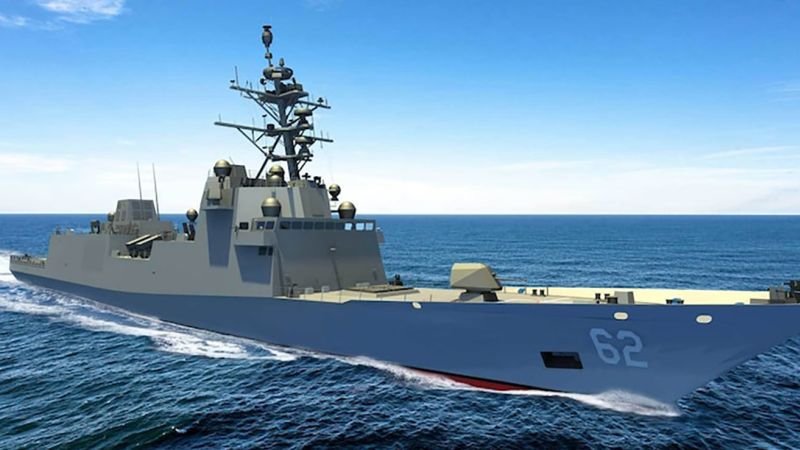
The US Navy’s troubled shipbuilding program suffered a major blow on Tuesday when Navy Secretary John Phelan announced he was canceling plans to buy Constellation-class frigates, once heralded as a key part of the US strategy to keep pace with China’s rapidly growing naval fleet.
Phelan said the billion-dollar program for surface fighters is not producing much benefit.
“I won’t spend a dollar if it doesn’t strengthen our preparedness or ability to win,” the Navy secretary said in a post on social media.
“To deliver on that promise, we are reshaping the way the fleet is built and deployed – working with industry to deliver a warfighter advantage, starting with a strategic shift away from the Constellation-class frigate program,” he said.
The US needs to rapidly expand its fleet “to meet the threats of tomorrow,” a senior US defense official told reporters, according to USNI News.
“This framework seeks to put the Navy on a path to building new class ships more rapidly and providing essential capabilities to our warfighters in greater numbers and faster,” the official said.
The service already had a contract with Fincantieri Marine Group for six warships, described on the Navy’s website as “next generation small surface combatants.” At one time he planned to build 20 of them, each costing about $1.1 billion.
A Navy fact sheet states that the Constellation class will be “an agile, multi-mission warship”, capable of operating in open ocean or littoral environments, providing “an enhanced combat-credible forward presence that will provide a military advantage at sea.”
With a displacement of about 7,200 tons, the ships were seen as filling the gap between the 10,000-ton Arleigh Burke-class guided-missile destroyers – the backbone of the US fleet – and the 3,500-ton littoral combat ships (from another naval shipbuilding program widely considered to have failed).
The Navy has no frigates in its fleet since the USS Simpson was decommissioned in 2015.
During that time, Chinese shipyards were producing warships at a frenetic pace, with the country surpassing the US in fleet size by several years.
The People’s Liberation Army Navy is expected to have about 400 hulls in the water by the end of this year, according to Pentagon estimates. According to the International Institute for Strategic Studies, about 50 of those ships are frigates.
The US fleet consists of about 240 ships and submarines.
Experts say this is a troubling statistic, given that history shows that the larger fleet usually wins in any conflict.
Initially, the Constellation class was conceived as a faster way to build warships for the US Navy. It was based on an in-service Italian design, which would be modified to meet American requirements.
But those amendments proved to be more comprehensive than planned. Costs escalated and construction soon fell behind schedule. Plans to deliver the USS Constellation in 2026 have already been pushed back to 2029, according to a report by the Congressional Research Service.
Many experts said it was time for the Navy to end the troubled program.
Analyst Carl Schuster, a former US Navy captain, said “Constellation was a huge waste of money” and would not meet the Navy’s mission requirements even for low-level threats, let alone a modern navy like China’s.
The ship’s defense capability against drones, aircraft, missiles and even small boats is weak, he said.
“It will not last long in operations against the Houthi-level threat,” he said, referring to the rebel group in Yemen that is threatening shipping around the Arabian Peninsula.
“Another in a string of bad government shipbuilding programs,” said Sal Mercogliano, a naval analyst and professor at Campbell University in North Carolina.
Those programs include littoral combat ships (LCS), derisively known in some circles as “little dirty ships.”
A 2023 investigation by ProPublica called that shipbuilding program “one of the worst in the Army’s long history of purchasing overpriced and underperforming weapons systems.”
Since 2008, the Navy has commissioned 35 LCSs and two are still under construction. ProPublica reported that the total cost of that program could reach $100 billion.
But the LCS has experienced frequent malfunctions and does not provide the flexibility in mission operations that the Navy originally planned. The service is already retiring ships, some of which have at least five years of active duty.
But the fate of the Constellation class, on which two ships are still in service, may be similar to that of the Zumwalt-class destroyers. Plans to acquire 32 of those 16,000-ton stealth warships, which the Navy calls “the largest and most technologically advanced surface combatant ships in the world,” were cut to just three due to cost overruns.
Like the Zumwalts, both Constellations may end up as black sheep in the US fleet.
Phelan said Tuesday that construction on Constellation and the other ship in that class, the USS Congress, will continue, but said their fate has not yet been determined.
“Those ships are under review,” he said, indicating that the Navy wants to keep the shipyards in business and keep their workforce employed while it implements “strategic changes” to its construction program.
A statement from Fincantieri Marine Group said it would transfer its workforce to other programs.
“This new arrangement guarantees continuity and workload visibility for Fincantieri’s personnel” and the shipyards on the Great Lakes, it said, calling them “a vital pillar of the U.S. maritime industrial base.”

Phelan said American shipbuilding capacity should be protected.
Phelan said, “Shipbuilding is a major concern. The Navy needs ships and we look forward to building them in every shipyard.”
Last summer, Phelan spoke to Congress about the Navy’s shipbuilding problems.
“All of our programs are messed up,” he said during a U.S. House hearing in June.
He testified, “I think our best is six months late and 57% over budget…that’s the best.”
Washington has already begun using foreign shipyards in South Korea and Japan to maintain some naval ships, and an official at a South Korean shipyard recently told CNN that it could be possible to build US Navy ships there. But US law would have to be changed to allow this.
Mercogliano said the Navy’s problems are not with the shipyards.
“The issue is not about shipbuilding but about the navy and their ability to design,” he said.
Schuster agreed.
“Have you noticed that the US Navy has neither designed nor built an effective, problem-free surface warship since it began building the Arleigh Burke-class destroyers 20 years ago?” he asked.
<a href=