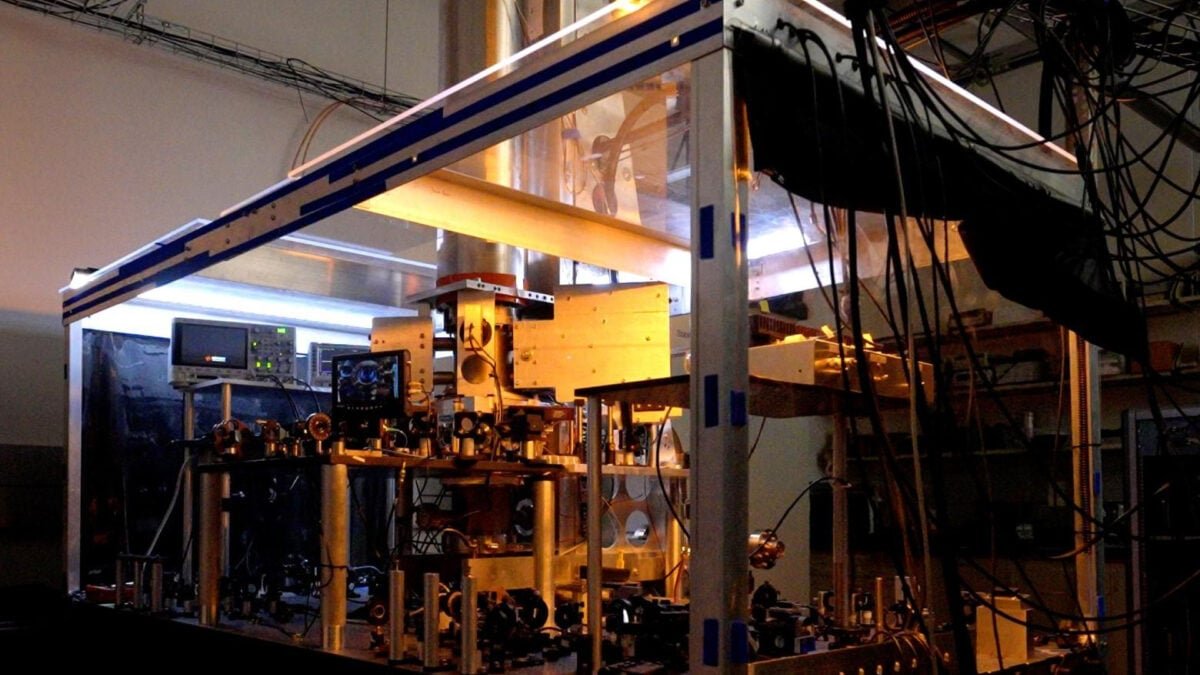
The atomic clocks had a battery backup system that kept them running for some time, but on December 19, according to a community email from NIST supervisory physicist Jeffrey Sherman, the “atomic ensemble time scale” failed due to a disconnect between some of the clocks and NIST’s measurement systems.

“One effect is that Boulder Internet Time Services no longer has an accurate time reference,” Sherman said. As a result, the U.S. official time slowed down by about 4.8 microseconds — a time frame that is “both big and small at the same time,” Sherman told NPR.
timekeeping history
NIST, short for National Institute of Standards and Technology, officially became America’s timekeeper through the America Competes Act in 2007. As part of the Department of Commerce, NIST collaborates with the US Navy to determine accurate time in the United States.

More informally, NIST and its predecessor, the National Bureau of Standards, had been managing official time references for stock exchanges and industries such as the electric power sector since at least the 1960s.
Today, NIST’s standard time serves as a reference point for things like telecommunications and GPS signals. The atomic clock constellation is a mix of hydrogen masers and cesium beam clocks, which produce a weighted average of physical signals that NIST researchers use to keep time.
big but small, atomic time
The level of precision for atomic timing is literally on the atomic scale. For reference, according to NIST, the international standard for “1 second” corresponds to “a period of 9,192,631,770 periods of radiation corresponding to the transition between two ultrafine levels of the ground state of the cesium-133 atom.” This means that even slight inconsistencies in the group can turn into serious errors.
To be fair, a “drift” of 4.8 microseconds would be too small to be noticed by the general public – which is why Sherman described the error as “both big and small”. To NPR, NIST clarified that it has given “high-end” users access to other timekeeping networks to minimize disruptions from the Colorado power outage.
NIST staff was also able to resolve the problem in a reasonable amount of time. The power outage lasted approximately two hours, and critical operations personnel on duty immediately activated a reserve diesel generator to keep the clocks running.
“Additional quick action by NIST facility staff secured temperature controls for the most sensitive clocks,” Sherman said in a follow-up community message on Sunday. By December 21, utility power had returned to NIST’s facilities, and “assessment and repair activity is in progress.”
<a href