The space agency said the rapid turnaround sets “a successful example for efficient emergency response in the international space industry.” “It clearly embodies the spirit of manned space flight: exceptionally hard-working, exceptionally capable, exceptionally resilient and exceptionally dedicated.”
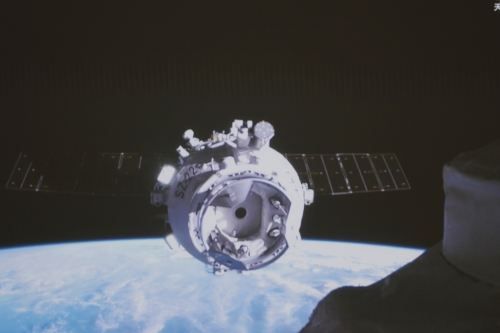
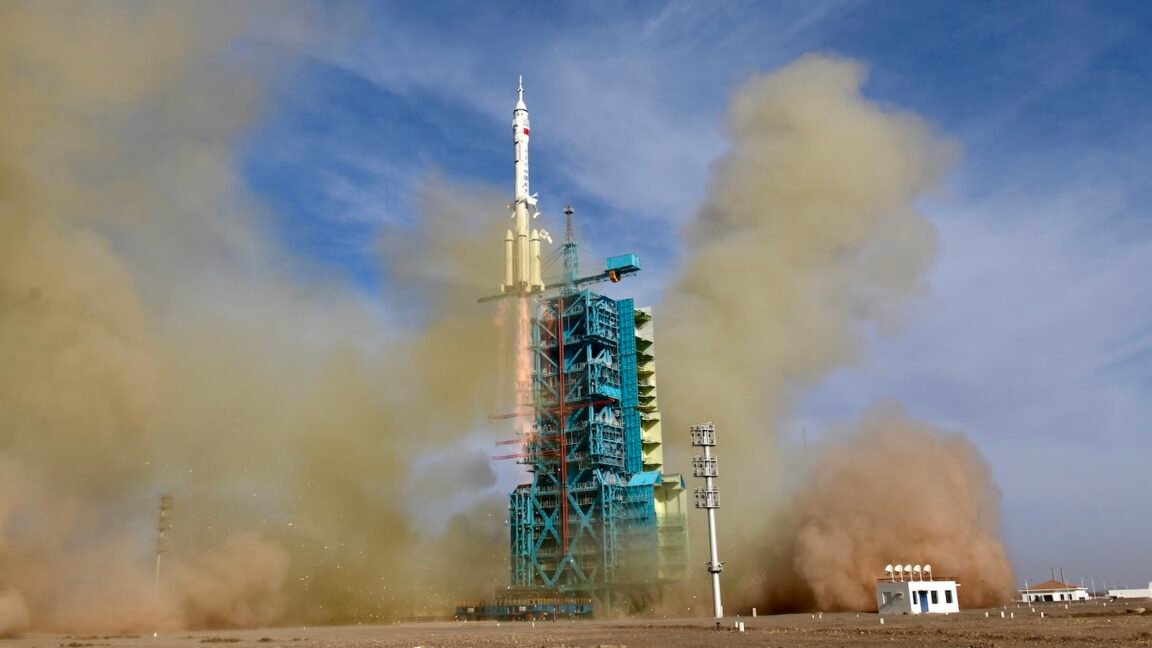
The Shenzhou 22 spacecraft lifted off for an automated docking with the Tiangong space station early Tuesday.
Credit: China Manned Space Agency
Now, 20 days after the saga began, the Tiangong outpost again has a lifeboat for its long-term residents. Astronauts Zhang Lu, Fu Wei and Zhang Hongzhang will return to Earth on the Shenzhou 22 spacecraft next year, soon after the arrival of their three replacements.
While the crew is just a month into their planned six-month expedition, an emergency could force them to leave the station and return home at any time. Although remote, another collision with space junk, a major system failure, or a medical emergency involving one of the astronauts could trigger an evacuation. That’s why Chinese officials wanted to launch Shenzhou 22 quickly to give the crew a ticket home.
The International Space Station follows the same policy, with SpaceX’s Dragon spacecraft and Russian Soyuz ships acting as lifeboats until their crews’ scheduled return to Earth.
The condition of the damaged Shenzhou 20 spacecraft is reminiscent of two recent incidents on the ISS. First, in 2022, a Soyuz crew spacecraft docked on the ISS suffered a coolant leak – also caused by a suspected space debris attack – showering frozen ammonia crystals into space and making it unsafe to bring its crew home. Russia launched an empty replacement Soyuz two months later, and the damaged Soyuz MS-22 aircraft ultimately made a successful landing without the crew.
And then, last year, Boeing’s Starliner crew capsule suffered a series of helium leaks and propulsion problems that made NASA managers uneasy about its ability to return safely to Earth with astronauts Butch Wilmore and Suni Williams. Both astronauts remained on the ISS as Starliner made a successful unmanned landing in September 2024, while SpaceX launched its already scheduled Crew Dragon mission to the station, keeping two of its four seats vacant. The Dragon spacecraft brought Wilmore and Williams home in March.
<a href