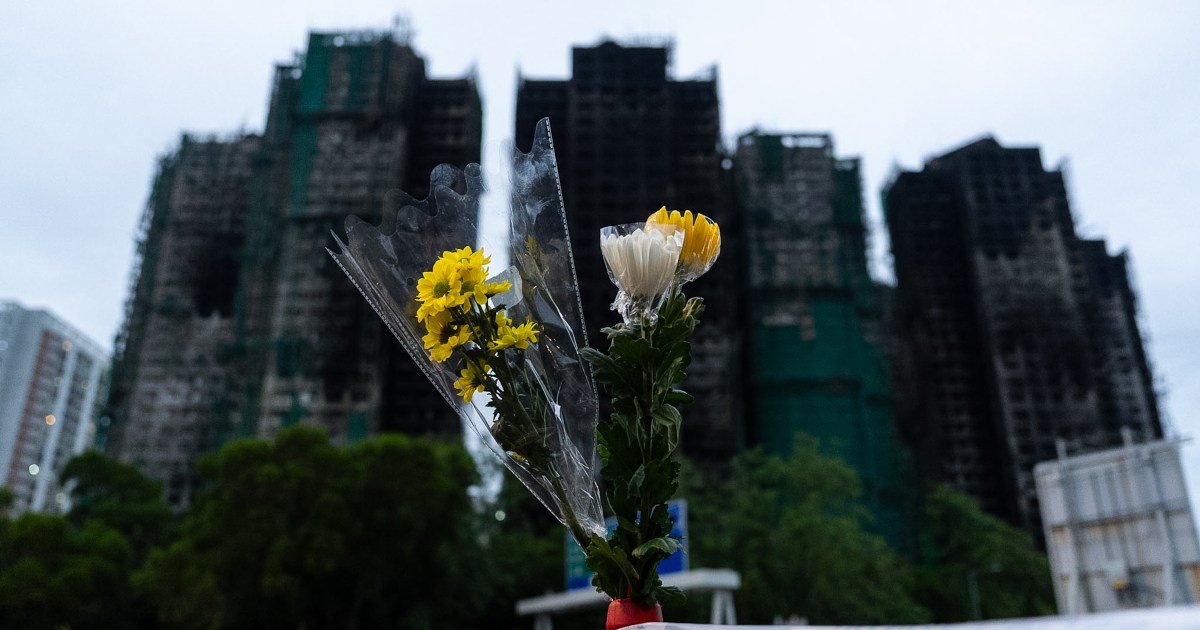
Hong Kong’s national security police arrested three people over the weekend, state-backed and commercial media reported, as calls grew for accountability after the city’s worst fire in nearly eight decades.
Recommended Stories
4 item listend of list
A day after the arrest of a university student on suspicion of treason, authorities on Sunday arrested former district councilor Kenneth Cheung Kam-hung and an unidentified volunteer who were managing supplies for survivors, according to multiple reports. The Standard newspaper reported that Cheung was arrested on suspicion of “attempting to incite discord”.
On Saturday, authorities arrested Miles Kwan, a 24-year-old student at the Chinese University of Hong Kong, after he created an online petition demanding greater transparency and accountability from the government, multiple reports said.
The petition contained four demands, including the establishment of an independent commission of inquiry to investigate the circumstances of the fire, including whether potential conflicts of interest may have contributed to the disaster.
The petition had garnered more than 10,000 supporters, before it was removed from the internet on Saturday.
China’s National Security Office in Hong Kong appeared to condemn the petition before removing it, accusing activists of using the ‘people’s petition’ banner to incite conflict and subvert society.
Hong Kong’s Office for the Safeguarding of National Security also accused people with “sinister intentions” of taking advantage of the fire to plunge the city back into the “black-clad violence” that erupted during mass anti-government protests in 2019.
On Monday, a commentary in the Beijing-backed Wen Wei Po newspaper called on the public to remain vigilant against “anti-government elements” with “malicious intentions.”
“They have gone as far as setting up a so-called ‘concern group’ to ‘act as a representative’, putting forward so-called ‘four demands’, distributing leaflets and starting a petition, all in an effort to incite public unrest,” the comment said.
“Their actions are completely devoid of conscience and humanity.”
‘derogatory’
The action is the latest sign of shrinking space for dissent in Hong Kong, following Beijing’s sweeping changes to the semi-autonomous territory’s political and legal landscape in response to 2019 protests.
China has repeatedly denied that Hong Kong’s civil liberties have deteriorated, and has insisted that the passage of two far-reaching national security laws has ensured that residents’ rights and freedoms are “even better protected” than before.
Beijing has also argued that the law ensures the continuation of Hong Kong’s partial autonomy under the “one country, two systems” under which Britain returned the territory to China in 1997.
Nathan Law, an activist and critic of Beijing who served in Hong Kong’s legislature, called the authorities’ actions “outrageous” and the latest example of “extreme authoritarian tendencies” in the former British colony.
“The government aims to create a chilling effect by arresting these individuals. Any civil action without the government’s permission is now illegal,” Law, who lives in self-exile in the UK and is wanted by Hong Kong authorities on national security charges, told Al Jazeera.
“The government is concerned about people gathering and initiating collective action, whether it is political or not.”
The Hong Kong Police Force did not respond to requests for comment.
Ronny Tong, a non-official member of Hong Kong’s de facto cabinet, rejected suggestions that officials were suppressing criticism of the government’s handling of the disaster.
Tong told Al Jazeera, “If you look at the major Hong Kong newspapers, there are a variety of suggestions and criticisms about the handling of the incident in Hong Kong, so there is by no means a general suppression of different views or criticism of the government.”
Tong said that while it would be inappropriate to comment on the cases of people who have yet to face judicial process, the law allows “constructive” criticism of authorities.
He said, “One should not make a case of just a few arrests – the circumstances of which are still unclear – to conclude that the Hong Kong government is trying to suppress views it does not like.”
At least 151 people were killed in a fire Wednesday at a high-rise apartment complex in Hong Kong’s northern district of Tai Po, the city’s worst fire since at least 1948.
The scale of the disaster has prompted an investigation into safety standards in Hong Kong’s construction industry, with authorities considering how the use of substandard materials in renovation works on the block may have helped the fire spread rapidly.
Hong Kong authorities have arrested 13 people as part of their investigation into the fire, including the director of an engineering consulting company involved in the renovation.
commission of inquiry
While the Hong Kong police and the city’s Independent Commission Against Corruption have launched separate investigations, the government has not yet indicated whether it will establish an independent commission of inquiry.
Hong Kong authorities launched the commission of inquiry in response to several previous disasters, a legacy of British rule in the territory.
Previous investigations, usually led by a judge, looked into tragedies including a 2012 ferry disaster that killed 39 people and a 1996 fire that took 41 lives.
Former Hong Kong lawyer Kevin Yam said Beijing could not afford public criticism of the official response to the fires because it worried that “the smallest spark of disagreement could escalate into something major”.
“Those who read George Orwell will know the phrase, ‘Those who control the past control the present, and those who control the present control the future.’ And the Communist Party of China has always been very good at this,” Yam, who is wanted by Hong Kong authorities for alleged national security crimes, told Al Jazeera.
“They find that once they silence dissent and criticism, and then they flood the field with favorable stories about how they handled things, that becomes the official record of history.”
Hong Kong, once known for its noisy media, vibrant civil society and political diversity, has dramatically reduced space for dissent after the 2019 protests.
Under the laws, which have been widely condemned by foreign governments and rights groups, authorities have forced the closure of critical media outlets, effectively removed opposition parties from the city’s legislature, and banned politically sensitive protests.
The mainland Chinese and Hong Kong governments have defended the laws as a proportionate response to anti-government protests, which began peacefully before erupting into street fighting between protesters and police and other national security threats facing the territory.
In a speech marking the fifth anniversary of the 2020 law in June, Xia Baolong, Beijing’s top official for Hong Kong affairs, called the law a “guardian” of the city’s semi-autonomous status and stability.
<a href