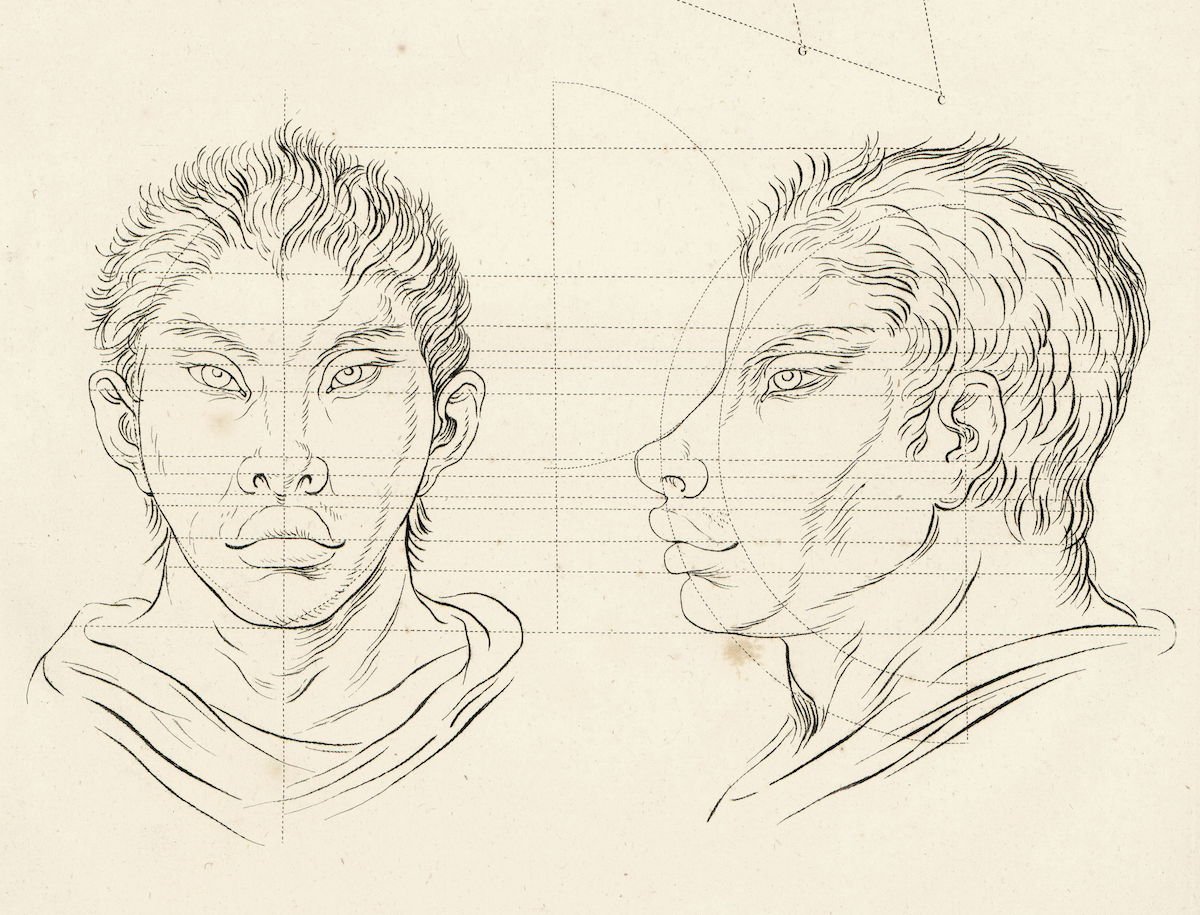
Still, he admits, it is true that prominent people have prominent noses – something everyone has agreed upon since Aristotle. An aquiline nose, as we know, is an essential component of a hero’s face, with a broad and prominent forehead, thick eyebrows and angled eyes such that “the inner corner forms an angle above the horizontal line which is then intersected only by the outer corner”. Variations on this theme are a sure sign that Minerva, the patron goddess of talents, has never come to visit. The beaked nose is only good for the eagle-like, resolute in his toga: Le Brun’s Raven-Man, frowning at the viewer and cawing in three-quarter profile, is plagued by even the “most scandalous” passions (perhaps this is because, as Aristotle argued, the nose is under the rule of Venus). The parrot-man, in his soft cloth hat, may remind one of a Renaissance philosopher – but the parrot’s beak, of course, is a sure sign of babylard outreAn excessive murmurer.