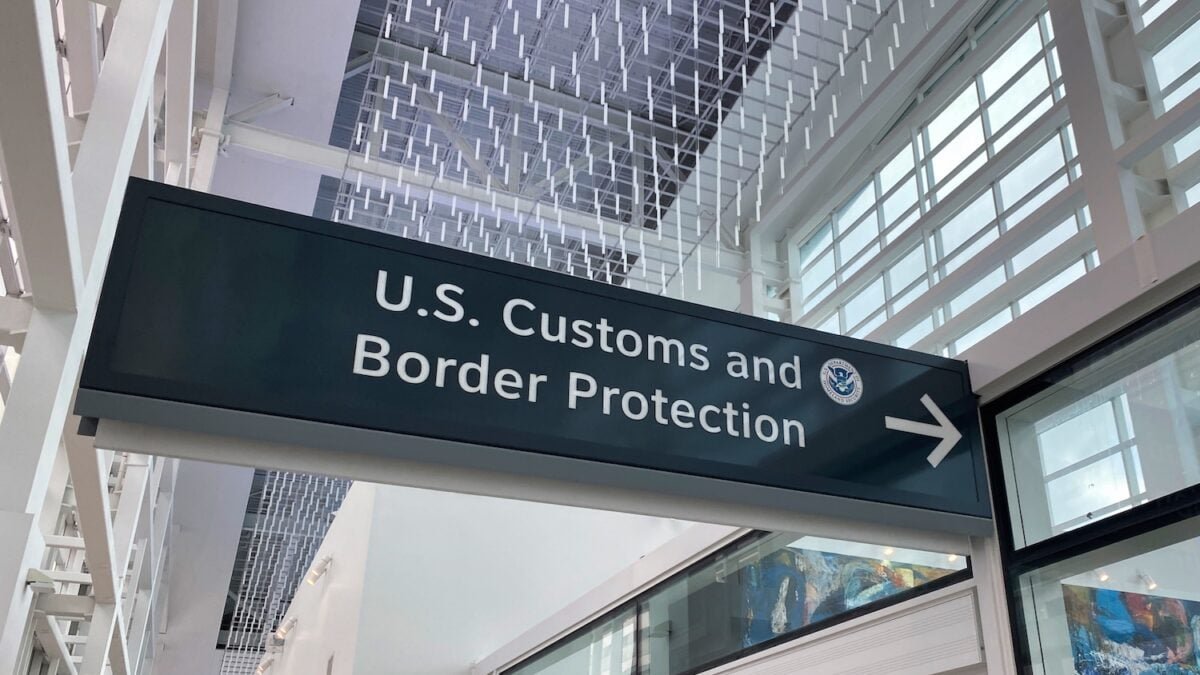

In the Federal Register on Tuesday, U.S. Customs and Border Patrol posted a proposed policy change: It now plans to scrub the social media history of tourists before admitting them, even if they’re coming from some of the world’s least-scrutinized countries.
According to its statement, CBP “invites the public to comment” on the newly proposed series.
Change. Here is number 3:
3. Essential Social Media:
To comply with Executive Order 14161 (Protecting the United States from Foreign Terrorists and Other National Security and Public Safety Threats) of January 2025, CBP is adding social media as a mandatory data element to an ESTA application. The data element will require ESTA applicants to provide their social media from the past 5 years.
Note that this is for “ESTA” applicants which stands for Electronic System for Travel Authorization. It does not take any additional action on people with ties to countries covered by Trump’s travel ban, such as Afghanistan, Myanmar, Somalia, Sudan and Yemen. It is aimed at travelers from visa exempt countries, whose citizens are in principle welcomed with open arms. Once they receive a $40 authorization through ESTA — which, funnily enough, there’s an app — people from visa exempt countries like Australia, Japan, France, Iceland, the United Kingdom and South Korea are typically able to travel freely to the US for up to 90 days.
CBP also plans to ask for other personal information, such as email addresses for the past ten years, and the addresses, dates of birth and other identifying details of all family members of ESTA applicants.
This is not the first such social media action. Earlier this month, the State Department announced an expansion of the screening process for people applying for H-1B and dependent H-4 visas – people who plan to visit the US for work reasons. If you’re in this group, you’ll be asked to “Adjust privacy settings for everyone.” [your] Social media profiles are made ‘public’ as part of the application process, and there is no mention of only checking what you have posted in the last five years.
Speaking to The New York Times, Bo Cooper, a representative of the immigration firm Fragomen, said about investigating tourists’ social media posts that since the process involves “looking at online speech, and then denying travel based on conscience and policy about what people have expressed”, “it would be interesting to see the tourism numbers.”
A June study by the World Travel and Tourism Council (cited by Forbes) found that of the 184 countries analyzed, only the US was expected to see a decline in tourism numbers in 2025.
<a href