

 getty images
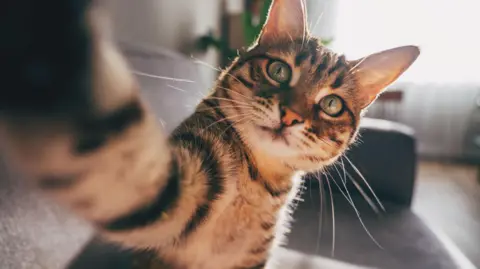
In true cat style, cats took their time deciding when and where to bond with humans.
The shift from wild hunter to pampered pet happened more recently than previously thought — and in a different place, according to new scientific evidence.
Studies of bones found at archaeological sites show that cats began their close relationship with humans only a few thousand years ago, and not in the Levant in North Africa.
“They are ubiquitous, we make TV programs about them and they dominate the internet,” said Professor Gregor Larson of Oxford University.
“Our relationship with cats now appears to have begun only 3.5 or 4,000 years ago, rather than 10,000 years ago.”
 getty images
All modern cats descend from a single species – the African wildcat.
How, where and when they lost their wildness and developed close relationships with humans has long puzzled scientists.
To solve the mystery, researchers analyzed DNA from cat bones found at archaeological sites in Europe, North Africa and Anatolia. They dated the bones, analyzed the DNA, and compared it to the gene pool of modern cats.
New evidence suggests that cat domestication did not occur at the same time as agriculture in the Levant. Instead, it happened a few centuries later, somewhere in North Africa.
“Rather than being in an area where people were first settling with agriculture, it seems to be more of an Egyptian phenomenon,” Professor Larsen said.
 Ziyi Li and Wenquan Fan
This fits with our knowledge of the land of the Pharaohs, as a society that revered cats, immortalizing them in art and preserving them as mummies.
Once cats became associated with people, they were taken around the world, valued as ship cats and pest controllers. Cats arrived in Europe about 2,000 years ago, much later than previously thought.
They traveled with the Romans throughout Europe and Britain and then began moving eastward along the Silk Road toward China.
Today, they are found in all parts of the world except Antarctica.
 getty
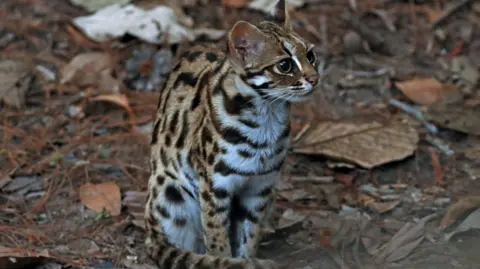
gettyAnd in a new twist, scientists discovered that a feral cat hung out with people in China for a while, long before domestic cats arrived on the scene.
These rival cats were leopard cats, small wild cats with leopard-like spots, which had lived in human settlements in China for about 3,500 years.
The early human-leopard cat relationship was essentially “commensalistic,” where the two species lived harmlessly alongside each other, said Shu-Jin Luo, a professor at Peking University in Beijing.
“Leopard cats benefited from living near people, while humans remained largely unaffected or even welcomed them as natural rodent controllers,” he said.
 getty
gettyLeopard cats did not become domesticated and continued to live in the wild throughout Asia.
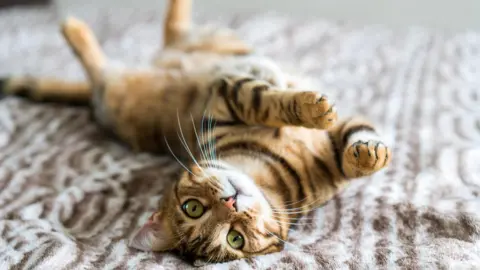
Interestingly, leopard cats were recently crossed with domestic cats to produce Bengal cats, which were recognized as a new breed in the 1980s.
This research has been published in the journal Science and in Cell Genomics.
<a href