
key takeaways
- CCL has recorded record revenues, growing deposits and strong pricing as its recovery gathers pace.
- Carnival grows margins through cost discipline while reducing leverage toward investment-grade levels.
- RCL shows strong demand, although yield growth has slowed amid higher costs and a more promotional Caribbean.
Carnival Corporation & PLC ,CCL , free report) and Royal Caribbean Cruises Limited ,rcl , Free Report) There remain two major forces driving the global cruise industry’s recovery, each capitalizing on resilient travel demand and record onboard spending trends.
Both stocks have staged impressive rebounds, with booking momentum remaining strong and pricing power at multi-year highs. Still, investors are now weighing which company offers the more attractive opportunity as the sector moves from a post-pandemic revival to sustained profitability and balance-sheet repair. In this faceoff, we will discuss how the two cruise giants fare based on growth prospects, financial health and valuations to determine which name is now in a better position.
CCL case
Carnival’s third quarter fiscal 2025 results show it firing on multiple cylinders. Management highlighted record revenues, net income and yields, with strong onboard spend and close-in demand continuing to deliver impressive growth. The company is also demonstrating cost discipline, beating expectations on unit costs thanks to operating efficiencies.
Customer deposits hit a new record in the third quarter of fiscal 2025, indicating increased booking momentum and pricing power in 2026. The leadership is confident that given a long runway for ongoing margin expansion and same-ship yield improvements, returns can continue to grow. Meanwhile, Carnival is rapidly strengthening its financial position, reducing leverage to 3.6x and approaching investment-grade metrics, paving the way for a return to dividends and buybacks.
The company’s latest commercial initiatives, including exclusive destinations like Celebration Key and a multi-brand strategy spanning North America and Europe, are already contributing to ticket price premiums and enhanced guest experiences. With minimal new capacity additions ahead, Carnival is positioned to drive growth from pricing rather than ship deployments, supporting continued free cash flow generation.
That said, Carnival’s transformation is still ongoing. Net interest expense remains significantly higher than pre-pandemic levels, and despite improvements, leverage is not yet at the company’s long-term target. Looking ahead to 2026, management acknowledged several headwinds: the rollout of a new loyalty program, which is putting pressure on yields, incremental destination-related operating costs, and increased dry dock expenses, with the potential for up to 200 basis points of margin drag next year.
RCL case
Royal Caribbean is benefiting from a healthy global appetite for leisure travel, with consumer spending keen to prioritize vacations despite normalization. Management highlighted all-time high guest satisfaction, strong new-to-cruise demand and growing loyalty, all of which are helping maintain pricing power. Booking trends remain strong, with record rates for both 2025 and 2026 and high average per day pricing locked in early.
The company is also delivering margin growth through strict cost discipline supported by technology and AI efficiencies. It expects “anemic” cost growth even as it expands destination offerings, a formula management believes supports continued earnings momentum. A solid balance sheet enables capital returns through dividends and share buybacks.
Looking ahead, RCL is focusing on its competitive strengths: innovative ships, exclusive destinations and a fast-growing digital commerce platform that is driving more revenue pre-cruise onboard. Private islands and beach clubs are proving to be high-margin revenue engines, further differentiating the brand due to greater capacity influx into the Caribbean.
Despite the momentum, there are still areas of concern. Yield growth has slowed from an earlier double-digit surge, reflecting tougher comparisons and mix changes that increase reliance on near-term demand, particularly in shorter itineraries. Management acknowledged the slightly more promotional Caribbean environment associated with increased industry supply to the region.
New destination rollouts and onboard expansion also come with structural costs and higher depreciation. Additionally, RCL expects increased fuel and regulatory expense pressures, including full exposure to the EU emissions trading system in 2026. Global minimum tax changes would also raise taxes. These downside headwinds may partially offset revenue gains.
How do the Zacks Consensus Estimate for CCL and RCL compare?
The Zacks Consensus Estimate for Carnival’s fiscal 2026 sales and EPS indicates year-over-year growth of 4.3% and 10.8%, respectively. Over the past 60 days, earnings estimates for fiscal year 2026 have seen an upward trend, as shown in the chart.
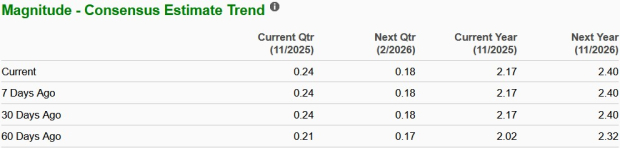
Image Source: Zacks Investment Research
The Zacks Consensus Estimate for Royal Caribbean’s 2026 sales and EPS implies year-over-year growth of 9.4% and 14.5%, respectively. Over the past 60 days, earnings projections for 2026 have seen a decline.
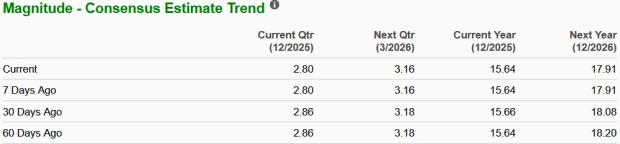
Image Source: Zacks Investment Research
price performance and evaluation
Royal Caribbean stock has increased 10% over the past six months, significantly outpacing its industry’s rise of 2.2%. Meanwhile, Carnival shares have gained 19.4% in the same period.
price display
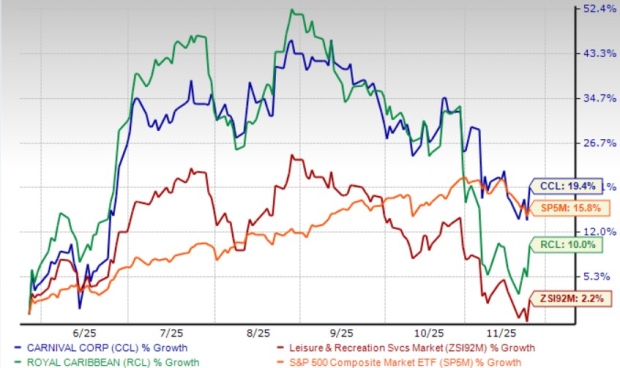
Image Source: Zacks Investment Research
RCL is trading at a trailing 12-month price-to-earnings ratio of 14.94X, which is lower than the last year’s average of 18.13X. CCL’s forward earnings multiple sits at 11.09X, which is lower than its average of 12.96X over the same time frame.
P/E (F12M)
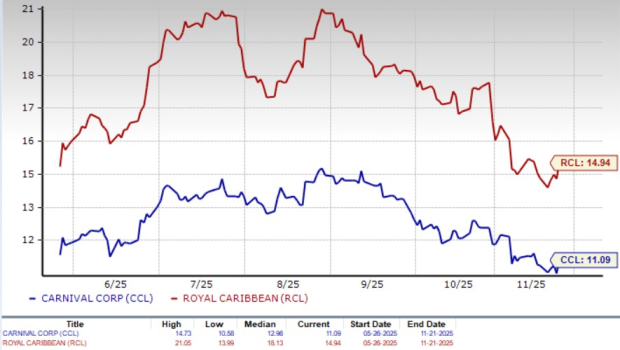
Image Source: Zacks Investment Research
wrapping up
Carnival appears to offer the more attractive upside at this stage of the recovery, given its quick operational turnaround, rapidly improving financial health, and strong recent stock momentum. The company is making meaningful gains in pricing and onboard spend, while benefiting from record customer deposits indicating continued booking strength. Carnival’s strategic shift toward increasing destinations and achieving greater yield from its existing fleet provides a clear path to continued margin expansion and growing free cash flow.
Although reinvestment needs remain, Carnival’s progress toward a healthy balance sheet and the potential resumption of shareholder returns provide catalysts that could unlock further valuation gains. Royal Caribbean remains a high-quality operator with strong demand trends, so existing investors in both should hold on.
CCL and RCL both carry a Zacks Rank #3 (Hold). you can see Here’s the full list of today’s Zacks #1 Rank (Strong Buy) stocks,
<a href=
ремонт квартир під ключ ремонт квартир Львів
Gaming portal Unblocked Games with free online games. A huge collection of browser games without restrictions: arcades, strategy, racing, logic games, and entertainment for relaxation right in your browser.
Компания “Маркет Климата” https://market-climata.ru/services/obsluzhivanie-konditsionerov/ предоставляет полный спектр услуг по Техническому обслуживанию кондиционеров в Москве всех марок и моделей.
The best reads here: reliable and efficient solution for generating high-quality leads
Мучает варикоз? https://zdorovie-veny.ru информационный сайт о здоровье вен и лечении варикоза ног: УЗДС диагностика, лечение варикоза, ЭВЛО (лазерное лечение), склеротерапия, восстановление и компрессионный трикотаж. Рекомендации врача, ответы на частые вопросы и профилактика варикоза.
MMORPG игра Scryde — онлайн-мир приключений, сражений и развития персонажа. Выбирайте класс героя, исследуйте локации, участвуйте в PvP и PvE боях, вступайте в гильдии и проходите квесты в захватывающей многопользовательской игре.
Ищешь кран? приварной кран для трубопроводов различного назначения. Надежная запорная арматура для систем водоснабжения, отопления, газа и промышленных магистралей. Высокая герметичность, долговечность и устойчивость к нагрузкам.
купить женские духи https://elicebeauty.com/parfyumeriya/dlya-muzhchin-1/filter/_o668/
Found a bride? best rooftop venues for a proposal in Barcelona romantic scenarios, beautiful locations, photo shoots, decor, and surprises for the perfect declaration of love. Make your engagement in Barcelona an unforgettable moment in your story.
Проблемы с застройщиком? взыскать неустойку за просрочку по дду помощь юриста по долевому строительству, расчет неустойки, подготовка претензии и подача иска в суд. Защитим права дольщиков и поможем получить компенсацию.
Нужен юрист? адвокат арбитражный суд представительство в арбитражном суде, защита интересов бизнеса, взыскание задолженности, споры по договорам и сопровождение судебных процессов для компаний и предпринимателей.
Full Article Here: https://www.symed.ru/products/ico
Информационный сайт https://zdorovie-veny.ru о здоровье вен и лечении варикоза ног: УЗДС диагностика, лечение варикоза, ЭВЛО (лазерное лечение), склеротерапия, восстановление и компрессионный трикотаж. Рекомендации врача, ответы на частые вопросы и профилактика варикоза.
A website https://grand-screen.com for searching and analyzing mobile apps. Compare features, explore reviews, ratings, and capabilities of Android and iOS apps. A convenient catalog helps you quickly find useful services and programs.
Отель в центре Москвы снять апартаменты в москва-сити омфортное размещение рядом с главными достопримечательностями столицы. Уютные номера, современный сервис, удобное расположение рядом с метро, ресторанами и деловыми центрами города.
Zalety aluminiowych zadaszen tarasowych https://aluminum-etrrace-canopies.ru
Нужен отель? отель белорусская идеальное место для расслабления в центре столицы. Тихий бутик-отель 4* сочетает классический комфорт с современным спа-комплексом. Гостей ждет настоящий отдых: можно посетить бассейн, расслабиться в сауне или заказать индивидуальные программы. Уютные номера и близость к метро делают этот отель со спа в Москве идеальным выбором для романтических и оздоровительных путешествий.
Нужна гостиница? номер с сауной уютные номера рядом с метро и деловым центром города. Удобное размещение для туристов и деловых поездок, комфортные условия проживания, современный сервис и удобная транспортная доступность.
Услуги по настройке https://sysadmin.guru и администрированию серверов и компьютеров. Установка систем, настройка сетей, обслуживание серверной инфраструктуры, защита данных и техническая поддержка. Помогаем обеспечить стабильную работу IT-систем.
A website with unblocked games for free online play. Popular browser games, arcades, platformers, racing games, and puzzles are available with no downloads or restrictions on any device.
Качественное SEO https://outreachseo.ru продвижение сайта для бизнеса. Наши специалисты предлагают эффективные решения для роста позиций в поисковых системах. Подробнее об услугах и стратегиях можно узнать на сайте
ремонт ванной спб цена ванны ключ ремонт ванной
Узнать больше здесь: https://vnutridoma-spb.ru
дизайн интерьера лофт квартира дизайнер квартиры спб
Старый паркет? шлифовка паркета цена профессиональное восстановление деревянного пола без пыли и лишних затрат. Удаляем царапины, потемнения и старое покрытие, возвращаем гладкость и естественный цвет. Используем современное оборудование, выполняем циклевку, шлифовку и лакировку паркета под ключ с гарантией качества и точным соблюдением сроков.