A nova is an astronomical phenomenon that occurs in a binary system when a white dwarf strips hydrogen-rich gas from its companion star, causing a thermonuclear runaway reaction on the surface of the white dwarf. It gets its name because of its sudden brightness which makes it appear as if a new star has appeared in the night sky. However, the material ejected immediately after the explosion is small and a challenge to observe, and so far astronomers can only estimate the initial stages by indirect methods.
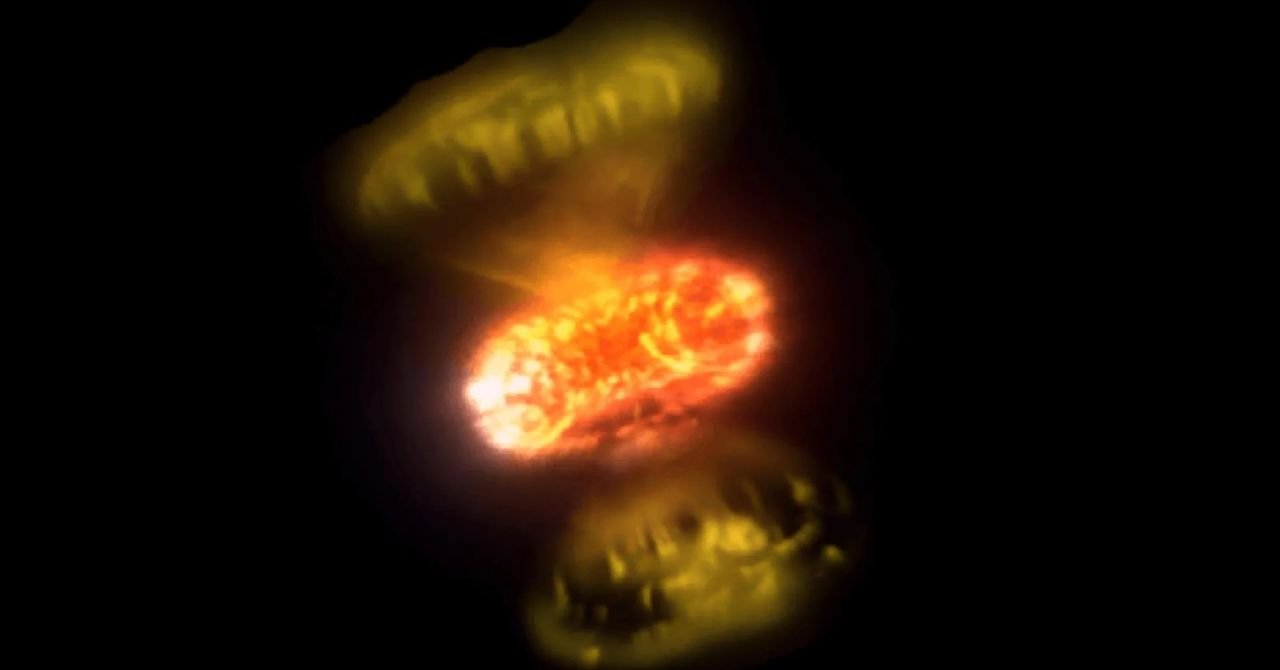
“The images give us a close-up view of how material is ejected from the star during the explosion,” explains Gail Schaefer, director of the CHARA Array. “Capturing these transient events requires the flexibility to adapt our night-time schedules as new targets of opportunity are discovered.”
explosive results
Schaefer and his team observed a nova V1674 Hercules in the Hercules constellation and a nova V1405 Cassiopeia in Cassiopeia. V1674 was one of the brightest novae ever recorded, reaching its peak brightness less than 16 hours after its discovery and rapidly fading within a few days. In contrast, V1405 took 53 days to reach its peak brightness and remained as bright for about 200 days.

Image of V1674, taken just days after its discovery, shows an eruption that is clearly not circular; There are two ejecta flows, one to the north-west and the other to the south-east, whose elliptical structure radiates almost vertically. This is direct evidence that multiple ejecta were interacting with each other in the explosion.
Spectroscopic observations also revealed different velocity components in the Balmer series of hydrogen atoms. While the absorption line before the peak was about 3,800 km/s, the visible component after the peak reached about 5,500 km/s.
Time is important. The new ejecta flow appeared in the image along with the detection of high-energy gamma rays by NASA’s Fermi Gamma-ray Space Telescope. The collision of different velocity streams produced a powerful, gamma-ray emitting shock wave.
The results of V1405 were even more surprising. The first two observations during the peak period showed only a bright central light source and some surrounding emissions. The diameter of the central region was about 0.99 milliarcseconds, which when converted to distance corresponds to a radius of about 0.85 AU (the AU astronomical unit, the distance between the Earth and the Sun).
<a href