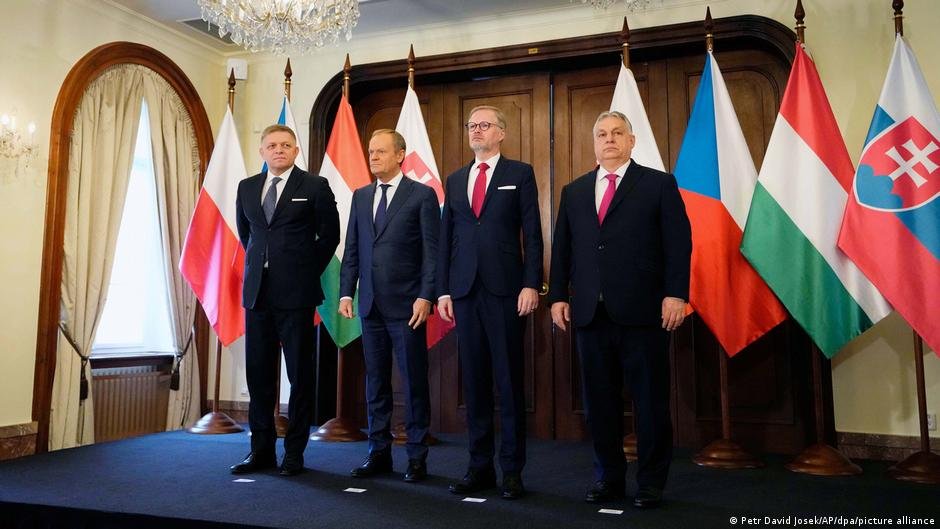
It was Nawrocki’s first visit to Prague since his election in June and took place just a week before the summit of the presidents of the so-called Visegrad group of Central European countries in Esztergom, Hungary on December 3.
Both men were keen to emphasize in the press briefing after their meeting that they were on the same page on most of the issues facing Europe, particularly the war in Ukraine.
“There is no doubt that it is the Russian Federation that is the aggressor,” President Nawrocki told journalists. He said Poland has a strategic interest in supporting Ukraine.
“It is in Europe’s interest to keep a lasting peace – not one that will allow Russia to rebuild its capacity for another war.”
Barriers to closer Central European cooperation
Nawrocki also stressed that both Poland and Czechia were leaders in the EU when it came to transitioning away from Russian gas.
But here, an interesting divide begins to reveal itself – one that neatly illustrates the obstacles to deeper Central European cooperation.
Nawrocki – officially non-partisan but widely seen as ideologically aligned with Poland’s previous Law and Justice (PiS) government – has clearly expressed a desire to “restore the strength” of the Visegrad Group (or V4), made up of Czechia, Hungary, Poland and Slovakia.
“We need to restore trust within Visegrad and intensify negotiations. Common values, cultural closeness and historical ties are the foundation on which we can build,” Nawrocki told supporters during his victory speech in Warsaw in June.
Visegrad is idle
The Visegrad Group was at the peak of its powers during the migrant crisis a decade ago, when four of its prime ministers opposed EU efforts to introduce a mandatory quota system for the redistribution of asylum seekers across the bloc.
But Russia’s invasion of Ukraine in February 2022 ended that cooperation – at least at the intergovernmental level – so severe were the differences over who started the war, whether to support Ukraine militarily, and the region’s dependence on Russian fossil fuels.
The governments of Poland and Czechia have been among Ukraine’s strongest supporters and have gone a long way to free themselves from Moscow’s grip on their energy supplies.
On the other hand, the prime ministers of Slovakia and Hungary have been reluctant to turn off the tap when it comes to Russian oil and gas, and when the topic turns to Ukraine, they often seem to be reading from a script typed in the Kremlin.
In short, at the Prime Ministerial level, Visegrad is lying idle.
Bratislava and Budapest rejoiced at Babis’ election victory
The populist-nationalist governments of both Slovakia and Hungary celebrated Andrej Babiš’s recent electoral victory in the Czech parliamentary elections.
“Bravo, Andrzej Babis!” Hungarian Foreign Minister Peter Szijjarto posted on social media.
“Another patriotic government in Central Europe! V4 will soon be revived!”. He proceeded, while Prime Minister Viktor Orbán described the election result as “a big step forward for the Czech Republic, good news for Europe”.
From Visegrad Four to Visegrad Three?
So, if and when Mr. Babis is eventually appointed prime minister, could a revival be on the horizon?
“Well, partly,” said Milan Nik, senior research fellow at the German Council on Foreign Relations, predicting that the Visegrad Four will now be revived as the Visegrad Three, at least at the intergovernmental level.
“There will be more coordination within the V3 at the EU level between prime ministers before the EU summit, but it will be much more topic-based and uneven,” Nick told DW.
He added, “As long as Donald Tusk is prime minister, Poland will not be a part of it.”
Babis will avoid conflict with the EU
Nick said he believed that those looking for Andrzej Babis to become a reliable member of a sovereigntist, anti-Brussels coalition within the Council of Europe may be disappointed.
“The baby will be opportunistic and different,” he said.
“He understands the relative size and relevance of Poland and Orbán’s relative isolation. He will try to jump on Orbán’s bandwagon when it is useful, but – like Fico – will carefully avoid a head-to-head confrontation with the EU Commission.”
Meanwhile, Martin Ehl, chief analyst of the Czech financial daily Hospodarske NovinySaid that geopolitics will probably be more important for Poland than short-term political goals.
poland looks west
“Poland has a traditional sense of being something more than just a Central European country,” Ehl told DW.
“Tusk is looking to the West and the Russian threat creates more natural cooperation opportunities for countries around the Baltic Sea,” he said.
“We have already seen that during the outgoing Czech government of Petr Fiala: despite political declarations about closer Czech-Polish relations, Tusk’s government was not really interested in doing anything,” he said, adding that a new government in Warsaw could certainly change that equation.
There is a lot of difference of opinion on Ukraine.
For now, Visegrad exists as a symbolic expression of cultural closeness and shared historical experience: presidents meet, flags are raised, national anthems are sung.
On December 3, the four Visegrad presidents will gather in Esztergom, the cathedral city on the banks of the Danube River in Hungary.
But the meeting of the four Visegrad prime ministers is still some way off, so Russia’s war against its neighbor is divisive.
A new Prime Minister in Prague might make the voices of Central Europe a little less incoherent, especially when the song is about Brussels interference in their affairs.
But they are still far from being reconciled, especially when it comes to the defense of Ukraine.
Edited by: Angiel Flanagan
<a href