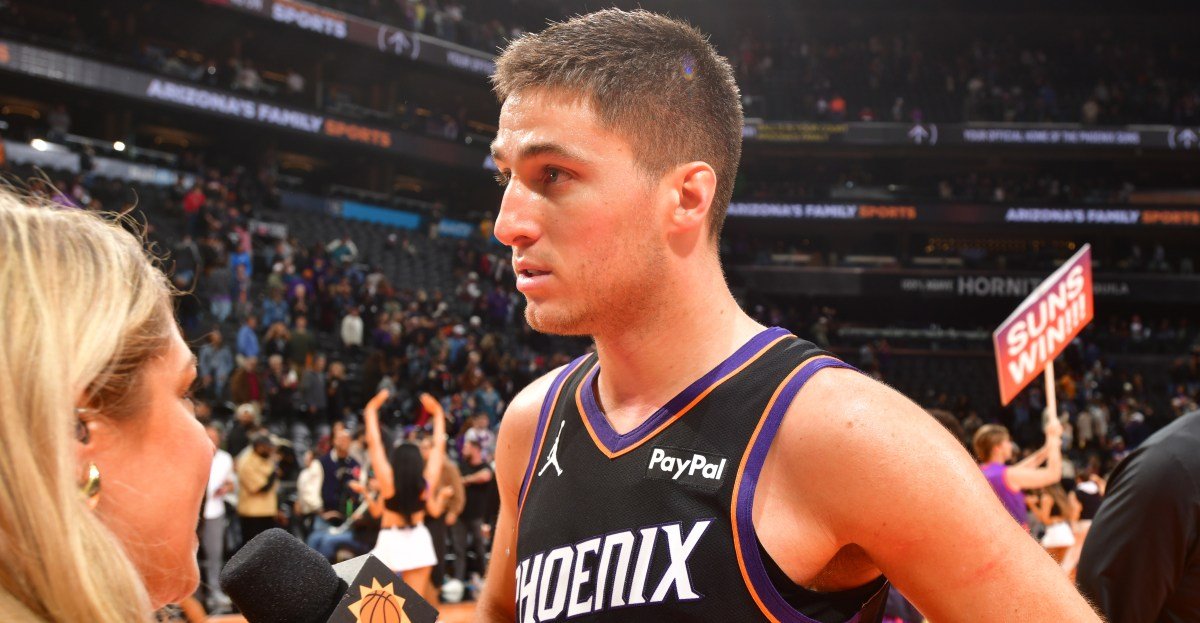
There is already some concern over whether the Suns can afford to re-sign Colin Gillespie next season. He’s already playing well beyond what he’s being paid for this year and should get a nice raise in his next contract, and in this, I’m going to discuss the options available to the Suns to make this possible as well as the realistic numbers of what the Suns can offer him as well as what other teams can do under NBA rules.
First of all, the Sons have early bird rights to Colin. The difference between EBR and full bird rights is that a team can offer an early bird free agent 175% of his previous salary (up to the maximum) or 105% of the league-average salary from the previous season, whichever is greater, without using cap space. Full bird rights give teams more leeway in contract offers, including offers up to the maximum contract. While this places restrictions on how much the Suns can offer Gillespie in the offseason, other teams will also be limited to exceptions in using available cap space or making him offers.
As for specifics on what the Suns could offer Collin, they don’t have any cap space, so that option is gone. 175% of his salary this year would be a pitiful $4,163,022, which any other team could easily beat. The third option, 105% of the league-average salary last season, is a different story, however.
According to Basketball Reference, the average league player salary for this season is $12,661,208. 105% of that is $13,294,268, which would be the Suns’ best offer in the first year of the new contract. He will be eligible to sign a contract of up to 4 years with an 8% annual increment.
Early Bird Rights Maximum Offer
First year: $13,294,268
Second year: $14,357,810
Third year: $15,506,434
Fourth year: $16,746,949
Total contract value: $59,272,401
The new contract may be for a minimum of two seasons but no more than four seasons, and may include a player or team option in the final year. The positive for Collin in signing a two-year contract with a player option in the second year instead of a four-year one would be that the Suns would have Collin’s full Bird rights, and it would be possible to offer him an even bigger contract if he plays well enough to earn it.
If another team wanted to offer him the full non-taxpayer mid-level exception ($15,139,000 in 2026–27), it would be slightly higher than the Suns’ offer, and could be used to sign a player for up to 4 years, but only allows for a 5% annual raise instead of 8%. As the figures below show, overall, this type of contract offer would pay Collin approximately $6 million more over that 4-year period.
First year – $15,139,000
Second year – $15,895,950
Third year – $16,690,747
Fourth year – $17,525,285
Total contract value – $65,250,982
Will an additional $6 million spread over 4 years be enough to lure him away from Phoenix? Maybe, but Colin has said several times that he wants to stay in Phoenix long-term, so that may not be enough. And another thing to consider is that using a non-taxpayer MLE immediately gets hard-capped one term on the first tax apron for that season. While this doesn’t really have any relevance to Collin’s decision, it will certainly play a role in whether a team would be willing to make him such an offer. The Suns aren’t hard-wired to re-sign him by using their early bird rights, so it wouldn’t be a consideration for them.
There will be some teams that have enough open cap space that will make him an offer that is much higher than either of the two offers I mentioned above, but I firmly believe he will have to play at an All-Star/All-NBA level to get more than either of them. As much as I love Collin and have confidence in his abilities, I’m not sure he’ll reach that level of play… but I’m not completely ruling it out either. While it’s possible that another team could make them an offer that the Suns can’t match, I consider the chances of that happening to be very low at this point.
Ultimately, fans shouldn’t worry too much about whether the Suns can re-sign Colin Gillespie after this season. He wants to stay in the Valley, and the Suns are able to make him a very good, competitive contract offer to do so without putting themselves in a real financial bind regarding the salary cap. In that regard, at least, they may have to go above the tax apron first to re-sign both he and Mark Williams, but they can do so while re-signing their own free agents.
While it wouldn’t be optimal, the restrictions under the first tax apron aren’t nearly as bad as they faced under the second tax apron, and I really don’t doubt that Matt Ishbia would do it if he felt it was best for the team.
<a href=