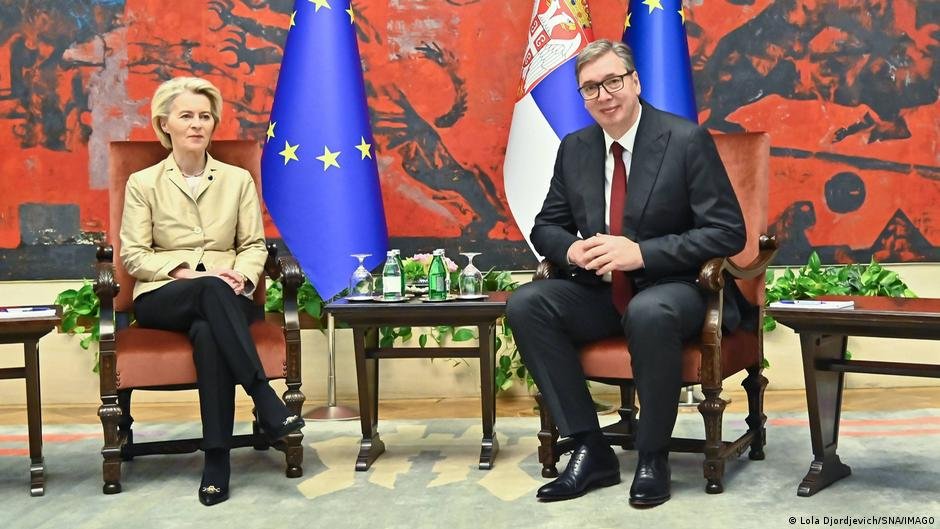
The European Commission president was in Serbia as part of her tour to the Western Balkans to discuss EU enlargement with candidate countries in the region.
That day, he invited Serbian President Aleksandar Vucic to visit Brussels a month later so that the two could “take stock together.”
It was October; It is December. According to multiple sources who spoke to DW, the meeting was postponed because Serbia had no progress to report.
It was confirmed on Tuesday that President Vucic would travel to Brussels on Wednesday to meet with European Commission and European Council presidents Ursula von der Leyen and Antonio Costa.
What does the EU expect from Serbia?
Nemanja Todorovic Stiplija, editor-in-chief of the independent, Belgrade-based news portal European Western Balkans, told DW that the European Commission and the European Council have made it clear that Serbia’s progress will be measured on three key issues outlined in a paper Serbia will submit to the EU in 2024: improving media freedom, ensuring free and fair elections, and aligning Serbia’s foreign policy with the EU.
In response to DW’s inquiry, a Commission spokesperson said that in addition to these areas, Serbia is expected to “make more efforts and make agreements to normalize relations with Kosovo and to address disinformation and foreign manipulation of information.”
“Serbia should step up its efforts towards a more stable and higher alignment and reassure us about its strategic direction, including engaging with the EU restrictive measures taken in the light of Russia’s aggressive war against the EU (Ukraine),” the Commission spokesperson said.
Regression on media freedom
So, has Serbia made any progress in these key areas?
Although Serbia’s media laws have been amended, the amendments have not stopped the continued erosion of media freedom.
Indeed, the European Commission’s latest progress report The “backsliding” in freedom of expression in Serbia notes that “the climate for journalists, media professionals and outlets has seriously deteriorated.”
The Regulatory Body for Electronic Media (REM) is the principal institution responsible for overseeing and ensuring the independence of electronic media in Serbia.
One of its main functions is the election of new REM Council members, a process intended to guarantee the autonomy of the body. However, the ruling Serbian Progressive Party (SNS) is accused of manipulating the electoral process to maintain control over REM, thereby reducing the independence of electronic media in the country.
What about free and fair elections?
When it comes to ensuring free and fair elections, the only formal change made by the government relates to amendments to the law on the Unified Voter Register.
Rasa Nedeljkov of the NGO Center for Research, Transparency and Accountability (CRTA) told DW that the amendment stipulates a deeper audit of the register, which has not yet been done.
Nedeljkov says that over the past ten years, the OSCE’s Office for Democratic Institutions and Human Rights (ODIHR) has made 56 priority recommendations to Serbia. How to improve electoral conditions. According to ODIHR’s own assessment, only four have been implemented.
Meanwhile, the situation on the ground is getting worse. Recent local elections in Negotin, Mionika and Sekanj were marred by physical confrontations, attacks on journalists, observers and opposition members, and numerous allegations of irregularities such as vote-rigging and vote-buying.
Nedeljkov says in reference to those reports, “Serbia is rapidly sinking into electoral autocracy, where elections have become a spectacle and have been replaced by violent, systematic coercion of voters to show up at polling stations, while their will – through various threats – is taken away.”
Has Serbia’s progress stalled?
Countries that wish to join the European Union are required to implement reforms in various areas in preparation for membership. Interactions between the bloc and candidate countries are known as chapters and clusters.
Serbia has not opened a single chapter or cluster in three years.
Additionally, the EU has already postponed payments of €111 million ($129 million) in support of its growth plan due to incomplete reforms.
In October, the European Parliament adopted a harsh resolution condemning political polarization and state repression in Serbia.Progress reports published later noted retreats not only from media freedom, but also from democracy and fundamental rights,
What does Belgrade want?
Belgrade will be hoping for a change in Brussels’ mood toward Serbia as it would help the country’s leadership politically and economically.
The government could also sell the inauguration of a negotiating group in its own country as proof of its legitimacy, which has been weakened by more than a year of anti-government, anti-corruption protests.
Additionally, money from the first tranche of the EU Growth Plan will help the government close the budget gap.
Role of EU member states
But such change is no longer up to the Commission alone, Bojana Selakovic of the civil society coalition National Convention on the EU told DW: EU member states also have the right to have their say.
“The Baltic states are insisting that Serbia should completely distance itself from its alliance with Russia,” he told DW. “Another group – like Sweden, the Netherlands and Denmark – are very strict with regard to democracy and the rule of law, while Germany still insists on solving the Banjska case,” she explains, referring to the armed conflict between ethnic Serb militants and Kosovo police in northern Kosovo in September 2023.
This explains why Serbia launched an intensive diplomatic effort to change minds across Europe, with Serbia’s parliamentary speaker Ana Brnabić visiting Sweden and its European Integration Minister Nemanja Starovic traveling to the Netherlands.
Is Serbia a priority for the EU?
At the same time, Brussels is dealing with other crises that push Serbia down its list of priorities.
International relations expert Dusan Riljic says Ursula von der Leyen is currently lighting “very big fires” – from the US peace plan for Ukraine to relations with Israel and Gaza.
“Events in South-Eastern Europe are of little importance for EU policy, as there is no major risk of deterioration. A deeper or stronger EU reaction may occur when it becomes clear again that Aleksandar Vucic and his regime are fundamentally destroying the beginnings of democracy in Serbia,” Riljic told DW.
Selakovic, on the other hand, believes that the EU is still motivated to keep Serbia in its sphere of gravity.
“Otherwise Serbia will be left floating in some kind of Turkish scenario, and in fact it will be a far greater threat to the EU than if it remains in a package where some minimal progress is recognized and where the EU’s strategic interests are protected,” he concluded.
Edited by: Angiel Flanagan
<a href