
Brexit was always an economic deal. This was a decision to move away from deep integration with the EU in exchange for greater domestic control over migration, regulation and trade policy. There was never a question whether there would be costs involved. It was how big those costs would be, how quickly they would arise, and whether the benefits of autonomy would offset them.
Nearly a decade after the referendum, the broad answer is now clear. Brexit has made Britain’s economy smaller than it otherwise would be. The effect has not been a sudden collapse, but a gradual and cumulative decline in trade, investment and productivity.
The Trade and Cooperation Agreement avoided tariffs on trade in most goods. But it did not preserve anything close to the UK’s economic relations as a member of the single market and customs union. Firms now face customs checks, rules of origin requirements, regulatory paperwork and the pitfalls of automatic mutual recognition. Service firms, especially in deregulated sectors, lost important market access rights. Free movement ended.
These changes increased the cost of doing business with Britain’s largest trading partner. Standard trade theory predicted declines in trade, investment, and productivity over time.
The evidence now points strongly in that direction. The initial estimates prepared immediately after the referendum were necessarily provisional. They had little post-Brexit data to work with and had to separate out the effects of Brexit from Covid 19, energy shocks and wider global disruption. But as more data accumulated, a clearer picture has emerged.
Most serious estimates now suggest that Britain’s GDP is several percentage points below where it would otherwise be. The Office for Budget Responsibility has long believed that Brexit would reduce long-term productivity by about 4%, largely because lower trade intensity makes the economy less open and less productive. Other studies, using synthetic control methods or firm-level evidence, produce estimates in a similar wide range and sometimes on a larger scale.
The exact number matters less than the direction and persistence of the effect. Brexit did not cause an immediate recession after 2016. Nor did trade with Europe stop. But that was never the most plausible mechanism. The more significant effect is cumulative: fewer firms trade, weaker investment, less competitive pressure, less integration into European supply chains, and less flow of knowledge and technology across borders.
Trade is the most direct medium. UK goods trade has performed poorly compared to both pre-Brexit trends and comparable economies. Estimates generally suggest that exports of goods are about 10–15% less than they otherwise would have been, with a similar impact on imports.
One obvious puzzle is that the overall data does not always show a simple decline in UK-EU trade compared to trade with the rest of the world. But this is less convincing than it seems. Brexit has affected not only bilateral trade with the EU, but also the UK’s position in global value chains. If a UK firm becomes less attractive as part of a European supply chain, it could lose business with both EU and non-EU partners.
There is also a firm size effect. Larger companies are better able to absorb new administrative and regulatory costs. Smaller companies are less able to do this. The result is that overall trade flows may appear relatively resilient while the number of companies exporting to the EU declines. This matters, because exporting is a pathway through which small companies grow, innovate, and become more productive.
Service trade is more mixed. The UK has strengths in high-value, digitally deliverable services, and these have proven more resilient than goods. But this overall resilience hides regional deficits. Financial services, legal services and other regulated sectors have faced new barriers as TCAs provide only limited access compared to single market membership.
Investment may be the most important vehicle economically. Brexit led to a marked increase in uncertainty and a reduction in expected returns for companies using the UK as a base for European markets.
This matters because productivity growth depends largely on investment. If investment remains low for a sustained period, the productive capacity of the economy is affected. Brexit has therefore exacerbated one of the UK’s pre-existing weaknesses: poor productivity performance since the financial crisis.
The story of migration is different. The end of free movement led to a sharp decline in migration to the EU. Sectors such as hospitality, agriculture, logistics, food processing and parts of manufacturing have lost access to familiar and flexible labor supplies. In many cases, adjustment occurred not through large wage increases, but through higher prices, lower production, or changes in business models.
But the post-Brexit immigration system has also allowed much more non-EU migration, especially through work and study routes. This has largely offset the decline in EU migration overall. The result has been a structural change rather than a simple reduction in migration.
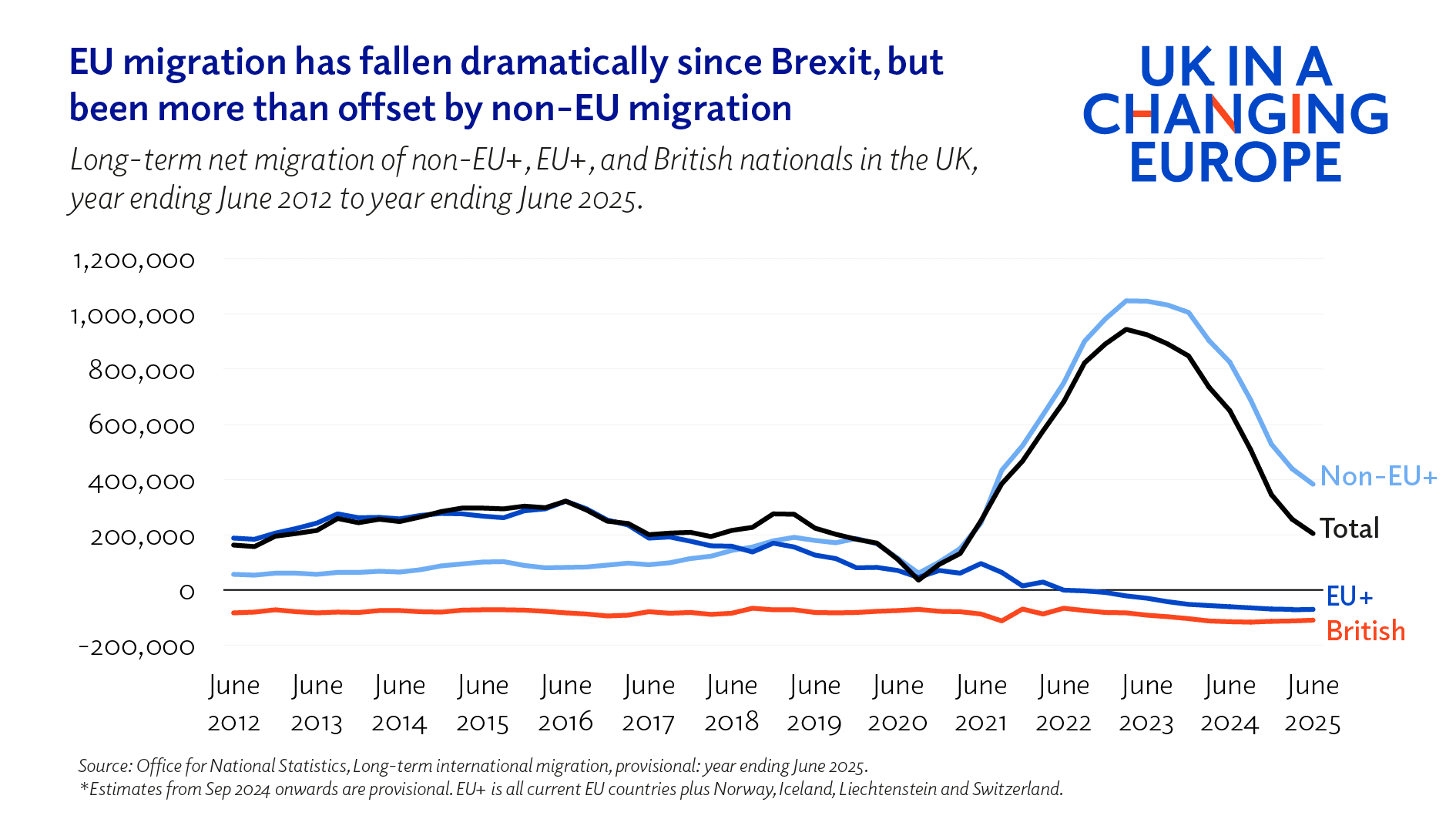
From an economic point of view, this is murkier than the business story. Overall, migration changes probably increased aggregate GDP relative to a low-migration scenario, but their impact on per capita GDP is small and difficult to quantify.
The broader problem is that Brexit has made it harder to solve Britain’s current economic challenges. The country already had weak productivity growth, low investment, strained public finances, and large regional disparities. The problems have become more serious due to low trade intensity and weak investment. A smaller economy also means lower tax revenues, which limits fiscal space for governments to improve public services or reduce taxes.
What about the benefits of autonomy? In theory, the UK could now regulate differently, set its own trade policy and design its own migration system. In practice, the economic benefits have so far been limited. Regulatory divergence may create opportunities in specific areas, but it also increases costs in many other areas. New trade agreements with non-EU countries could bring some benefits, but official estimates suggest these are small compared to the costs of reduced EU integration.
The May 2025 UK-EU ‘Common Understanding’ should be seen in this context. Agreements that reduce controls on agri-food trade, improve professional mobility, reduce regulatory friction or support cooperation in specific sectors would reduce costs for some companies. Small exporters in particular may benefit from lower fixed costs. But such measures cannot replicate the economic value of single market membership.
Brexit has therefore not created an economic crisis in the traditional sense. The UK economy continues to grow, unemployment remains relatively low, and many companies have adapted. But optimization does not equate to the absence of costs. The more relevant counterfactual is not whether the economy is still functioning, but how much better it might have performed; On that question, the evidence is increasingly settled.
By Professor Jonathan Portes, Professor of Economics and Public Policy, Department of Political Economy, King’s College London.
<a href