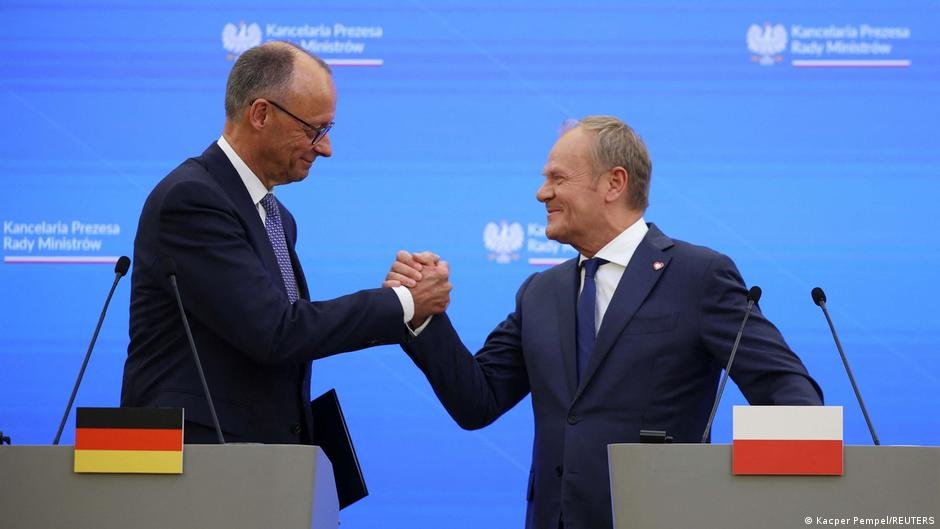
But the heavy burden of the past will be the ever-present elephant in the room.
The right-wing conservative Law and Justice (PiS) party, which governed Poland from 2015 to 2023, placed reparations for the damages caused by Nazi Germany’s occupation of Poland during World War II at the center of its policies toward Germany.
In 2022, Poland’s PiS-led government demands war reparations from Germany amounting to 6.2 trillion zloty (about €1.5 trillion or $1.7 trillion).
Nawrocki renews demands for war reparations
Although PiS lost the parliamentary elections in October 2023 and had to make way for a coalition led by Donald Tusk, its candidate, Karol Nawrocki, won the presidential election in early summer.
In his address on September 1, marking the 86th anniversary of the beginning of World War II, Nawrocki reiterated his country’s demands for war reparations from its western neighbor.
He also said that the future of the partnership between Poland and Germany depends on the resolution of this question. President Nawrocki reiterated these demands during his initial visit to Berlin a little more than two weeks later.
need a human feeling
Although the pro-European centre-left government led by Donald Tusk agrees with the German view that legally, the question of war reparations is closed, both Warsaw and Berlin are very aware that without a humanitarian gesture to the surviving Polish victims of German aggression during World War II, there can be no breakthrough in German-Polish relations.
Ahead of the last round of German-Polish intergovernmental consultations in July 2024, media reported that the German government had offered €200 million in support of the approximately 60,000 surviving Polish victims – an offer Warsaw rejected as insufficient.
Since then no solution is visible.
Piotr Buras, head of the Warsaw office of the European Council on Foreign Relations, said, “A breakthrough would require a hint of compensation, which ultimately does not draw a line under the past, would be received positively by Poland, or at least Poland’s ruling coalition.”
Hopes for restart soon fade away
Any hopes of a new beginning in German-Polish relations were soon dashed after the victory of Friedrich Merz and his party in the German general election in February.
While Merz kept his election promise to visit both Paris and Warsaw immediately after his appointment as Chancellor on 7 May, and Tusk spoke of a “new start” in German-Polish relations, the positive mood was quickly overshadowed by Germany’s unilateral decision to initiate checks on its border with Poland.
When German police began turning back irregular migrants at the border, pressure increased on Tusk, forcing him to introduce border checks on the Polish side as well.
These investigations are making life difficult for many travelers, businesses and carriers on both sides of the border.
PiS incites anti-German sentiment
The right wing in Poland considers Germany as its main rival and never misses an opportunity to criticize its western neighbour.
Jaroslaw Kaczyński, the Euroskeptic leader of PiS, has called Donald Tusk a “German agent” in the Polish parliament.
Kaczynski sees the EU – which he says is dominated by Germany – as the biggest threat to Poland’s sovereignty. “The Germans want to take away our state,” he said at a party conference in October.
Years of criticism of Germany have left a mark on Polish society. The German-Polish Barometer, a survey of Poles and Germans that has been conducted at regular intervals since 2000, shows that Polish attitudes towards Germans have reached an all-time low.
In the most recent survey, only a third of Poles expressed a positive view of Germans, while the number expressing dislike for Germans was 25% – the highest level in years.
Driving with the handbrake on
The anti-German atmosphere in Poland severely restricts Tusk’s room for maneuver when it comes to his policy toward Germany.
He avoids bilateral projects with Berlin, wants broader international formats and prefers other partners, including countries in Northern Europe and the Baltic Sea region.
German political scientist Kai-Olaf Lange says that in its policy towards Berlin, Poland is driving “with the handbrake on”.
What are the prospects for a security partnership?
Experts say the security partnership – which is a logical consequence of the war in Ukraine – is the project most likely to revive German-Polish cooperation.
Positive examples of such cooperation already exist. Two German Patriot air defense systems will remain operational in eastern Poland until December. They are guarding Jasionka airbase near Rzeszow, which serves as a hub for arms transfers to Ukraine.
German fighter aircraft are also involved in monitoring Polish airspace. A Polish adviser told DW on condition of anonymity that Poland’s interest in the Bundeswehr, Germany’s army, is strengthening.
What progress can be expected?
AS Polish daily newspaper Gazeta Wyborcza Reported on Monday, the two governments are expected to work together on the production of drones and long-range missiles.
However, it was also reported that negotiators from both sides did not reach a solution to the issue of compensation for Polish war victims.
Germany will return to Poland the archive of the Teutonic Order, a set of 73 documents that were looted by German occupiers in Warsaw during World War II, according to the ONET news website.
Artefacts to be returned will also include a fourteenth-century statue of the head of St James the Elder, which was stolen from Malbork Castle, the order’s former headquarters in northern Poland, after the war.
Warsaw has long been demanding the return of countless cultural properties looted from Poland occupied by Nazi Germany.
new confidence
The Polish government will arrive in Berlin on Monday with a new confidence that stems from Poland’s economic success and its role as a leading state.
A Polish adviser told DW that the old balance of power — where Germany was seen as the teacher and Poland as the apprentice — is a thing of the past, adding that the success of Monday’s intergovernmental consultations depends on whether Germans understand it.
This is an adapted and updated version of an article originally published in German.
<a href