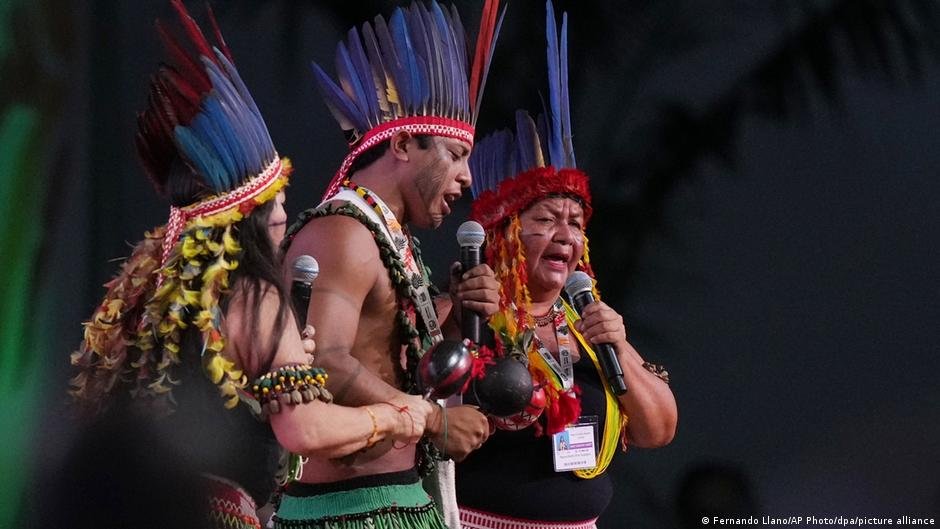
The Amazonian city of Belém was chosen for the talks to showcase the role of the region’s 1.7 million indigenous people as efficient managers of the world’s largest rainforest.
These gestures are a departure from negotiations in which indigenous communities – who protect much of the world’s biodiversity – have long felt unheard. But whether they will translate into meaningful action remains to be seen.
What are indigenous communities demanding?
These diverse groups of more than 5,000 indigenous people living in 90 countries represent just 6% of the global population, but are vital to protecting nature and the climate.
As custodians of their land, one of their main demands is how that land is managed. Many of their territories face encroachment from oil and gas drilling, mining and logging.
“We want to reach a consensus where indigenous territories will not be sacrificed,” said Kichi Lucia Ixiu, a Guatemalan native. Who traveled through the Amazon for several weeks to deliver this message to world leaders.
For many communities, land rights are an ongoing issue. Although an estimated 100 million hectares (247 million acres) were granted legal recognition to indigenous, African-descendant and other local communities worldwide between 2015 and 2020, claims to a further 1.4 billion hectares remain to be resolved.
“We hope that COP30 will strengthen the international commitment to demarcate and protect indigenous territories, recognizing them as fundamental areas for conservation and climate balance,” said Alcébias Sapara, a leading member of the Coordination of Indigenous Organizations in the Brazilian Amazon.
Sapara said they would also push for direct funding mechanisms for indigenous-led initiatives – so they can manage their territories autonomously and sustainably – and to integrate traditional knowledge into climate policies.
Christine Halverson, program director for Rainforest Foundation US, said they also want to ensure that any green energy projects that could impact indigenous lands and livelihoods happen only after those communities are consulted and give their consent.
Halverson said indigenous people are also requesting greater protection, as many face threats and violence to protect their lands. In 2024, almost a third of environmental defenders disappeared or killed internationally were indigenous.
Can they help protect the climate?
“Without indigenous peoples… there is no future for humanity,” Brazil’s indigenous peoples minister, Sonia Guajajara, told AFP. He highlighted how they ensure clean water and protect biodiversity where they live.
Indigenous communities are widely seen as the world’s best forest protectors. They manage about a quarter of the world’s land and half of the remaining forests.
In addition to being rich in biodiversity, the world’s forests are important carbon sinks, storing an estimated 861 gigatons of carbon – equivalent to about 100 years of fossil fuel emissions.
Intact forests have absorbed about one-fifth of emissions in the past, but they are increasingly under threat from human activity and climate change. Tropical deforestation due to wildfires increased by 80% last year.
There is growing credible research supporting the argument that granting land rights to indigenous people has an important role in tackling climate change.
“The evidence is clear: where indigenous territorial rights are respected, deforestation decreases; where they are denied, destruction increases,” Guajajara said in a written statement before the COP.
Giving communities the power to stop development projects such as oil drilling and mining on their lands has also been found to be a cost-effective way to protect nature.
According to a 2023 study, ensuring land rights for indigenous people in the Brazilian Amazon could reduce deforestation by 66%. Another estimated emissions would be 45% higher in the Amazon without indigenous protected lands.
What can indigenous communities achieve at COP30?
There were some victories even before the official opening of COP30.
It includes dozens of countries that have pledged by 2030 to formally recognize land rights to 80 million hectares where indigenous, African-descendant and other communities live. The move has been cautiously welcomed by indigenous leaders, who warn that enforcing land rights in practice could be challenging.
The launch of the Tropical Forest Forever Facility (TFFF), a proposed $125 billion (€108 billion) global conservation fund that would pay countries based on how well they protect their forests, with a promise to give 20% of the funds to indigenous peoples.
While this is an important step forward, to be truly effective Halverson says the TFFF must guarantee indigenous people direct and equitable access to the resources they need.
He said that if commitments in Belém on land demarcation, direct funding and global recognition of territorial rights are met, “COP30 could become a milestone for climate justice.”
Is COP30 really paying attention to indigenous communities?
Minister Guajara told DW that this year marks the highest indigenous participation in the history of the COP and their most significant presence in decision-making spaces. Yet, only a fraction have access to restricted conversation areas.
“Having credentials to enter the workplace does not guarantee that the voices and views of Brazil’s indigenous representatives will be heard,” the organization Indigenous Climate Action said.
While COP30 has shown progress in the visibility of indigenous peoples’ concerns, so far “it is still not enough compared to what we expected,” said Alcibias Sapara.
Indigenous protesters disrupted the Belém climate talks twice this week in a bid to make their voices heard. Leaders of the Munduruku indigenous group, who led a demonstration on Friday, presented a number of demands to Brazil, including the rejection of deforestation carbon credits. Carbon credits have come under scrutiny for failing to deliver on emissions reduction promises.
Some believe that “the Brazilian government is not listening to their demands and is not including their voices, even though they call it the ‘Indigenous COP,'” Indigenous Climate Action said in a statement.
But with global emissions and temperatures still rising, says Hayley Walker, associate professor of international negotiations at the IESEG School of Management in France, Mutirao’s concept could help drive the change needed toward actual implementation of climate action on the ground.
“If it moves forward, the Call of Mutirao could be an important gift from Brazil’s indigenous peoples to the rest of the world, with the potential to move us much closer to addressing climate change,” Walker said.
Edited by: Tamsin Walker
<a href