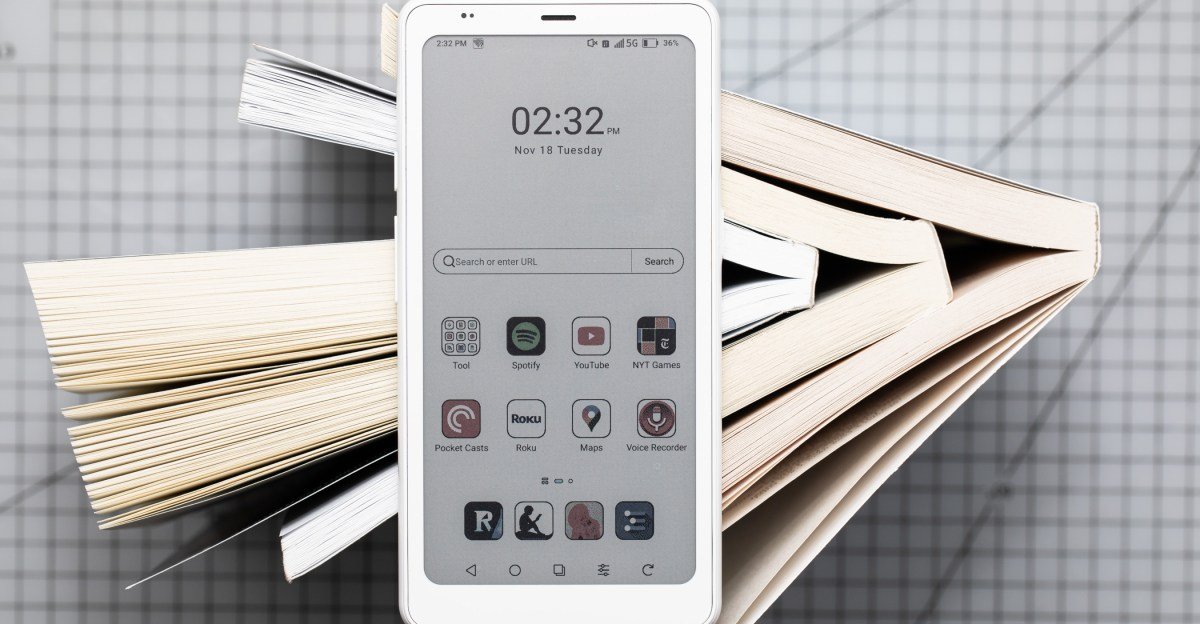
Year after year, model after model, the Buox Palma gets a little closer to my dream device. Onyx, the company that makes it, has found a formula that is both simple and delightful: it’s a gadget the size of a smartphone, with access to the full potential of Android apps, but with an E Ink screen that gives the Palma a more focused existence.
My Palma is almost exclusively for four things: reading (via Kindle and Readwise), listening (via Pocket Casts and Spotify), taking notes (via MyMind and Workflow), and controlling my Roku TV. The Palma can do a lot of things, but it only does a few things well. And battery life is good.
On paper, the new Palma 2 Pro is the first to tick all the boxes. The new $399.99 device is the most expensive Palma has made yet, but also easily the most high-tech. Most importantly, it has a SIM card slot to add (data-only) cell connectivity. It also has a color screen, a newer version of Android, a faster processor, more RAM, stylus support, and a bunch of new software features. This could be the do-it-all minimalist device we’ve been waiting for.
After testing the device for some time, I’m sorry to report: it’s not. The idea is a good one, and both the SIM slot and pen support make the Palma useful in new ways. But one of this device’s “upgrades” is actually such a huge downgrade that I almost immediately found myself using the Palma 2 Pro less than its predecessors. This is such a serious problem that I cannot recommend purchasing this device at all; Buy the Palma 2 instead. Or just wait a while, and hope Onyx figures out how to give us all the right features at once.


Let’s do this first: The problem is the screen. The Palma 2 Pro features a 6.13-inch color screen, based on E Ink’s Kaleido 3 technology. Kaleido 3 technology is a few years old, and it’s basically a colored filter layered over a standard black-and-white E Ink screen.
You can find Kaleido 3 screens in a lot of gadgets, none of which look amazing, but many of them look good. The technology comes with some inherent drawbacks, most notably its resolution – 150ppi is only half as sharp as modern black-and-white E Ink screens – and its brightness. Amazon’s Kindle is based on the ColorSoft Kaleido 3, for example, but Amazon has rebuilt the entire display stack to make it sharper, brighter, and more accurate. Amazon was very clear that it didn’t believe Kaleido was good enough on its own.
Amazon was right. The Palma 2 Pro’s screen is glitchy. It’s so dim that I have to turn up the device’s brightness much higher than previous models to see text on the screen. The low pixel density makes any small text essentially unreadable, and it still seems vaguely out of focus, even if I’m reading text on a blank background. I’ve spent hours messing with the Palma’s (many, many, many) display settings, and still can’t get it to the point where I like the way it looks.

and for what? Sure, the Palma 2 Pro renders things in color, but those things look more like impressionist paintings than candid photos. It’s supposed to support 4,096 colors, but in practice turns most things some weird brand of rust red. The screen is relatively sharp, making it fun to pan and zoom through the pages of comic books, but the ghosting effect is very poor and everything looks blurry. In all my testing, there was not a single time when I was glad to have this color screen instead of the sharper, brighter, more pleasant black-and-white panel on the Palma 2.
It’s a shame the screen is so bad, because the SIM slot is the best thing ever in Boox Palma. I bought a $20 prepaid data-only SIM card, inserted it into the slot on the bottom of the device, and never thought about connectivity again. Since you’re unlikely to be using this device for much video streaming, a little data goes a long way, and having my reading lists and podcast queues automatically update solved one of the few problems I had with living the Palma life.
I use the Palma as an iPod/Kindle combination, but adding cell connectivity means you can use the Palma 2 Pro as a phone. It’s surprisingly good: the microphone sounds great, although it’s not great at canceling out background noise, and the speaker isn’t great but certainly good enough.
The Palma Phone may not be a phone for making calls (although some enterprising users are proving otherwise), but you can easily use the calling features of any messaging app. I’m not sure I’d recommend it or any E Ink phone as an iPhone or Pixel replacement, but the Palma 2 is a great backup phone or weekend device. And maybe, since it’s all And The price of a Kindle replacement, $400, is a little easier to swallow. Perhaps.

So that’s the worst thing about the Palma 2 Pro, and the best thing about it. Everything else Palma is par for the course. It still feels a bit plasticky and fragile. It still benchmarks like a midrange phone from four years ago, and while the numbers are a bit higher than the Palma 2, I don’t really notice a difference. The camera is still more for scanning QR codes rather than creating memories. The battery still lasts for about a week.
Everything else is par for the course Palma
There are some small but still nice upgrades. It has 8GB of RAM and runs Android 15, both of which bode well for the overall longevity of the device. (Given the typical combination of an older chip and older software, I always worry about how long the Palma will remain useful.) The Palma 2 Pro also supports Onyx’s $46 InkSense stylus, which writes quite smoothly and can be used for everything from notes to actually jotting down your text in longhand, if for some reason that’s your preference. It’s not the best stylus experience I’ve ever had, but it works.
In addition to plenty of customization options, Boox offers its own unique set of built-in apps for reading, file-sharing, and a few more. You can safely ignore most or all of them, as I do. The AI assistant app is a little too pushy and hard to ignore, and it puts Palma’s entire non-chaotic existence at risk. However, with a little work, you can still turn it off and get back to the things you want to do.
Ultimately, Palma – like most Onyx, many Other Boox devices — exactly the sum of all these parts. The company doesn’t do a lot of in-house parts development or introduce big new ideas about software. Instead it is constantly remixing parts and specific sheets to try and find the right mix for the right device. The Palma combination (Smartphone, E Ink, Play Store) remains excellent. Data connection makes all three parts better. There may also be a color screen. But not this one. This sent me straight to Palma 2. It’s black and white, and it only works over Wi-Fi, but at least it’s nice to look at.