
Big Tech has spent the last year telling us we’re living in the age of AI agents, but much of what we’ve been promised is still theoretical. As companies race to turn imagination into reality, they have developed a collection of tools to guide the development of generative AI. A cadre of major players in the AI race, including Anthropic, Block, and OpenAI, have come together to promote interoperability with the newly formed Agentic AI Foundation (AAIF). This move advances some popular technologies and could make them a de facto standard for AI development going forward.
The path to development of agentic AI models is vague to say the least, but companies have invested so heavily in creating these systems that some tools have surfaced. AAIF, which is part of the non-profit Linux Foundation, has been launched to regulate the development of three key AI technologies: Model Context Protocol (MCP), Goose, and Agents.MD.
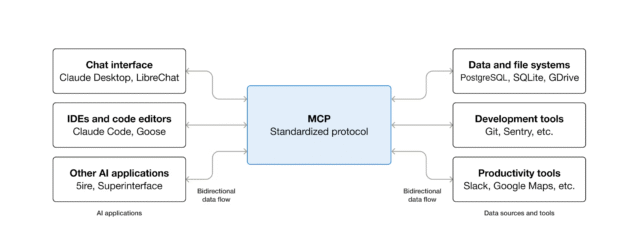
MCP is probably the most famous of the three, having been open-sourced by Anthropic a year ago. The goal of MCP is to connect AI agents to data sources in a standardized way—Anthropic (and now AAIF) is fond of calling MCP a “USB-C port for AI.” Instead of creating custom integrations for each individual database or cloud storage platform, MCP allows developers to quickly and easily connect to any MCP-compliant server.
Since its release, MCP has been widely used in the AI industry. Google announced at I/O 2025 that it is adding support for MCP to its dev tools, and several of its products have added MCP servers to make data more accessible to agents. OpenAI also adopted MCP just a few months after its release.
The increased use of MCP can help users customize their AI experience. For example, the new Pebble Index 01 ring uses a local LLM that can act on your voice notes, and it supports MCP for user customization.
Local AI models have to make some sacrifices compared to larger cloud-based models, but MCP can fill the functionality gap. “A lot of the work on productivity and content is completely doable,” Vinesh Sukumar, head of AI products at Qualcomm, told Ars. “With MCP, you have to join hands with multiple cloud service providers to accomplish any type of complex task.”
<a href