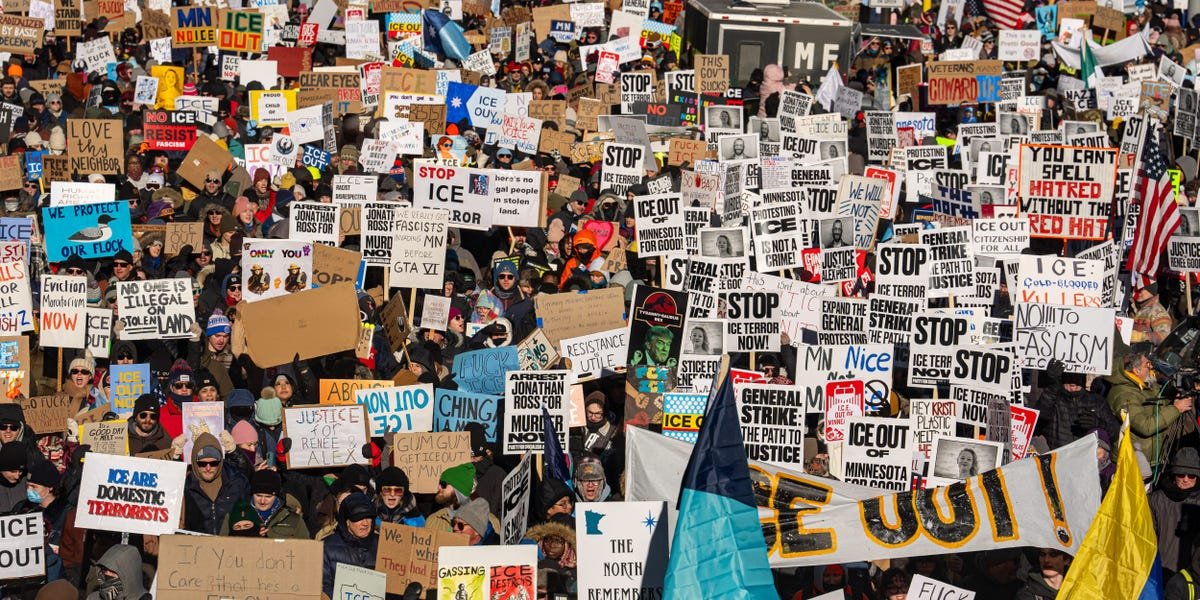
Economic boycott is a familiar tool of protest. The problem is that they often put the most pressure on the smallest businesses.
That was the case during Friday’s nationwide general strike, which was designed to pressure the Trump administration to roll back its aggressive anti-immigration policies.
For many small business owners, the shutdown created a dilemma. Supporting the cause often means losing a day’s revenue and jeopardizing their ability to keep employees employed. On social media, owners voiced apologies as well as solidarity for staying open.
However, according to Scott Galloway, a New York University marketing professor famous for criticizing Big Tech, there may be another way.
Rather than shutting down entirely, Galloway is calling on Americans to focus on major tech companies by unsubscribing or opting out of services like OpenAI’s ChatGPT, Amazon’s Prime Video and Microsoft Office.
He says a targeted boycott starting Sunday and lasting the entire month of February could impact the market, which in turn would impact CEOs who have the ear of President Donald Trump.
He wrote in a blog post announcing the boycott, “We are proposing something quieter and less cinematic than a protest that would go on all day on cable TV, but would be much more upsetting to the Trump administration. A one-day meltdown is disturbing. A month-long meltdown is horrifying.”
Prominent tech CEOs have sought the President’s support during his second term. For starters, many of them donated to his inauguration.
AI executives like OpenAI CEO Sam Altman and Meta CEO Mark Zuckerberg also accepted invitations to a White House dinner with Trump in September, where the leaders took turns praising the president. Apple CEO Tim Cook and Amazon CEO Andy Jassy attend the White House premiere of the documentary about first lady Melania Trump at the height of January’s anti-ICE protests in Minneapolis.
Supporting the AI industry in competition with China is a key pillar of Trump’s economic agenda.
“These are the leaders who have the ear,” Galloway writes. “The slightest deceleration in the growth of their companies could have a substantial impact on valuations priced to perfection. Small changes in consumer behavior – starting as early as the first of February – could have a big impact, extending all the way to the White House.”
anti-ice movement
Regular protests against the tactics of ICE and Border Patrol personnel have gripped the country for months. Thousands marched again in Minneapolis on Saturday. Tensions rose dramatically after the murders of Renee Good and Alex Pretty at the hands of federal immigration agents in Minneapolis in January.
In both cases, protesters recorded videos and posted them on social media for the world to see, leaving little room for the Trump administration to manipulate events in its favor.
While those videos and the subsequent protests — as well as the nationwide shutdown effort — have raised awareness, they have done little to lead to significant changes in the administration’s immigration policies so far.
The Department of Homeland Security last week demoted a key Border Patrol officer and promised more changes. However, at the same time, according to an internal memo seen by The New York Times, the acting director of ICE expanded the need to power agents to conduct warrantless searches.
Galloway writes, “Real change always comes from the American people, not from our political parties. But the establishment doesn’t fear protests so much as it fears an economic comeback.” “It’s important to get up off your couch, take to the streets, and build community, but the most radical act in a capitalist society is not to march, nor to spend.”
<a href