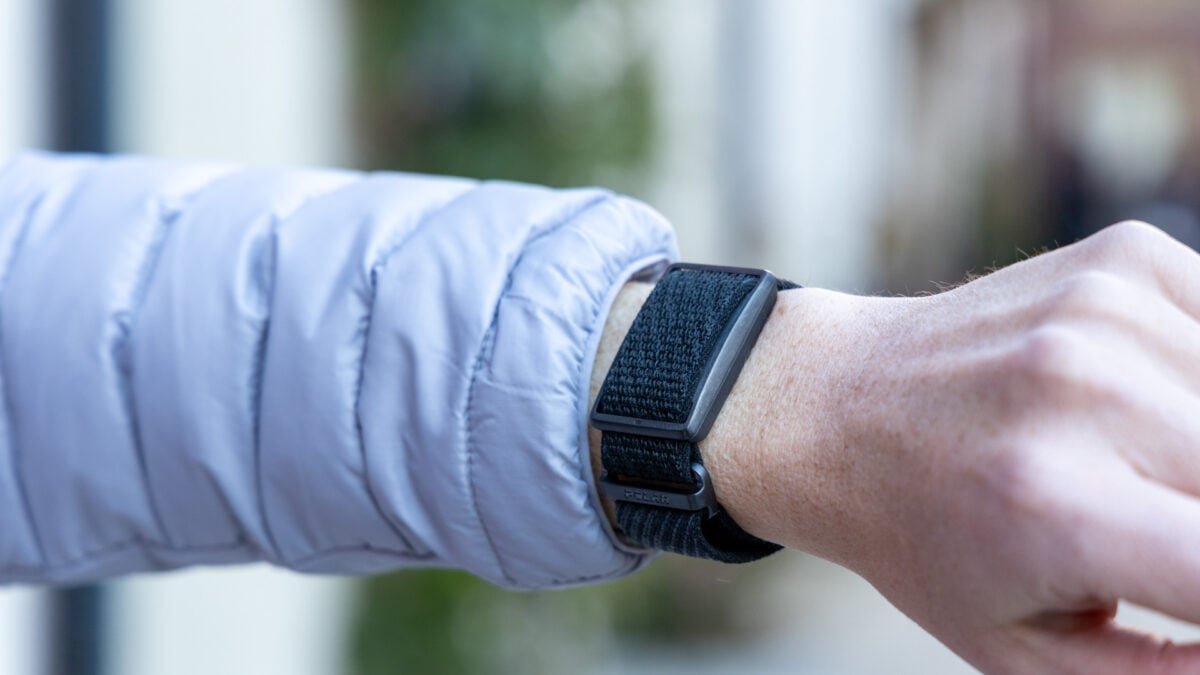

Screenless fitness trackers can sometimes feel like they’re not doing the job they set out to do. Of course, there’s no constant flow of data every time you turn your wrist. But in the absence of that quick glance, I find myself constantly opening a tracker’s companion app – just to check the data it’s collected. In the end, I find myself spending more time staring at those charts and figures than I would if I were repeatedly glancing at the little screen on my wrist.
So when I started testing the Polar Loop—a new screen-free wearable health and fitness band—I wasn’t that excited. After all, the new product from Polar (the company that introduced the first wireless heart rate monitor almost 50 years ago in 1977) looks almost like Whoop 5.0. In fact, the device, which was revealed in early September, has been dubbed a subscription-free competitor to Whoop. Polar Loop costs $199 and all of its features come with a free—again, free—app. Whoop, on the other hand, includes its bands in the subscription, but it starts at $199 per year and goes up from there.
polar loop
If you want freedom from all the distracting data that some health trackers provide, but still want to track your basic health, the Polar Loop could be a perfect companion.
- long battery life
- extremely comfortable
- no distracting display
- No annual subscription
- There may be too little data
- rudimentary app
- no gps in loop
If you expect to use your device for more than a year, the cost of the Whoop 5.0 really increases, while the cost of the Loop doesn’t increase at all. I spent a couple of weeks training with the Loop, and in the end, what attracted me to it was less about the cost (which, obviously, is still important when making decisions about buying a wearable) and more about what the Loop does. No Do: Dump a ton of health and fitness data on yourself.
If this sounds counterintuitive, that’s the point. If the goal of creating a screen-less fitness tracker is to let you spend less time looking at the thing, and more time living your life, the accompanying app should match the same tone. And there are almost no screenless wearables on the market today that do that. Here’s a more in-depth look.
The Goldilocks of fitness trackers?

Polar is a company for which monitoring our health is nothing new. In the late 1970s and early 1980s, the company introduced the first wireless heart rate monitor, the Sport Tester PE2000, which was initially designed for elite endurance athletes, especially cross-country skiers. The design – a chest-strap transmitter attached to a wrist receiver watch – allows real-time monitoring without wires, which was revolutionary at the time.
But a chest strap worn 24 hours a day can irritate any normal person. These days, almost all heart rate tracking systems on the market use an optical heart rate monitor, which works by shining light into the skin to detect changes in blood volume with each heart beat.
You can find out a lot from your heart rate, and most wearable devices today use heart rate to track everything from sleep to step counts to exercise and recovery. The Polar Loop is no different in this regard. The accompanying app, Polar Flow, provides a detailed picture of your last night’s sleep and also includes other basic metrics like step count and heart rate.

The step count and heart rate were consistent with what my Apple Watch was telling me (I often wore them both at the same time, though not always). Sleep tracking also seemed to match the Ora 4 Ceramic, which I was also testing at the time. Although it’s impossible to know for sure how accurate sleep trackers are, since I don’t know what time I fall asleep or stay awake throughout the night, they seem to be consistent with the times I go to bed and wake up. During a few test nights, my cat woke me up around 4 a.m. to eat food, and the Loop successfully tracked that wakeup and the fact that I fell asleep again.
One aspect of Loop’s sleep tracker that I particularly liked was that it actually asks every morning how restful I thought the previous night’s sleep was (with a range of emojis from sad faces to happy faces). Much of the science of sleep tracking is still a black box. Scientists do not yet know enough about the relationship between the time spent in different stages of sleep and a good night’s rest. So the basic question of how well rested you feel is still relevant. Although you can’t actually do anything with that data at this point, I found it useful to think about my night’s rest rather than just relying on the app to tell me I got a good night’s rest.

But the special thing about Loop is what it emphasizes and what it leaves out. Much of the Polar Flow app focuses on fitness training. When you open it, you’re automatically given a “cardio load status,” which essentially measures how fit you are. It estimates this based on the workout you’ve done (again, nothing like Polar’s own running watch or any other fitness watch like the Garmins or Corros of the world can do this).
The Polar Loop is excellent because of its simplicity. There were days when I could go out for a run with nothing but loops and forget about pace, time, and distance and just enjoy the run. This is something that most running watches and fitness trackers don’t really do. Technically, you could just set a running watch or your phone to a 30-minute timer, but having access to see your speed, distance, and heart rate with the twist of your wrist is very attractive to me (and most runners I know).

For me, all this sets the Polar Loop apart. Its non-existent screen with its small number of apps means that, if you want, you can actually passively monitor your health and not pay attention to it. Perhaps this will change soon as the app is still in its infancy and a major update is expected in the next year. But right now, Polar Loop is a perfect health companion for me: not too much information, but not too little either — and the ability to zone out during a race knowing you’re still tracking it is exactly what I want right now.
This begs the question: is there an ideal or perfect health or fitness tracker? Absolutely not. That would be like asking for the perfect pizza topping. Ideal is what fits all Yours Wants and needs at any given time, and we all prioritize different things when it comes to fitness and health tracking. One size doesn’t fit all, despite what a company called Fruit wants everyone to believe with its smartwatch.
Extremely comfortable with over a week of battery

Battery life on the Loop is pretty amazing. Polar says it lasts up to eight days on a single charge and can store data for up to four weeks without syncing.
Although I want to avoid simply comparing the Whoop 5.0 to the Loop, my one minor quibble with the Whoop 5.0 was that for whatever reason it was so uncomfortable on my small wrist. On the other hand, I found the Loop incredibly easy to put on, take off, and wear indefinitely until charged. For me, a device that’s intended to be worn all day for several days needs to be comfortable – and the Loop does the job. For statisticians: The tracker itself is 27 x 42 x 9 mm and comes with a fabric band (which comes in two sizes) and weighs 29 grams. The Loop also comes in three colors: Gray Sand, Night Black, and Brown Copper.
Is Loop a cheaper version of Whoop 5.0?
Aesthetically, both the Loop and Whoop 5.0 generally look and feel similar (though I would argue that the Loop is more comfortable for those with smaller wrists). At their core, they’re each screenless, passive health monitors. The main differences are their pricing and what they offer in their apps. Because Whoop requires a year-round subscription, it will be far more expensive than Loop, which is a one-time expense with a free app.
As far as what they both offer, they couldn’t be more different. Whoop is an omnichannel health tracker that’s attempting to cram as much health information into its app as possible and reports daily stress and recovery scores, focusing on optimizing your overall health — essentially becoming a health perfectionist. The Loop is almost like its laid-back cousin. It’s moving toward the same goal of improving health but with a more relaxed, casual approach. To go into specifics, they both provide heart rate, heart rate variability, sleep stages, and fitness training status. Apart from these, Whoop also provides advanced insights like body temperature, oxygen saturation and stress and recovery score, so that you get more tracked stats.

With all this in mind, Whoop is better suited for users who want to learn more deeply about their health and wellness, while Loop, at least in its current version, is more suitable for people who want to wear it and forget it and get more basic daily updates on their health, without additional insights or the need to get a perfect stress or recovery score.
Although I can’t see someone who is training for a specific fitness goal, like a marathon, using the Polar Loop as their sole device, I can see it being used in two ways: 1) as a sole device for someone who wants to passively track their everyday health and fitness without any specific goal in mind or 2) someone who uses a fitness watch for workouts and wants something else that fits their Tracks everyday health without requiring them to see or pay attention. However it is important to note that the Loop does not have an internal GPS. This means that the Loop estimates distance (and speed) based on internal sensors (accelerometer, wrist movement) rather than satellite data. On that note, the Polar Loop keeps pace with Polar’s fitness watches, which are arguably the most accurate at tracking heart rate, speed, and distance, though their tradeoff is that they’re not as sleek or compact as smartwatches like the Apple Watch Series 11 or Pixel Watch 4.
So whatever way you like to track your health, Polar Loop could be ideal to add to the mix.