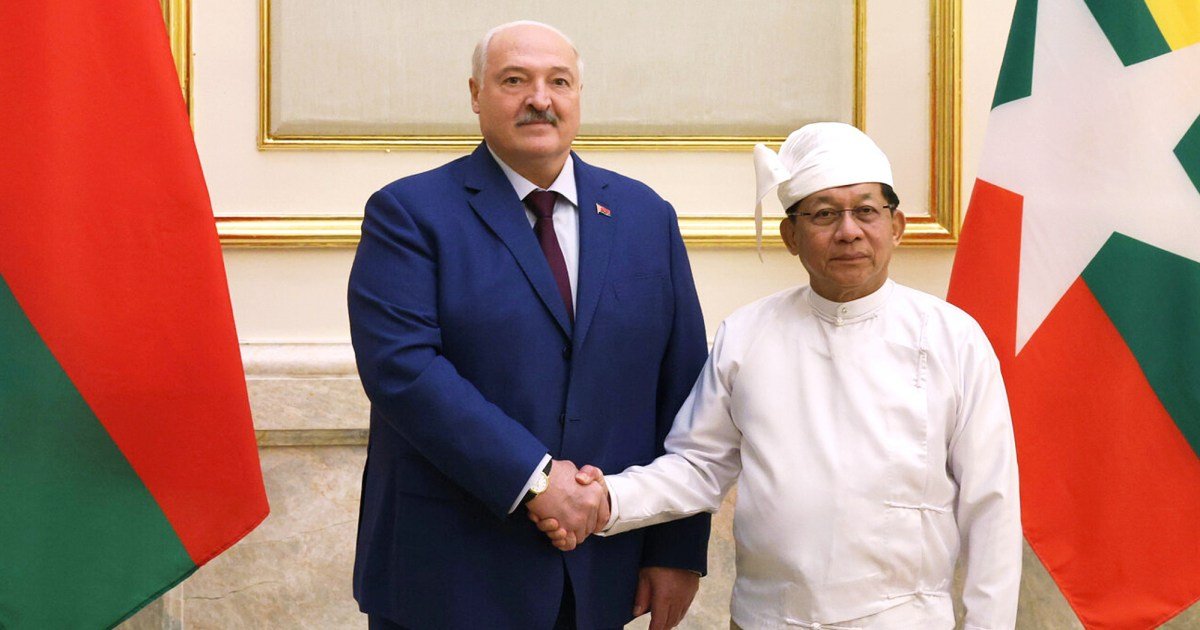
Alexander Lukashenko’s visit comes shortly before the military government is scheduled to hold national elections, which have been widely condemned as a sham.
Myanmar state media reported on Friday that the country’s self-appointed de facto leader, Senior General Min Aung Hlaing, met Lukashenko at the presidential palace in the capital Naypyidaw.
Recommended Stories
list of 3 itemsend of list
Military-run outlet The Global New Light of Myanmar reported, “The visit demonstrated Belarus’ goodwill and trust towards Myanmar and marked a historic occasion. It is the first time in 26 years of diplomatic relations that a Belarusian head of state has visited Myanmar.”
Lukashenko was greeted with full state honors and cultural artists by senior figures in Myanmar’s military government, including Prime Minister Nyo Saw, upon his arrival at a military airport in Naypyidaw on Thursday night.
Lukashenko is only the second foreign leader to visit Myanmar, after former Cambodian Prime Minister Hun Sen, since its military ousted the democratically elected National League for Democracy (NLD) government of Aung San Suu Kyi in a coup on February 1, 2021.
The Belarusian leader’s visit also comes just a month before the military hosts national elections, which many domestic and international observers have condemned as a sham. His visit is widely seen as a show of support for elections scheduled for the end of December, and what the military government sees as a return to normalcy.
Following Lukashenko’s meeting with Min Aung Hlaing on Friday, The Global New Light also confirmed that Belarus plans to “send an observation team to Myanmar” to monitor the elections.
A day after the Myanmar-Belarus Development Cooperation Roadmap 2026-2028 was signed in Yangon, the leaders also agreed that “cooperation will also be strengthened in military technologies and trade”.
Belarusian state media quoted Foreign Minister Maxim Ryazhenkov as saying that Myanmar had “significant capabilities in various industrial sectors”, while Belarus had “expertise and modern technologies in mechanical engineering”.
“Myanmar plans to mechanize its agriculture, and we produce a whole range of machinery and equipment in Belarus. As our president says, no topic is off limits for our cooperation,” Ryazhenkov said.
The government of Belarus is widely considered authoritarian, with Lukashenko serving as the former Soviet state’s first and only president since the establishment of the office in 1994.
Along with key backers China and Russia, Belarus is one of the very few countries that has continued talks with Myanmar’s military leaders since the coup.
A popular protest movement soon after the coup erupted into a years-long civil war, further weakening the Myanmar military’s control over the fractured country, where ethnic armed groups have fought for independence for decades.
In preparation for the elections, military government census takers in late 2024 were able to count the population in only 145 of Myanmar’s 330 townships – indicating that the military now controls less than half of the country.
Other recent estimates put the army in control of less than 21 percent of the country’s territory. Ethnic armed groups and the anti-regime People’s Defense Forces – who have vowed to boycott and violently disrupt upcoming elections – control almost twice the amount of territory.
Amid geographical limitations and rampant violence, as well as the Myanmar military’s plans to disband Aung San Suu Kyi’s hugely popular NLD in March 2023, critics have pointed to the absurdity of holding elections under such circumstances.
Preparing for the elections, military leaders on Thursday issued a mass pardon, pardoning or dropping charges against 8,665 people imprisoned for opposing military rule.
<a href