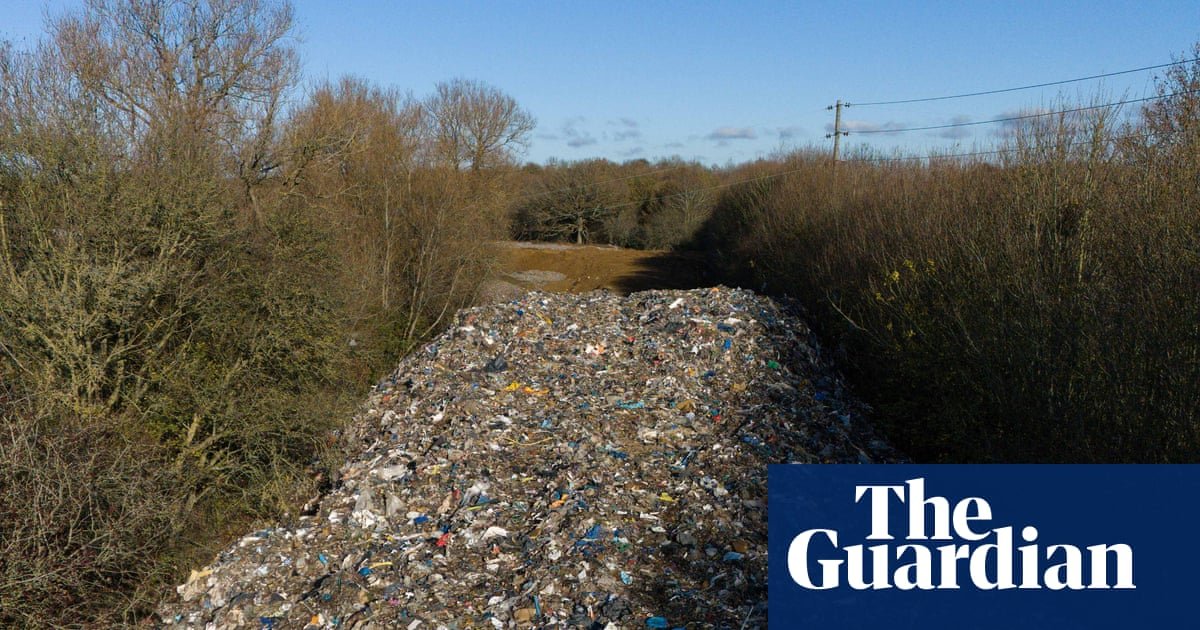
Research has shown that there are estimated to be at least 8,000 illegal landfill sites in the UK, containing approximately 13 million tonnes of waste.
The scale of criminal dumping means at least £1.63 billion has been avoided in landfill taxes, according to analysis of data from satellite company Air & Space Evidence shared with the Guardian and Watershed Investigation.
“The big concern is that as well as avoiding landfill tax, they are also avoiding the rules that control what can go into landfill and ensure that people and the environment are safe,” said Professor Kate Spencer, a landfill expert at Queen Mary University of London.
“There is nothing to stop any pollutants from being discharged into nearby rivers or soil. We also know that illegal waste disposal can cause a major concern for local communities in terms of odour, eyesore and litter.
“We have illegal waste sites in Essex which regularly catch fire with the potential to harm local air quality and human health.”
The high estimated number of illegal sites shows that authorities are barely scratching the surface of the crisis. In the year 2024–2025, the Environment Agency (EA) closed 743 illegal waste sites in England and the agency’s waste investigation data showed 1,143 ongoing cases of illegal dumps.
Yet Air & Space Evidence said EA had no interest in using its intelligence tools, which could help inform law enforcement where to look for illegal waste sites.
“When we talked to the Environment Agency there was a lot of interest at a technical level, but no interest at a management level,” said Ray Harris, a company director and emeritus professor of geography at University College London.
“From the outside, it seems like a fear of finding out. If the Environment Agency finds more illegal waste sites they feel they have to do something about them. So, they don’t want to know.”
Air & Space Evidence says its detection tool has been tested by authorities in New Zealand, where law enforcement has confirmed waste at all 125 suspected landfill sites, 58% of which were previously unknown to them.
The estimated number of sites in the UK was calculated by examining detailed satellite images of areas including London, Brussels and Bucharest – as well as parts of New Zealand – and was used to model the average number of sites across the country.
The figure of 8,000 sites is at the lower end of the estimate; Researchers found that their number could be up to 13,000.
In October, a House of Lords report highlighted widespread failings within the EA, including the poor performance of its joint unit for waste crime and limited police involvement in addressing “new narcotics”.
Lady Sheehan, chair of the Lords Environment and Climate Change Committee, said in her report, “Despite the scale and seriousness of the crimes raised by members of the public in many cases, we found numerous failings by the Environment Agency and other agencies, from a slow response to repeated public reports (such as in the case of Hodes Wood, Kent) to a stark lack of successful convictions.”
Offenders dumped 35,000 tonnes of rubbish in Hodes Wood, burdening taxpayers with £15m of clean-up costs, and several hundred tonnes of household and commercial waste is estimated to have accumulated at the Kidlington site, in Oxfordshire. According to the committee, there are six sites of similar or larger size, which they say point to a “fundamentally broken system.”
EA Waste Crime data shows ongoing cases have been open for an average of four years. There are 13 cases that have been open for 11 years, some of which involve the burning of hundreds of tons of asbestos.
After newsletter promotion
“Without regulation it will get even worse,” Spencer said. “I suspect there are legal mechanisms in place to regulate this, but it depends on resources and identifying who is responsible.
“We have a system to make polluters pay, but if you can’t find the culprit, who pays to clean up these sites?”
The scale of the problem, lost revenue, and cleanup costs have led some to question the overall benefits of a landfill tax.
“The landfill tax is significant and it is leading to these loopholes,” said Paul Brindley, a senior lecturer at the University of Sheffield. He said tax revenues have been falling over the past decade.
“The cleanup costs far exceed the money we get from the landfill tax and we’re losing all these unknown sites. Is the landfill tax counterproductive and creating an environmental disaster that will get even worse?” He said.
A spokesperson for the Environment Agency said: “Illegal waste dumping is appalling, and we work tirelessly to protect the environment and communities from it.
“Investigations can be multi-layered and complex as we seek to bring rogue operators – often from the criminal underworld – to justice.
“Last year alone our dedicated teams successfully stopped activity at 743 illegal waste sites, and we are doubling the number of staff in our joint waste crime unit to help crack down on these pathetic crimes.”
Shlomo Doven, of the UK Without Incineration Network, said: “These illegal waste sites are well known to local people.
“They often warn councils and the Environment Agency and when no action is taken they stop reporting it, because they lose confidence in the system and give up hope that the EA is able to protect them and the environment.”
<a href