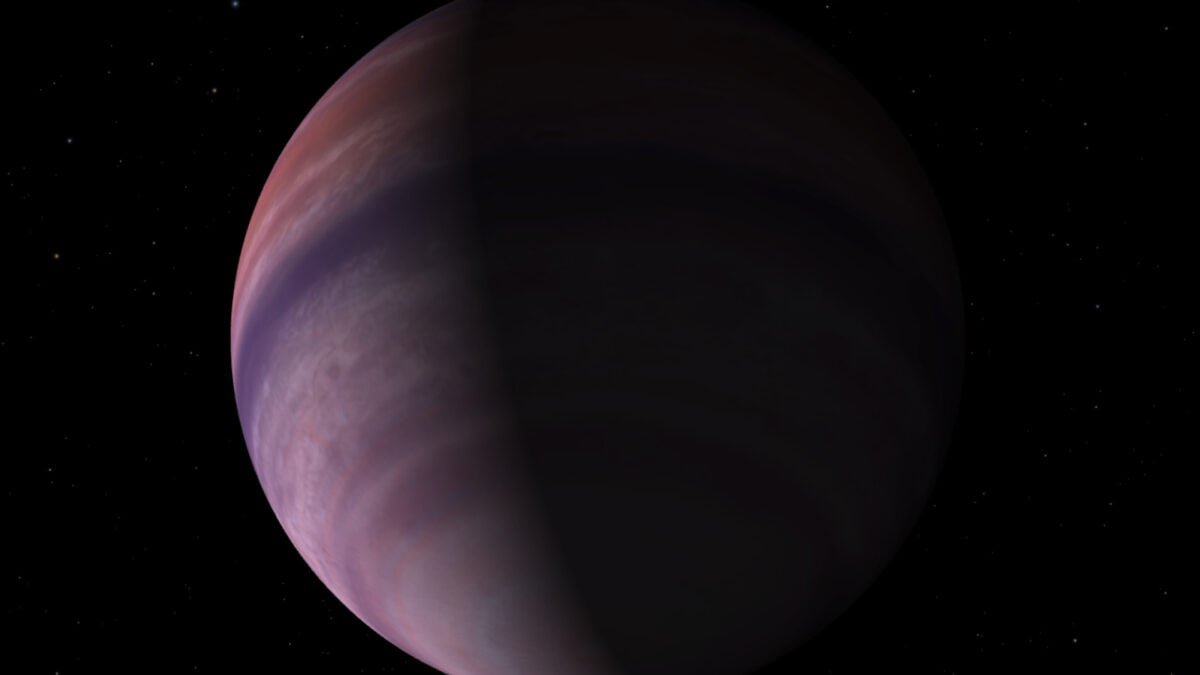

An upcoming Astronomy & Astrophysics paper describes how astronomers designed and used a new, alternative approach to exomoon detection that successfully discovered a promising exomoon candidate in the orbit of the Jupiter-like exoplanet HD 206893 b, located about 133 light-years from Earth. Specifically, the team reused high-precision astrometry – a mathematical approach to mapping stellar distances – to carefully evaluate any and all signals near the exoplanet.
The object appears to be about 0.4 Jupiter masses, which is more than seven Neptune masses, and still much smaller than HD 206893 b at 28 Jupiter masses. So this is an absolutely massive exomoon orbiting an absolutely massive exoplanet. Well, if true. As the researchers themselves acknowledge, the purported exomoon will now face scrutiny from the broader astronomical community. Nevertheless, they argue that the observation cements astrometry as a promising tool for future exomoon searches. The paper is currently available as a preprint.
We didn’t find any exomoons?
Given the tremendous success of our ongoing exoplanetary searches, it is strange that we have not found any exomoons yet. So why aren’t the tried-and-true strategies that work for exoplanets working for their orbiting companions? Indeed, there has been much discovery of exomoon candidates in the last few years.
The reality is not so simple, he said. To take exoplanets as an example, all “discoveries” go through a rigorous process of checking and double-checking for mistakes, such as, but not limited to, asteroid sightings, tricks of the light, duplicate findings, etc. In fact, NASA acknowledged that approximately 8,000 exoplanet candidates are currently awaiting confirmation from the astronomy community.
Exomoon discovery faces similar challenges. There’s also the fact that, on a cosmological scale, exoplanets are already considered extremely small. If our solar system is any guide, moons are small compared to their host planets, which means exomoons should be even smaller – and therefore difficult to detect.
“In addition, there is no definition of what an exomoon is, and some ambiguity remains as to whether it might include, for example, binary planets,” the study explains, adding, “The lack of detection stands in stark contrast with the ubiquity of moons in our Solar System.”
small thing, big problem
The new model attempts to address some of these challenges by combining different, existing approaches to exomoon detection. By directly measuring the spatial fluctuations of the host planet, astronomers should be able to calculate the effect of the gravitational pull of the orbiting moon. According to the paper, this will give researchers more flexibility in evaluating the possibility of the presence of exomoons around exoplanets.
To test their model, the team monitored the astronomical position of exoplanet HD 206893 b using the gravity instrument on the Very Large Telescope in Chile. They observed the fluctuating difference between the motion of the exoplanet and the signal of a nearby secondary, possibly an exomoon candidate. Furthermore, astrometric techniques allowed researchers to calculate the size and orbit of this candidate.
Although the team believes the new exomoon signal is promising, they “emphasize the tentative nature of this candidate, which requires further confirmation using gravity data,” the paper states. But more importantly, this experiment demonstrates the effectiveness of high-precision astrometry, and current and next-generation instruments “will usher in a new era of comparative exolunar science,” he said.
Indeed, as the researchers note, the new method is intended to complement existing methods. If so, the new study would be another example of multi-messenger astronomy – an observational approach that uses multiple methods to study a single signal. Even if this particular sign turns out to be useless, the proposal should definitely be the start of something good. Astronomers are getting closer to confirming the first known exomoon. And in fact, they may already be there.
<a href