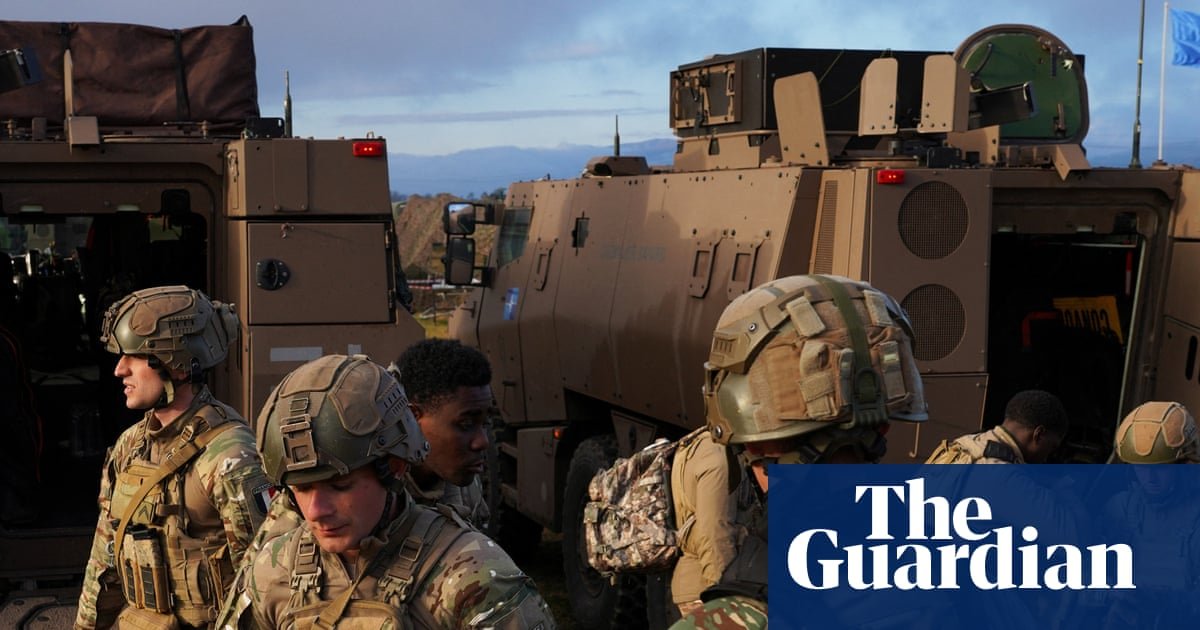
France will this week become the latest EU country to plan to expand its military, with Emmanuel Macron expected to announce on Thursday that military service will be reinstated – albeit on a voluntary basis – nearly 30 years after the end of conscription.
Faced with uncertainty over the Russian military threat and America’s commitment to defending its transatlantic allies, Europe has been moving at the fastest pace since the Cold War to radically reduce its defense industry and its deployment capability.
Despite significant losses in the war on Ukraine, Russia is perceived by European armies as a potential direct threat within two to five years. Meanwhile, Washington has made it clear that it expects its EU allies to take greater care of their own defense.
But if the issue of investment in the defense industry is primarily economic, the question of significantly expanding the number of full-time armed service members is also very social – and causing heated debate in many countries.
Fabien Mandon, France’s top general and chief of staff of the armed forces, sparked a media and political uproar last week by saying the country should be prepared “to lose its children” because Russia is “preparing a confrontation with our countries by 2030”.
The think tank wrote in a recent report: “Most European armies struggle to meet their recruitment targets and retain trained personnel, as well as generate adequate reserves.”
Sophia Besch, a defense expert at the Carnegie Endowment for International Peace, said that “the growing shortage of military personnel” is forcing more and more Western European countries to explore different types of recruitment models.
“There will also be a need to accelerate the training cycle for reservists, which some countries need to reactivate in large numbers,” Besch said. “For countries without a tradition of military preparedness, all of this is a politically and socially sensitive challenge.”
Many EU countries have some form of conscription, led by the Nordics and Baltics, where “total defence” underpins military thinking and the scope of draft intake is increasing. Finland has one of the world’s largest reserves based on universal male recruitment.
Sweden reintroduced selective recruitment in 2018 – with mandatory registration for men and women, but a strict selection process that takes into account a number of factors, including physical fitness and the youth’s “willingness to serve”.
Denmark’s conscription system was extended to women and in June it was extended from four to 11 months. Estonia has universal male conscription, while Latvia and Lithuania, like Denmark, choose conscription by lottery if there are not enough volunteers.
Elsewhere, Croatia, which abolished compulsory military service 18 years ago, recently reinstated conscription, while Poland is working on a plan to create mass military training for every adult male in an effort to double the size of its army.
While recent polls have shown that majorities in several European countries, including Germany, France and Poland, support some form of compulsory military service, other countries have so far distanced themselves from conscription.
Germany’s government decided against a system of compulsory military service this month after a bitter debate, opting instead for a voluntary model – but if it fails to find the numbers, it will reconsider a mandatory nationwide call-up.
France’s proposed plan is unlikely to reintroduce compulsory military service, which was abolished in 1997. Many countries provide military service volunteers with perks such as cash bonuses, preferential access to public sector jobs and higher education places.
Army leaders generally say that volunteers are more professional and motivated than conscripts, but volunteer armies are expensive. Constables not only make up the number of active service personnel, but also provide a large pool of potential reserves.
However, compulsory military service is not a panacea and may even be counterproductive. Besch argued, “In countries where there is domestic resistance, conscription may also weaken public resolve to strengthen national security.”
“Most successful European recruitment models now rely on a strong degree of voluntariness – but it takes time to generate willingness to serve in a population that does not have a recent history of military service and constant domestic debate.”
<a href