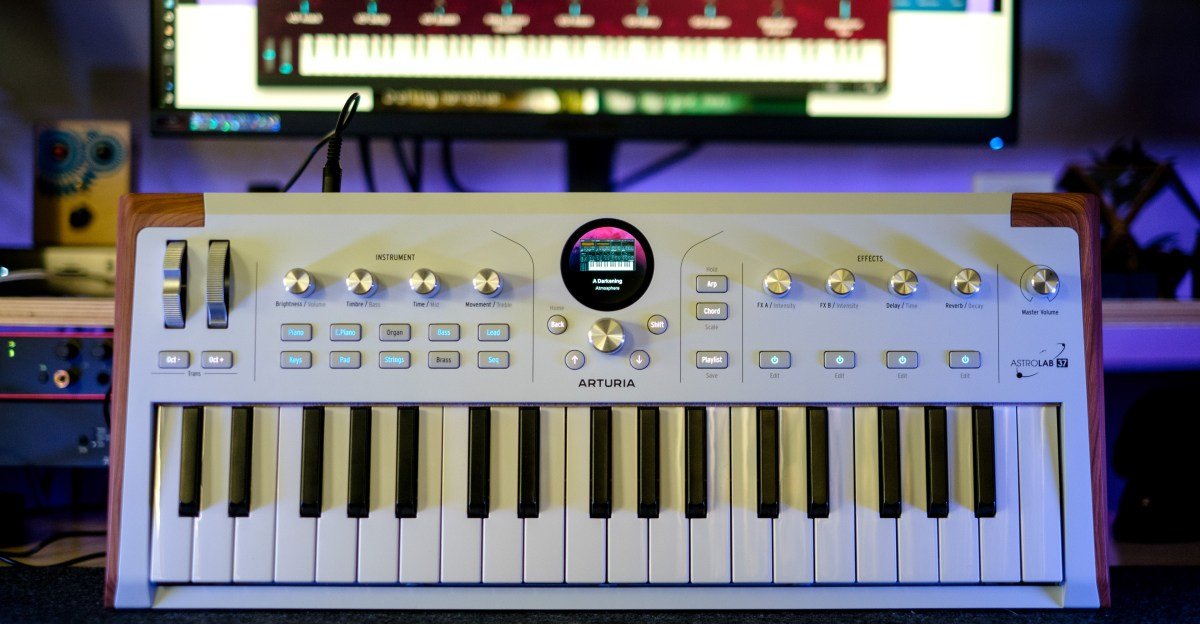
Last year, Arturia launched its first stage keyboard, the Astrolabe. Unlike synthesizers, stage keyboards are more focused on delivering performance-ready presets than on sound design. They are geared towards touring and performing musicians who need access to a wide variety of sounds with minimal noise, rather than bedroom tinkerers. But, whereas the first entries in the series were larger and expensive – $2,999 for the 88-key model, and $1,999 for the 61-key model – the Astrolab 37 offers similar sonic performance in a smaller, more affordable package. It is a portable 37-slimkey device that costs only $699.
What makes the Astrolab range different from most of its competition is that it is essentially Arturia’s AnalogLab classic synth emulation in hardware form. Arturia’s synth plugins are incredibly popular, and with good reason – they’re excellent. But until last year, they were limited to your computer. AstroLab gives you access to most (though not all) of them in a standalone tool, albeit in a different form.
Arturia’s V Collection gives you deep editing tools and rich recreations of synths like the Yamaha CS-80 and Fairlight CMI that are basically unrepeatable. (And, even if you do manage to track one down, they’ll cost you thousands of dollars.) AnalogLab, and by extension AstroLab, are like preset browsers, a greatest hits collection of sounds taken from the much more expensive V Collection suite.

In the case of the Astrolabe 37, it comes preloaded with over 1,800 presets, including 44 instruments ranging from acoustic piano to analog classics like the Minimoog, to ’80s digital lo-fi machines like the Ensonic SQ-80. Most of the synths are excellent. Rhodes emulation is my favorite (and there are plenty of options), and having access to Arturia’s Pigment (my favorite software synth) in hardware form is awesome. Only the organ and acoustic piano are a bit disappointing. They’re not bad by any means, but I think if these are your priority, you might be better served by the Nord.
You can load it with additional sounds using AnalogLab Desktop software over USB or AstroLab Connect Mobile over Wi-Fi. However, the first is ideal, as wireless connectivity is quite unstable. You should be able to connect to your Wi-Fi network, but I could never get it to work. Connecting directly to Astrolabe using its own hotspot was more reliable, but it also had a tendency to disconnect after a while.
Navigating a library with this depth can be overwhelming. Arturia makes things easier by allowing you to filter by sound type (bass, lead, etc.), instrument, favorite, or sound bank. There are also Songs, which group presets together for quick, one-button access, and Playlists, which allow you to group songs together to easily move through your setlist. This is definitely useful for live performances.
The preset has four macros that you can control with the knob on the left, and what they control may change depending on the patch. On the right side are four knobs for dialing in effects like chorus, reverb and delay. This gives you at least some control over the sound, but there’s no way to create patches from scratch and do serious sound design. Instead, you’ll have to pay for the V Collection, which starts at $199, and upload your own custom presets. It is not unusual for a stage piano to have a minimum of practical controls, but the Astrolabe is particularly rare given the depth of its sound engines.

Sonically, you’re not losing anything by downsizing the Astrolabe 37 from the larger versions; All the differences are in the hardware. The faceplate is plastic, but not cheap-feeling, and retains the beautiful wooden cheeks of the larger 37 models. While the 88- and 61-key models have a large navigation wheel with a color screen, the 37 has a small separate encoder below the screen. It’s also missing a locking power cord, which can be a problem if you’re a particularly active artist.
The biggest tradeoff, however, is in the keyboard. The Astrolabe 61 has a semi-weighted keyboard, and the 88 has a hammer-action fatter keybed. The latter, in particular, which sounds very similar to a real piano, is fantastic if you’re accustomed to the cheap, springy synth-action keybeds of most affordable synth and MIDI keyboards. The Astrolabe 37 features a synth-action keybed with mini keys and aftertouch. It’s not bad, it’s probably the same keybed found on Arturia’s recent KeyStep MK2 controller, but it definitely lacks the premium feel of its bigger siblings.
On such a small keyboard, some of the Astrolabe’s features, such as the ability to split the keyboard in two with the bass on the lower keys and the lead tone on the higher keys, make no sense. Most serious keyboard players, especially professional players, want something larger. But musicians who want to cram as many sounds into as little space as possible without having to worry about OS updates causing their laptop to shut down in the middle of a set may find a lot to like in the new Astrolabe 37.
<a href