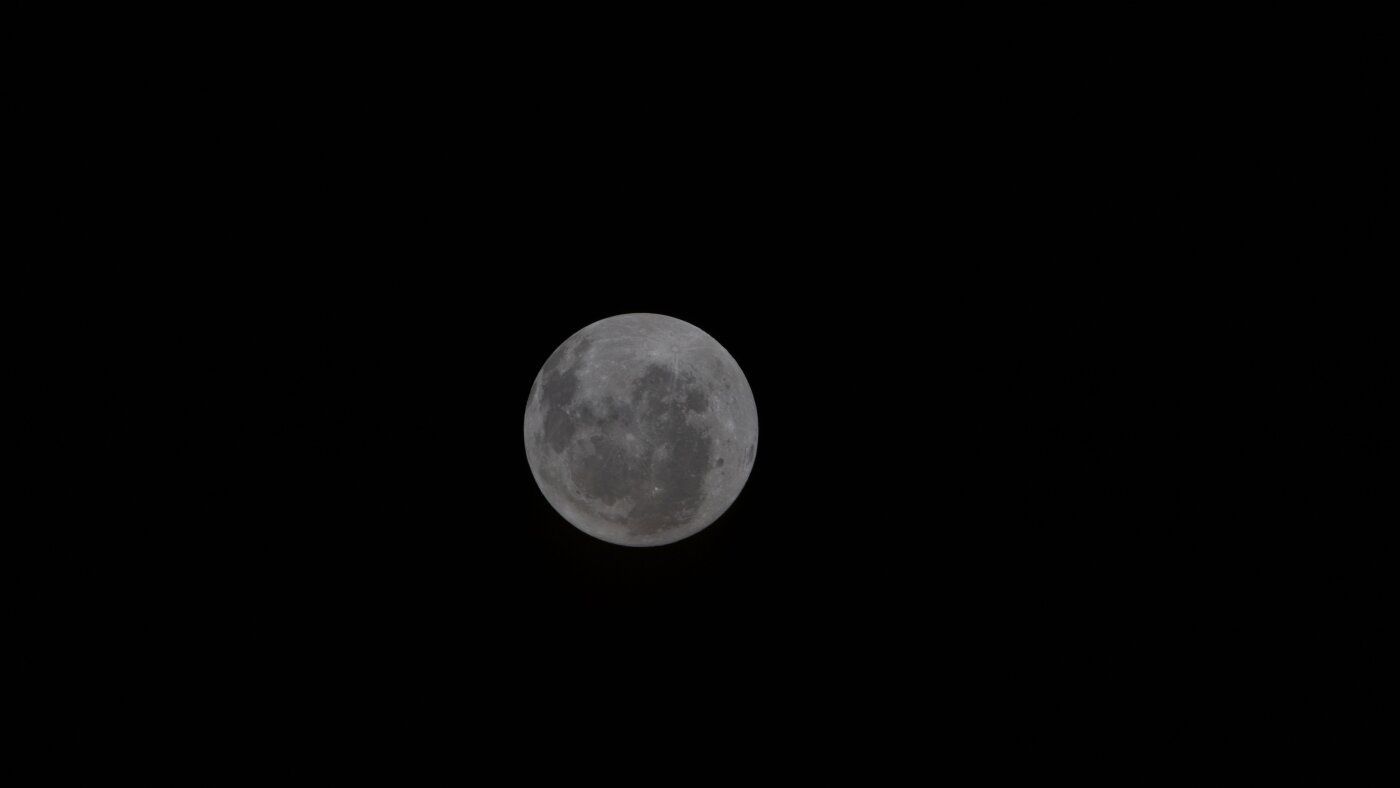

In this handout image provided by NASA, a view of the Moon taken by an Artemis II crew member through the window of the Orion spacecraft on Friday, the third day of the mission.
NASA/Getty Images
hide caption
toggle caption
NASA/Getty Images
The four-member crew of NASA’s Artemis II mission on Monday is looking at parts of the moon that human eyes have never seen before.
The agency’s Orion space capsule launched last week atop an SLS rocket from Kennedy Space Center and sent humans on a mission to the Moon for the first time in more than 50 years.
Monday’s lunar flight – when astronauts circle the moon – will mark the farthest humans have ever traveled in space. At 1:57 p.m. Monday, the astronauts passed the Apollo 13 mission’s distance record of 248,655 miles. According to NASA, the flyby, during which the crew will look out windows and make live observations, will be about seven hours long.
Astronauts will also have the unique opportunity to watch the solar eclipse disappear behind the Moon from the opposite vantage point.
While NASA has photos of the Moon from satellites like the Lunar Reconnaissance Orbiter, a planetary scientist at the agency explained in news conferences over the weekend why the human eye and human observations are important to lunar understanding.

“I know the data we get back will inspire the next generation of scientists and explorers,” Artemis II lunar science lead Kelsey Young, who wore earrings depicting the eclipse, told reporters Sunday. “But it will also bring the moon closer and unite us all.”
Purpose and nuances of color
On Monday morning, three NASA astronauts Reed Wiseman, Victor Glover and Christina Koch, along with Canadian Space Agency astronaut Jeremy Hansen, woke up just 18,830 miles from the moon, listening to “Good Morning” by Mandissa and TobyMac.

The Artemis II crew captured another photo of the moon on Monday as it got closer to the Orion spacecraft’s window.
NASA
hide caption
toggle caption
NASA
During the flight, the crew will have a specific vantage point of the Moon as a full disk. At any given point, about half of the moon is illuminated, Young said, but at closest approach during the mission, the far side of the moon will be about 21% illuminated.
Artemis II has 10 science objectives for the flyby. One is to observe color variations on the moon’s surface.
Young said, “The human eye, especially when it is connected to a well-trained brain, which I assure you these four people have, is capable of making subtle color observations in the blink of an eye.”
Young said the astronauts will uncover “subtle color nuances” during the flight, especially their unprecedented views of the far side of the moon.
Young used the analogy of a sandbox: On the beach, the sand is not perfectly flat. It has texture and grains of different particle sizes. Using a flashlight, Young described two angles of view of the sandbox.

By shining a light directly over the sandbox, “you’ll see shades of color and albedo (reflectance) on that surface.” But by using the same flashlight and moving it to the edge of the sandbox, “you’ll lose all the nuances of color, but you’ll see topography and morphology,” she said.
Applying this analogy to a flyby, while the Sun – the light source – will not move, the spacecraft will. As a result, Young said, astronauts will be able to see the same spot more than once from different angles of illumination.
“We understand what (the Moon) is made of. We understand the topography, but we don’t know what the crew is going to see in these specific lighting conditions from a scientific standpoint,” Young said. “And that’s exciting.”
The crew will fly past two previous human landing sites — Apollo 12 and 14 — and get a brief glimpse of the moon’s south pole, where NASA said humans could land as early as 2028.
Real-time overview and 3D effects
NASA scientists have identified about 35 geological features for the crew to inspect. During the flight, Young said, the astronauts will provide details in real time a few times per hour. The public can listen to the comments on the livestream.
Young said Wiseman, a NASA astronaut and mission commander, said over the weekend that he could “see a lot more topography” than visualizations around the moon’s Tycho crater.
“He’s seeing the 3D effect start to be realized,” Young said. “When they get even closer and they have extreme flyby profiles over several hours, they’re really able to tease out that dynamic between topography, surface texture, morphology and color and albedo and how and whether those things overlap.”

Artemis II controllers monitor the progress of the Orion spacecraft in the White Flight Control Room at the Johnson Space Center in Houston on Friday.
Ronaldo Schmidt/AFP via Getty Images
hide caption
toggle caption
Ronaldo Schmidt/AFP via Getty Images
The public heard some live commentary from Wiseman about the moon on the NASA Solar System Post at around 3 a.m. Sunday morning.
“You know I’m not one to exaggerate, but it’s the only thing I can think of. Looking at Tycho, there are mountains to the north, you can see Copernicus, Rainer Gamma. It’s everything from training but in three dimensions and absolutely incredible,” Wiseman said. “Spectacular.”
Mission Control laughingly responded: “Copy, Moon Joy.”
distance from the moon
While Apollo 13 traveled very close to the Moon and several crewed Apollo missions actually landed on it, the closest Orion will come to the Moon’s surface is 4,070 miles. But Young said Artemis II’s distance is actually an asset for its scientific purposes, because it will allow astronauts to get a full view of the moon with different illumination changes.
During the Apollo missions, geologists trained astronauts to look for certain features on the Moon. Since this flyby will be at a higher altitude than those missions, it will allow the astronauts to assess what they are seeing on a different scale.
But will there still be cameras there?
Yes.
The spacecraft will be equipped with two Nikon D5s and a Nikon Z9, and Young said the agency will downlink as many photos as possible after the flight. She expects thousands.
“We’ll get some things out to the public as quickly as possible,” Young said.
<a href