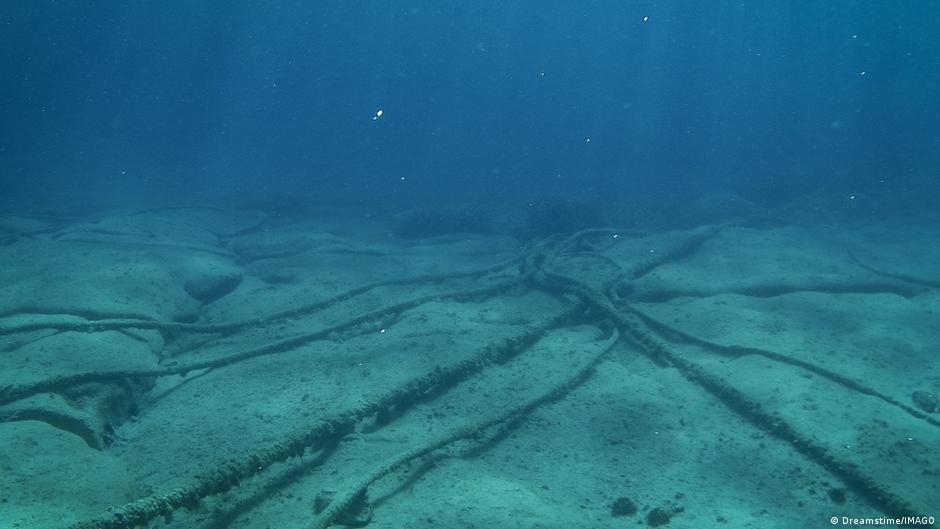
A 2021 report by Total Telecom put their number at around 500, with a total length of about 1.3 million kilometers (808,000 mi). The numbers have only increased since then.
“All global data exchange flows through these cables,” said Johannes Peters, head of the Center for Maritime Strategy and Security. At the Christian Albrechts University in Kiel.
“The Internet, payment orders, any type of information you can think of, any type of verbal communication, it moves almost exclusively through these cables,” Peters told DW. “Globally, we depend on them.”
But these communication networks are being seen as targets of potential sabotage.
The threat has become clear from a series of ongoing incidents in the Baltic Sea. A study from the University of Washington in Seattle found that about 1 in 10 cables are likely to break since 2022, with seven of those cut between November 2024 and January 2025, with additional incidents recorded this summer.
Based on recorded ship movements or anchor trails, Russia was repeatedly named as the likely culprit. But Moscow’s responsibility has not been proven beyond all doubt, and the same applies to claims that the damage was intentionally caused. It is also possible that the cables may have been damaged accidentally or due to carelessness.
China is also suspected of damaging some data cables near the Baltic Sea and Taiwan. Last November, Sweden urged China to participate in an investigation related to a similar incident.
Are problems arising in the Pacific region?
Asian countries are also vulnerable to undersea cable damage. US allies Japan and South Korea, as well as Taiwan – a self-ruled island that Beijing views as Chinese territory – are connected to the US through cables passing under the Pacific Ocean. Their leaders fear that in case of conflict with China, these underwater cables could be targeted.
According to a report by the Center for Strategic and International Studies (CSIS) In Washington, China has already developed a ship that can cut cables located as deep as 4,000 meters (more than 13,100 feet) below the surface.
American officials are also issuing similar warnings. The US-China Economic and Security Review Commission, which was tasked with briefing the US Congress, recently reported that China “has become increasingly involved in undersea cable-cutting activities as a gray zone pressure tactic, and there is growing evidence that Beijing is developing new cable-cutting technologies for potential wartime use.”
What happens if cables are damaged?
Severing intercontinental data cables would have huge consequences, according to Kenny Huang, head of the Asia Pacific Information Center (APIC), which serves as the Internet address registry for the Asia-Pacific region.
If the main cable is damaged, “You lose complete internet connectivity,he told DW.
“If you lose Internet connectivity, it means you lose everything,” he said.
An affected area will not even be able to use its own internal networks, effectively turning it into an information void. In the case of Taiwan, the island would be “blinded,” with effects that would extend beyond communications to education, the economy, agriculture, and many other areas.
Other countries in the region may face similar issues in the event of an underwater attack. And even if the cables are not cut or damaged, they can be used to tap into intercontinental information networks.
“Rival states could exploit these vulnerabilities to gather intelligence or create strategic advantages in maritime security conflicts.” Global Defense InsightAn online magazine warned in a report dated February 2025.
The Baltic Sea as a mixed battlefield
From a technical point of view, destroying underwater cables is not very difficult, said Johannes Peters of Kiel University.
“It is enough to drag some kind of anchor on the seabed, which will then pull the cable and eventually break it. You don’t need a particularly high-performance ship,” he told DW.
“China will be watching very carefully how the West responds to attacks on undersea cables. It will try to identify the resulting problems for Western countries – not only technical but also legal, arising from international maritime law. In this respect, the Baltic Sea is a kind of proving ground for maritime warfare right now, which is naturally being watched from other parts of the world.”
Can cables be secured?
This is one reason why cables need greater legal protection, Kenny Huang said, including higher penalties for intentionally cutting communications links.
Also, according to the official, some technical steps can also be taken, for example, once a cable is damaged, data traffic can be rerouted over a different cable or to a different provider. A multi-tier backup plan can make a difference.
At the same time, he warned that, in the event of a military attack on the undersea cable, “No actor is capable of defending that kind of attack.”
This is why countries in the region are increasingly focusing on prevention measures. Japan and its allies intend to eliminate Chinese companies from undersea cable projects if American investors and companies are already taking part, CSIS reports. Furthermore, Japan is now spreading its cables over a larger area, so a single attack is not a threat to the entire system.
States can also limit naval traffic in certain areas and issue special permits for vessels passing near the cable, Peters said.
“Even cables can be partially protected by using appropriate sensors,” he said.
This article was originally published in German
<a href