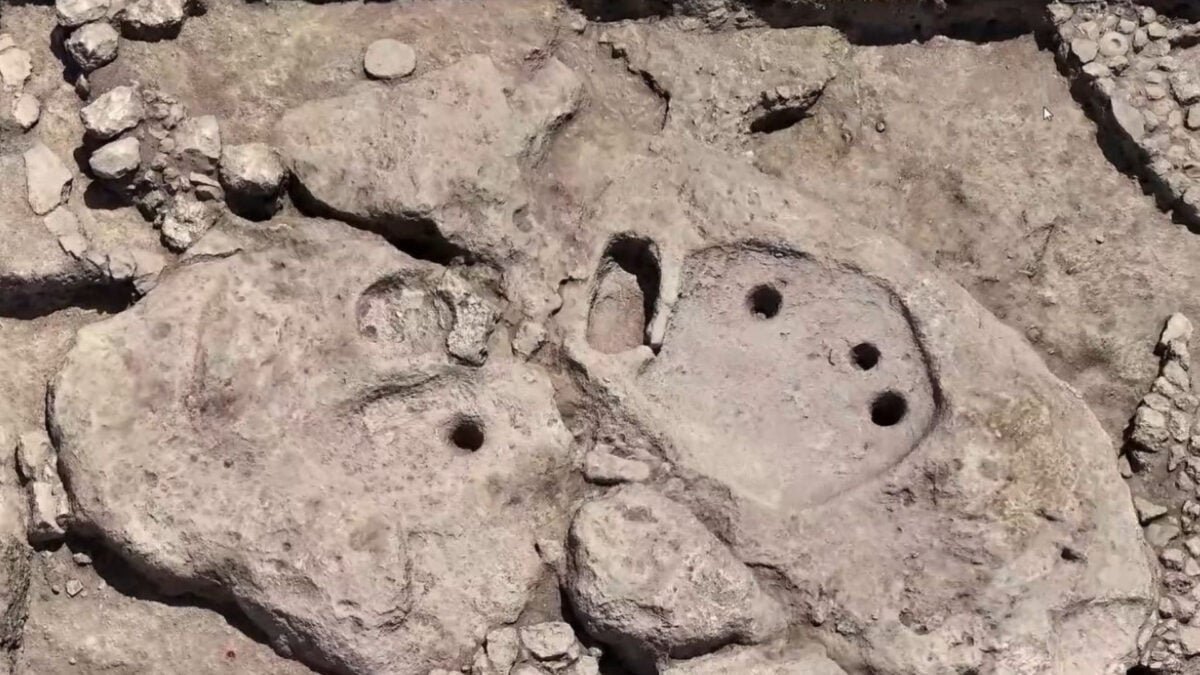
Archaeologists in Israel have unearthed extraordinary artefacts, including a 5,000-year-old winepress and a 3,300-year-old animal-shaped vessel.
Archaeological excavations associated with a highway development project in northern Israel, east of the ancient city of Megiddo, have shed light on the Bronze Age history of the area and the Canaanites – the community who lived in the Levant from about 3,000 BC. These discoveries provide information about early wine production as well as possible Canaanite rituals.

“Megiddo has been excavated for more than a century,” the researchers said in a statement from the Israel Antiquities Authority. “While it has long been recognized as an important site in the study of ancient urbanization and Canaanite worship, the excavations we conducted east of the tell reveal a new part of the matrix between known settlement in the city – evidence of which has been exposed at the tell – and activities in the area around and beyond the city.” A tell is a mound that marks the site of an ancient city.
A unique wine press
Researchers excavated a small wine production press carved directly into the rock from the Early Bronze IB period (3300 to 3100 BC). According to excavation directors Amir Golani and Barak Tazin, the discovery is unique because there are very few such presses that date back to the first urbanization of the area. “This discovery is the first time that such an establishment can be safely dated to the Early Bronze I period, approximately 5,000 years ago, making it the first and earliest direct evidence of wine production in our region,” Golani explained in an Israel Antiquities Authority video.
Archaeologists found several residential buildings around it, suggesting that the press was important to the ancient community and that Megiddo extended far beyond the established limits of history.

The team also discovered artifacts dating back to the Late Bronze Age II (1400 to 1200 BC) and buried as ritual offerings, including a miniature ceramic model of a temple, storage jars, jugs and juglets from Cyprus, and a set of vessels possibly used for libation (pouring drinks as offerings to the gods). “This is what real temples in the Canaanite Late Bronze Age would have looked like,” Golani said of the temple model.
a special vessel set
The utensil set consists of a ram-shaped container and some small bowls. Given that researchers usually find only isolated fragments of such vessels, this set is remarkable. It was preserved intact and buried in a manner that suggests its ancient function. According to the statement, this represents the first glimpse of the entire region and how the Canaanites used these vessels in their rituals. The researchers explain that the Canaanites would likely have used a small bowl with a handle to pour liquid into a second small bowl-shaped funnel attached to the body of the ram during a ceremony.
“The ram’s head was shaped like a spout. Once the vessel was filled, the liquid flowed out of its mouth by tilting the ram forward and collecting it in a small bowl placed in front,” the team said in a statement. “This vessel appears to have been intended for pouring valuable liquids such as milk, oil, wine or other beverages, which could either be drunk directly from the spout, or poured into a smaller vessel for consumption, or as a votive gift.”
According to the researchers, the fact that the vessels were buried in direct view of Tel Megiddo’s large temple area of the Late Bronze Age II may suggest the presence of a Canaanite folk cult outside the city, on the way to the main city gate. This may have included local farmers who could not visit the city and its temples. Some of the offerings were buried next to a large rock, which may have been used as an open-air altar outside Megiddo.
These discoveries shed light on the history of a region whose future, some might say, is even more obscure than its ancient past.