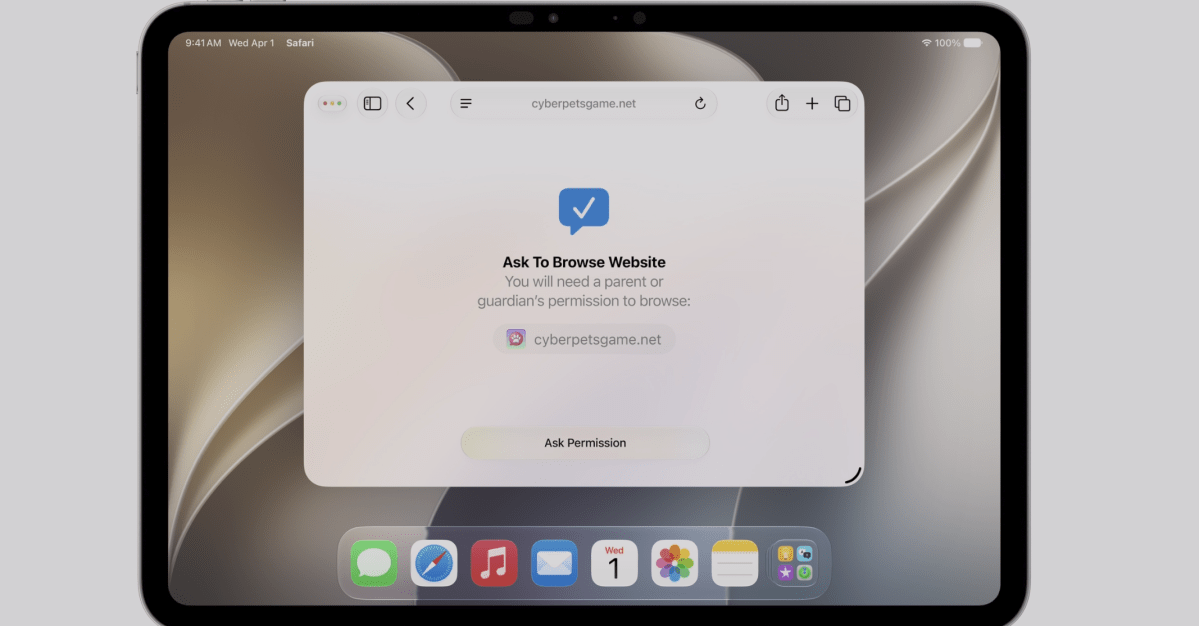
Apple spending a large portion of its WWDC keynote address on parental controls was surprising for several reasons. But the biggest thing is that, despite all the air time, it didn’t announce anything new beyond a redesigned interface. Almost all of the features mentioned already exist or are upgrades to current options. Why Apple chose to do this is no mystery. You can trace the thread from the recent landmark social media trial against Meta and Google to the protesters outside its Cupertino headquarters today: Apple is trying to show the world that it’s responsible when it comes to your kids.
Only it really isn’t. Screen time is useless. As a mom of two whose kids have Apple Watches, iPads, and iPhones, and who are now entering adolescence (18 and 15), I’ve spent several years struggling with Apple’s parental controls. In that time, I’ve gone through about 2,000 Screen Time passcodes and gained several new gray hairs.
Screen Time is not a reliable way to control your child’s device usage; The only real way to limit screen time is to remove the screen. This is something that Apple will never be able to get behind, and something that, as your child grows, becomes increasingly untenable for a number of reasons.
I’m not going to get into those here or argue how much responsibility should lie with the developer of the technology rather than the parents when it comes to parental controls – that’s a whole societal debate we can get into some other time.
My problem with Screen Time is that the most powerful technology company in the world that specializes in hardware and software has half-assed its “parental controls” for years and is now trying to put lipstick on a pig.

User forums are awash with complaints about Screen Time not working, being inaccurate, kids finding ways to bypass it, and frustrations at its limitations. In 2024, Joanna Stern wall street journal Reported on a bug that allowed children to bypass content restrictions on Screen Time for years.
The only good thing Apple has done for Screen Time since I started using Screen Time almost a decade ago is to add an alert that tells you when “someone” has used the Screen Time passcode – and that was that. last year.
Yet, here we are, and there are some updates to be happy about with iOS 27 coming this autumn. Ask to Browse, which requires them to request permission to visit a new website, would be good for monitoring kids’ web usage. Although you’ve been able to ask them to buy an app to download some of the time, as I know well, kids bypass restrictions on apps like Discord and TikTok by visiting websites instead. You can block different websites, but this is a real fun game of whack-a-mole.
One thing that Apple still needs to fix here is the ability for a child to re-download an app that was previously downloaded to their or a family member’s account. According to the Discord debacle, my daughter was able to re-download the app without asking, even after it was deleted from her device, because I downloaded it.

Communication limits, which let you manage your child’s contacts and specify who they can call and message and when, aren’t new either. And they are also unsettling and disturbing. When neither of us could add contacts to his phone I turned it off. This was an issue when she was on a school field trip and needed to add her teacher’s number, but it became a bigger problem when screen time prevented her from calling me. Some of the issues I encountered stem from the time it takes to sync across devices, especially when you’re not together. The redesigned Screen Time interface is expected to also include some behind-the-scenes improvements.
Time Allowance was the feature Apple spent the most time on during the keynote, even though it was already a feature. You are able to set time limits on apps for certain periods of time. What’s new is that you’ll now get some “expert” guidance on how much time you should give your child per app or category. Parental guilt increases as you set the Netflix slider to four hours so you can complete your report.
Parental guilt increases as you set the Netflix slider to four hours so you can complete your report.
What I would like to see are more detailed time allowance categories. For example, entertainment includes YouTube, Spotify, and Netflix. I’m glad my kid stayed on Spotify for several hours, but not on YouTube. You can set time limits for individual apps, but this tends to be too much.
Speaking of “a lot,” managing screen time for your kids can feel like a full-time job. I’m most interested in the redesigned Screen Time interface, which hopefully is much more useful than the current method of scrubbing through multiple screens in Settings. I’ve lost track of the number of parents who have asked me to help them turn on parental controls on their kids’ iPad or iPhone. When you search for “Parental Controls” in Settings, nothing shows up.
I’m disappointed that Apple didn’t make Screen Time a separate app; I guess this would add ease of use, but I mostly want it so I can lock it with Face ID. Children are smart. My daughter regularly comes to my phone without me noticing and unchecks the Block toggle at the end of Limits for each app. It’s a secret, because you have to dig very deep into multiple menus to find it, which means I often don’t notice the change. The dangers of parenting a tech-savvy teen.
If Apple wants to take credit for protecting our kids from the dangers of screen time, it needs to start with controls that parents can trust.
Correction, June 8: An earlier version of this article incorrectly referenced communication limitations in one example. Communication security is a feature that prevents extremism and violence in messages.
<a href