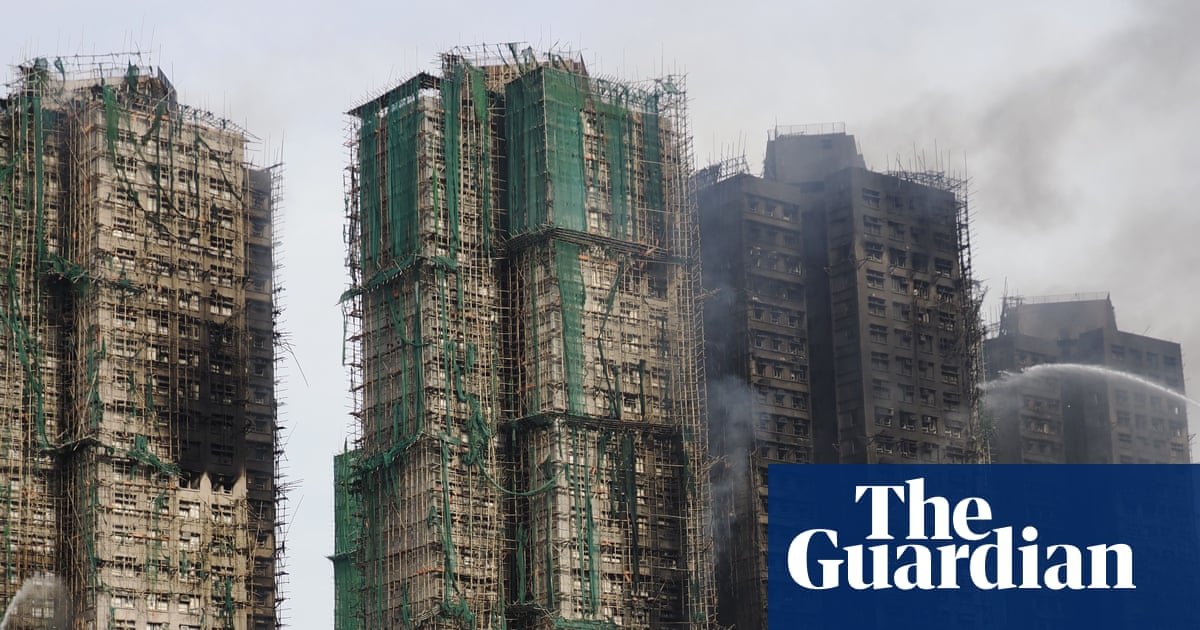
The fire at the Wang Fuk Court residential complex in Hong Kong is still burning, but questions are already being asked about what the deadliest fire in more than 70 years means for Beijing’s grip on power in the city.
The death toll from the fire that destroyed seven of eight high-rise apartment buildings in Wang Phuc Court, a residential complex of 4,800 people, is still rising. Hundreds of people are still missing.
But as firefighters work to contain the blaze and make progress in rescue efforts, anger is already rising among Hong Kongers over the cause of the fire.
The fire has also stoked social concerns over affordable housing in Hong Kong, where skyrocketing property prices mean many people live in tightly packed high-rise apartments that could become death traps if disaster strikes.
At a press conference on Thursday, Hong Kong’s leader, John Lee, said the government would set up a HK$300m (£29.2m) fund to help residents and that the city’s development bureau had discussed replacing bamboo scaffolds with metal alternatives. He also said that contractors in the Asian financial center will be given seven days to submit documents proving the use of fire retardant materials.
But some Hong Kongers are angry at the focus on bamboo as a possible instigator of the fires. On Thursday afternoon, most of the bamboo scaffolding was left standing, and the green mesh between the pillars was charred to ashes.
Angry people believe that blaming bamboo – which the government has already promised to remove from public works works – deflects responsibility from the real cause of the fire, which is still unknown. Bamboo scaffolding is considered an important part of local heritage, and is something that distinguishes Hong Kong from mainland China, where steel scaffolding is widely used in construction.
Michael Mo, a former Hong Kong district councilor who now lives in Britain, said residents of Wang Fuk Court had complained for months about the poor behavior of the construction company. He was born in the Tai Po area where Wang Fuk Court is located.
Last year, the text of an email purportedly from the Hong Kong Labor Department was posted on a Wang Fuk Court residents’ group. In response to inquiries about the maintenance works, the email said that because the works did not involve open flames, “the risk of fire from the scaffolding is relatively low”. It says Labor Department regulations do not cover flame-retardant standards for scaffolding. The department has been contacted for comment.
On Thursday, police in Hong Kong arrested three people linked to the building maintenance company responsible for the property.
Hong Kong’s corruption watchdog also said it would launch a criminal investigation into the renovation works.
Traditionally, major tragedies in Hong Kong have had open investigations, often led by an independent judge.
But many legal experts say Hong Kong’s judiciary is no longer independent, especially on cases that are critical of the government.
“I don’t think the government will start an independent committee on this,” Mo said.
Trust in authorities has declined since Beijing’s sweeping crackdown on the pro-democracy movement in Hong Kong, which included several violent clashes between police and protesters.
“Since the pro-democracy camp and civil society have been wiped out, there is no opposition to effectively sounding the alarm,” Mo said, adding that before 2019, there were guardrails, albeit incomplete ones, on officials. “In the absence of these… there is no way we can make government more effective or accountable.”
Beijing’s response to the fire has been swift. Chinese President Xi Jinping called for “all-out efforts” to extinguish the fires and minimize casualties and damage. Chinese companies including BYD, Geely and Alibaba have pledged millions of Hong Kong dollars in aid donations. A Defense Ministry spokesman said the People’s Liberation Army was prepared to “protect” the city.
Lee also indicated on Thursday that the upcoming Legislative Council elections scheduled for December 7 could be postponed due to the disaster. Elections were last postponed in 2020, ostensibly due to Covid, but it also served as a way to silence the pro-democracy camp. In the years since, that camp has been decimated, by imprisoning legislators or forcing them into exile, or by ousting candidates deemed disloyal to Beijing. This year’s election will be a vote for “patriots only.”
Additional reporting by Helen Davidson and Reuters
<a href