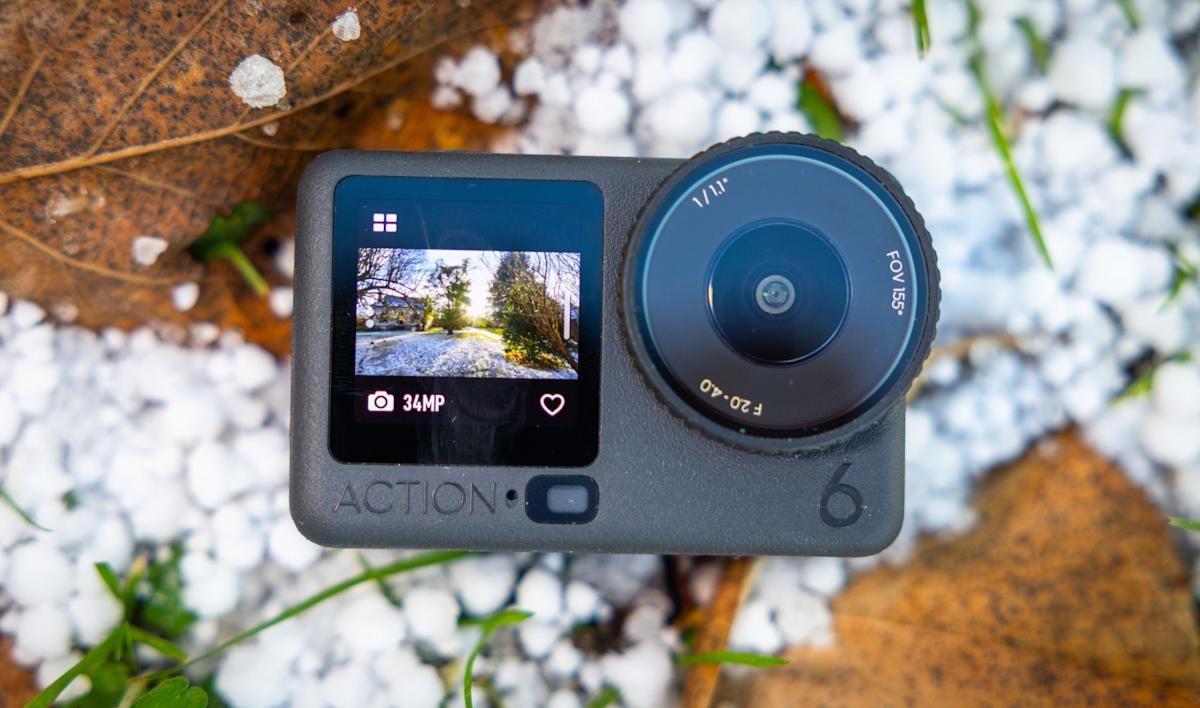
DJI may be the big dog in drones, but it plays third fiddle to GoPro and Insta360 in the action cam market. For better performance, the company has launched Osmo Action 6 with some innovative features. The first is a large, square sensor that enhances video quality in low light, while making it easier to output both horizontal and vertical video. The second is a variable aperture for flexible shooting in both bright and dark conditions.
As DJI’s new flagship non-360 action cam, the Action 6 goes up against GoPro’s Hero 13 and Insta360 Ace Pro 2. Both of these can capture higher resolution footage, so they are better for most users in daylight conditions. However, if you do a lot of shooting in dim or contrasty lighting, DJI’s Action 6 may be the best choice for you.
DJI
DJI’s Osmo Action 6 is the first to have a variable aperture and a large square sensor. Those features make it perform better than rivals in low light and for social media, but the lower video resolution is a disadvantage.
- Clear video in low light
- excellent battery life
- built-in storage
- flexible formats
- Lower video resolution than rivals
- manual aperture control limited
- Not enough film tone setting
$369 on Amazon
variable aperture
I’ve already gone over the specifications of the Osmo Action 6 in my previous news post, so check that out to see the full details. As far as what’s new, the first key feature is a variable f/2.0-f/4.0 aperture – a first for an action cam. This allows for brighter video and better stabilization when shooting at night compared to the fixed f/2.8 aperture on the Action 5 Pro. It also provides shallow depth of field and greater flexibility on sunny days.
The first thing I noticed with this feature was the lack of full manual controls. You can set it to just the fixed f/2.6, f/2.8, and f/4.0 “starburst” modes, or set it to automatic settings ranging from f/2.0-f/4.0 to f/2.8-f/4.0. This means that f/2.0 is not available as a fixed aperture, which is too bad because it would be ideal for portraits.
Still, the variable aperture is a highly useful feature. In auto mode, it ramps up from one setting to the next in fine steps (e.g. f/2.1 to f/2.2), so I never noticed any exposure jumps. In low light, I can dial down the ISO range to avoid excessive noise, giving me higher video quality. However, I would love to see full manual controls in a future update.
new class sensor
Another key feature is the new 1/1.1-inch (0.56 inch diagonal) square sensor that allows a wide range of resolutions and aspect ratios. The Action 6 supports vertical and horizontal resolutions up to 4K, in 16:9 or 4:3 aspect ratios for the latter orientation. The best new setting, however, is Custom, which lets you shoot 3,840 x 3,840 square video.
At 60 fps (a standard frame rate for action video), GoPro’s Hero 13 can reach a maximum of 5,312 x 2,988 pixels, while the Insta 360 Ace Pro 2 can reach 3,840 x 2,880 pixels. This makes the Osmo Action 6 the only current action cam with 4K vertical resolution at 60 fps.
The advantage is that you can film for both horizontal and vertical video platforms like YouTube and TikTok respectively, with no need to rotate the camera and no loss in resolution. If this sounds familiar, that’s why Apple has adopted a square sensor on the front camera of the iPhone 17.
I tested the custom aspect ratio in DaVinci Resolve Studio and it made exporting easier. First, I created and exported a standard 4K horizontal timeline, then copied the content to a vertical timeline. After reframing a few shots to keep the action in focus, I was immediately able to export a 4K TikTok video. This is a huge time saver for busy editors.
video quality
Sample image from DJI Osmo Action 6 in “Custom” mode (Steve Dent for Engadget)
With a 30 percent larger sensor, the Action 6 is better suited for night or indoor shooting using 6,400 ISO and above. Compared to the Action 5 Pro, I found the Action 6’s night video to be much cleaner. DJI has also improved the Night setting: video is cleaner, noise reduction is applied less aggressively and everything looks more natural.
The new sensor and variable aperture also help with DJI’s Rocksteady 3.0 digital stabilization in low light. For example, if you’re filming a bicycle at night, the Action 6 will use a higher shutter speed than the Action 5, so the video will be sharper. This helps the stabilization algorithms produce better results with less pixelation and tearing.
In daylight conditions, the Action 6 delivers sharp, color-accurate video that can be used straight from the camera – just like the Action 5. However, in adverse scenarios such as a sun-drenched forest path, the Action 6 has a slight advantage. When I turned on the 10-bit D-LogM setting to boost dynamic range, I noticed that dark shadow areas had more detail and less noise than footage from the Action 5 Pro or GoPro Hero 13.
However, if you mostly use YouTube and other horizontal formats the GoPro Hero 13’s extra resolution is an advantage. At up to 5,312 x 2,988 pixels at 60 fps, it delivers sharp 4K video after supersampling and more room to reframe shots in post production without any loss in quality.
The “custom” square format of the DJI Osmo Action 6 shown with gridlines enabled (Steve Dent for Engadget)
If you like shooting wide but hate distortion, DJI’s Natural Wide Field of View is a nice addition. The regular Wide setting distorts vertical lines, but Natural Wide keeps everything nice and straight, providing a larger field of view.
Finally, I tested the Action 6’s new Film Tone feature which borrows a trick from Fujifilm’s simulation. This is a way to get some fun looks straight from the camera, like “ancient and cool tones” or “classic negative film type”. The results are great for those who don’t want to mess with color in post-production, although DJI needs to add a few more options like black and white or sepia.
other updates
The Osmo Action 6 with its larger sensor is slightly larger than the Action 5 Pro in all dimensions, but it weighs the same at 5.26 ounces. As before, it can connect to two DJI wireless microphones simultaneously, including the Mic 2, Mic 3, and Mic Mini. And it comes with DJI’s new dual-latch quick-release adapter mount that can be attached in any direction, but it supports all of DJI’s older accessories.
Unlike its rivals, the Osmo Action 6 comes with 50GB of internal memory (up from 47GB previously) with a microSD card slot. This means you won’t have any trouble if you forget the memory card, as most of us have done at one point or another. DJI also doubled Wi-Fi transfer speeds to 80 MB/s and increased USB-C transfer rates to 800 MB/s.
Steve Dent for Engadget
As before, the Action 6 is waterproof up to 20 meters (66 feet) on its own, or about 200 feet with DJI’s waterproof case. And in addition to voice control, the Action 6 also supports gestures, so you can now wave at the camera to start and stop a video (as you can with the new Neo 2 drone). As before with the 1,950mAh Extreme Battery Plus, shooting time between charges is four hours at 1080p and two hours at 4K.
Finally, DJI has introduced two removable lenses for the Action 6, giving DJI some competition in that regard. The first is a macro lens with a minimum focal distance of only 4.3 inches, making it ideal for close-up work and portraits. The second is a FOV extension lens that increases the field of view from 155 to 182 degrees.
wrap up
With a larger sensor and larger aperture than competitors, DJI’s Action 6 is now the best action cam on the market for night shooting, delivering clean, sharp video with better stabilization than rivals. It is also ideal for users who output to both YouTube and TikTok.
However, for regular daytime shooting, the extra resolution offered on GoPro’s Hero 13 may be a better fit for some users. All that aside, it may just come down to price. Pricing for DJI’s Action 6 starts at $369 ($439 with extra batteries and a charger), while it’s $309 for the Hero 13 Black and $420 for Insta360’s Ace Pro 2. These are all great choices, but if low-light capability is more important than resolution, choose the Osmo Action 6.