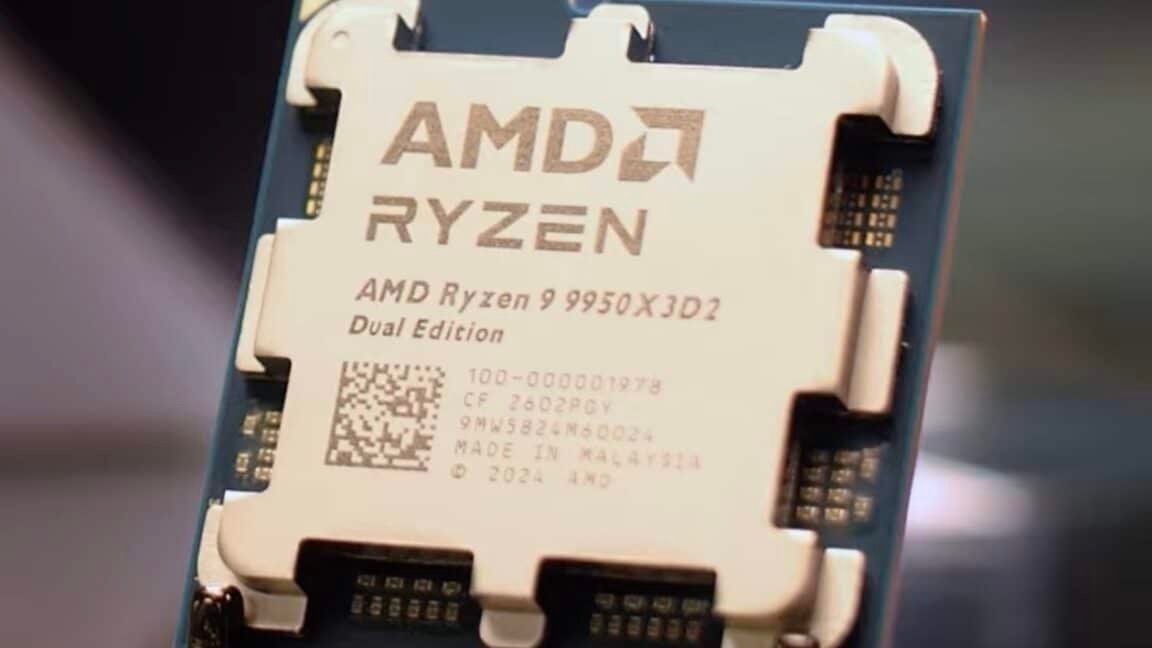
For nearly four years now, AMD has offered special “X3D” variants of its high-end desktop processors with an additional 64MB of L3 cache attached, an addition that benefits games disproportionately. AMD calls it “3D V-Cache” because it stacks the cache directly above (for the Ryzen 5000 and 7000) or below (for the Ryzen 9000) the CPU die.
The 12- and 16-core Ryzen chips have their CPU cores split between two silicon chiplets, which has historically made the 7900X3D, 7950X3D, 9900X3D, and 9950X3D a bit awkward. Of their two CPU chiplets, one has 64 MB of 3D V-cache associated with it, and one does not. AMD relies on its driver software to ensure that software that benefits from the additional cache runs on V-cache-enabled CPU cores, which usually works well but is sometimes error-prone.
Enter the Ryzen 9 9950X3D2 Dual Edition, a mouthful of a chip that includes 64MB of 3D V-cache on both processors, without the hybrid arrangement that has defined other chips so far. This gives the chip a total of 208 MB of cache – 16 MB of L2 cache, 32 MB of L3 cache built into each of the two CPUs (for a total of 64 MB), and then another 64 MB chunk of 3D V-cache per die. Overall, AMD says the new chip should be up to 10 percent faster than the 9950X3D in games and other apps that benefit from the extra cache.
<a href