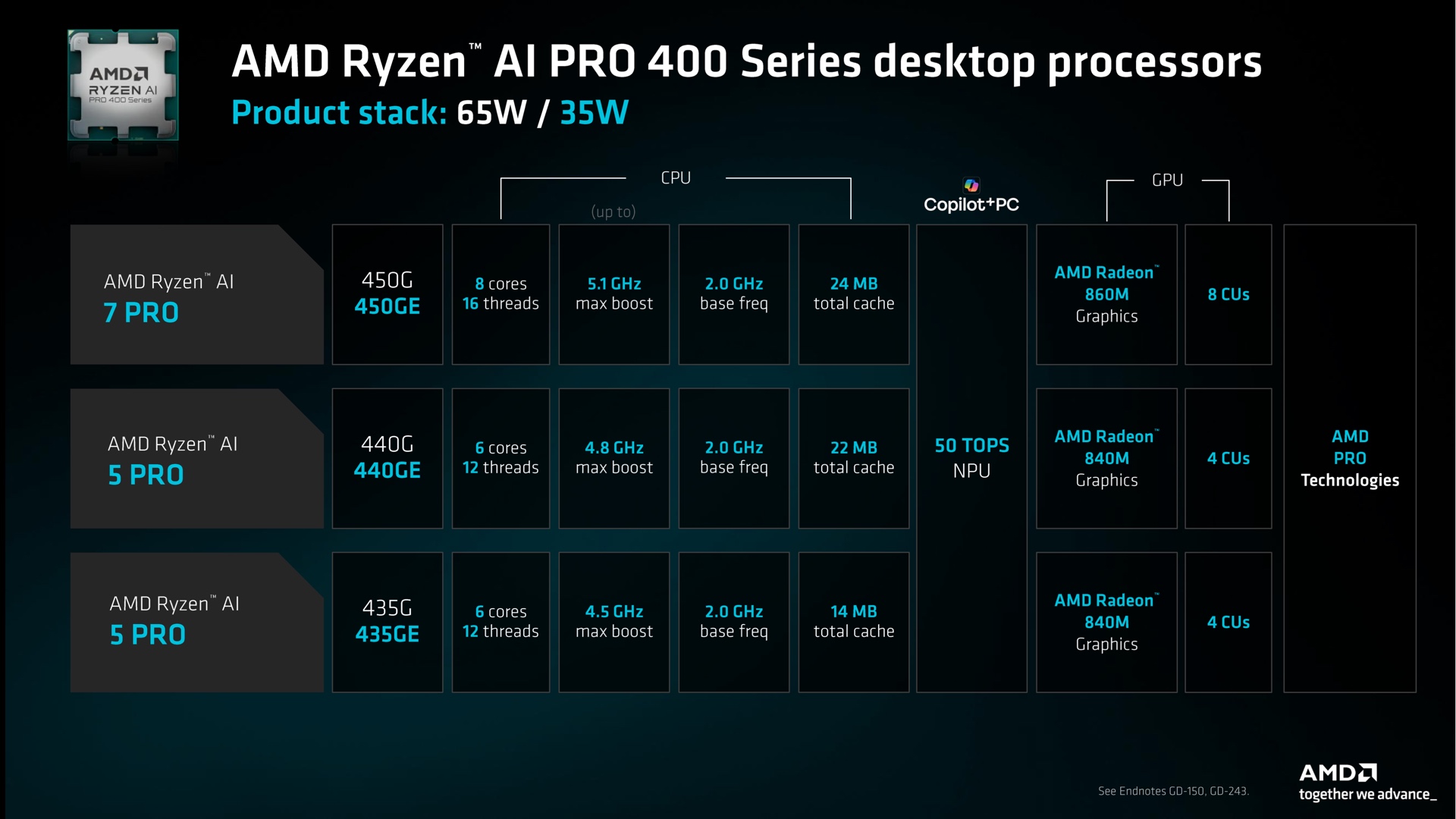
AMD’s initial lineup includes a total of six chips, split between variants with a 65 W and 35 W default TDP. Neither matches the specs of chips like the Ryzen AI 9 HX 370, which includes 12 CPU cores and a 16-core Radeon 890M GPU.
Credit: AMD
AMD’s initial lineup includes a total of six chips, split between variants with a 65 W and 35 W default TDP. Neither matches the specs of chips like the Ryzen AI 9 HX 370, which includes 12 CPU cores and a 16-core Radeon 890M GPU.
Credit: AMD
Like previous G-series Ryzen chips, these are essentially laptop silicon repackaged for desktop systems. Despite the Ryzen AI 400-series branding, they share most of their specs with the Ryzen AI 300 laptop processors. The two chip generations are extremely similar overall, but the Ryzen AI 400-series laptop CPUs include a slightly faster 55 TOPS NPU.
Unlike previous launches, AMD isn’t making its top-end laptop silicon available for desktop use, at least not yet. Neither of these chips include the full compliment of 12 CPU cores that you can find in the Ryzen AI 9 HX 375 or 370; You also can’t get a Radeon 880M or Radeon 890M integrated GPU. The three models AMD is announcing today are a Radeon 860M integrated GPU with 8 CPU cores (likely split evenly between the faster Zen 5 cores and the slower, smaller and more power-efficient Zen 5c cores) and 8 RDNA 3.5 graphics cores.
AMD could always decide to release a higher-end processor option at a later date, but the fact is that trying to build a mini gaming PC around a Socket AM5 processor right now makes little financial sense. These require a pair of fast DDR5 sticks to maximize their performance, and prices for fast DDR5 sticks have soared into the stratosphere over the past year. It’s hard to make any kind of gaming PC make financial sense right now, but the frames-per-second-per-dollar you get from desktop iGPUs don’t make them particularly attractive. This may explain why CPUs are targeting business desktops first.
The announcement of the Ryzen AI 400 desktop CPUs is in line with what AMD announced at CES earlier this year: low-key iterations on existing technology that do little to push the envelope. Given the current RAM and storage shortages and the fact that most of the world’s chipmakers are competing for manufacturing capacity at TSMC, maybe this is the best we can hope for.
<a href