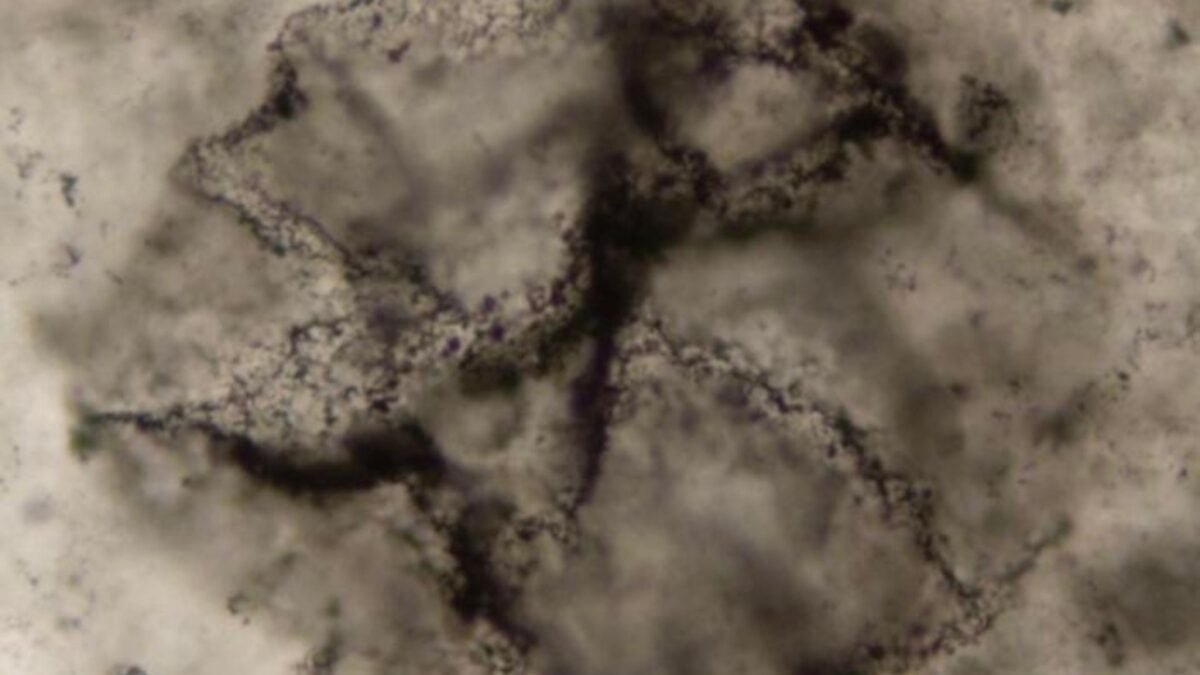

The findings, published Monday in the journal Proceedings of the National Academy of Sciences, include the detection of chemical “fingerprints” left by microbes in rocks dating back 3.3 billion years. In addition, they found chemical signals of photosynthetic life in rocks 2.5 billion years old, extending the chemical record of photosynthesis preserved in carbon molecules by more than 800 million years.
“Scientists have developed many different ways to infer life in ancient samples — looking at the texture of rocks, their minerals, isotopes — but using complex molecules to come up with a clear record of life was only used until about 1.6 billion years ago,” co-lead author Michael L. Wong, a research scientist at Carnegie Science’s Earth and Planets Laboratory, told Gizmodo. “We’re taking it to 3.3 [billion]So that age doubled.
Using AI for ancient chemical analysis
Wong led the project with Aniruddha Prabhu, another research scientist at Carnegie Science’s Earth and Planets Laboratory. While Wong is an expert in astronomy and planetary science, Prabhu is an AI and machine learning expert.
To understand how this new model accurately distinguishes biosignatures from nonbiological materials, you can think of it like facial-recognition software, Prabhu told Gizmodo.
The model is trained on GC-MS (Gas Chromatography Mass Spectrometry) data. This 3D spectral data looks like a landscape with peaks, valleys, hills and other features, Prabhu explained. The model identifies patterns among these features that match biological materials, in the same way that facial recognition software is trained to identify the shapes that make up a person’s eyes, mouth, nose, and bone structure.
“We are looking at all the data[set]And the model is able to pick out specific features that are very important to whether a sample is photosynthetic or not or biogenic or not – in a way that humans can’t do because of the sheer volume of data,” Prabhu explained.
The model is currently able to do this with 90% accuracy, and researchers expect it to improve as it is trained on more data from an increasingly diverse set of samples. This new technology could be a game changer for paleontologists, allowing them to detect ancient biomarkers even in badly degraded or deformed specimens. This is already opening up a whole new world of opportunities for ancient chemical analysis, and Earth is only the beginning.
out of this world possibilities
The search for ancient life extends far beyond our home planet. Astronomers like Wong look for evidence of life elsewhere in the solar system, such as on the icy moons of Mars or Saturn.
The fact that the AI was able to accurately detect signs of ancient life on Earth “increases my confidence that we are on the right track to developing the types of tools and machine learning algorithms we need to try to find evidence of life in ancient Mars rocks,” Wong said. “I’m full of optimism for applications elsewhere, beyond Earth.”
Wong, Prabhu and their colleagues chose to train the AI on GC-MS data because it is a flight-ready instrument. “It has space flight heritage, one of these pyrolysis GC-MS instruments is sitting in the belly of the Curiosity rover on Mars right now,” Wong said.
Prabhu explained that the model’s design also prioritizes computational lightness and interpretability, which is important for performing analyzes in real time as the rovers collect geological samples.
“So you have a rover on Mars or another planet, it picks up a sample, zaps it, and produces spectra. You can immediately get an initial prediction — a highly accurate, but early prediction — that scientists can use to understand that area and make decisions,” he said.
Both Wong and Prabhu hope to see this technology applied to the solar system, and they will seek a NASA partnership to expand its capabilities and eventually send it to space. For now, the model will continue to deepen our understanding of the emergence of life on Earth, helping us unravel the mysteries of our origins.