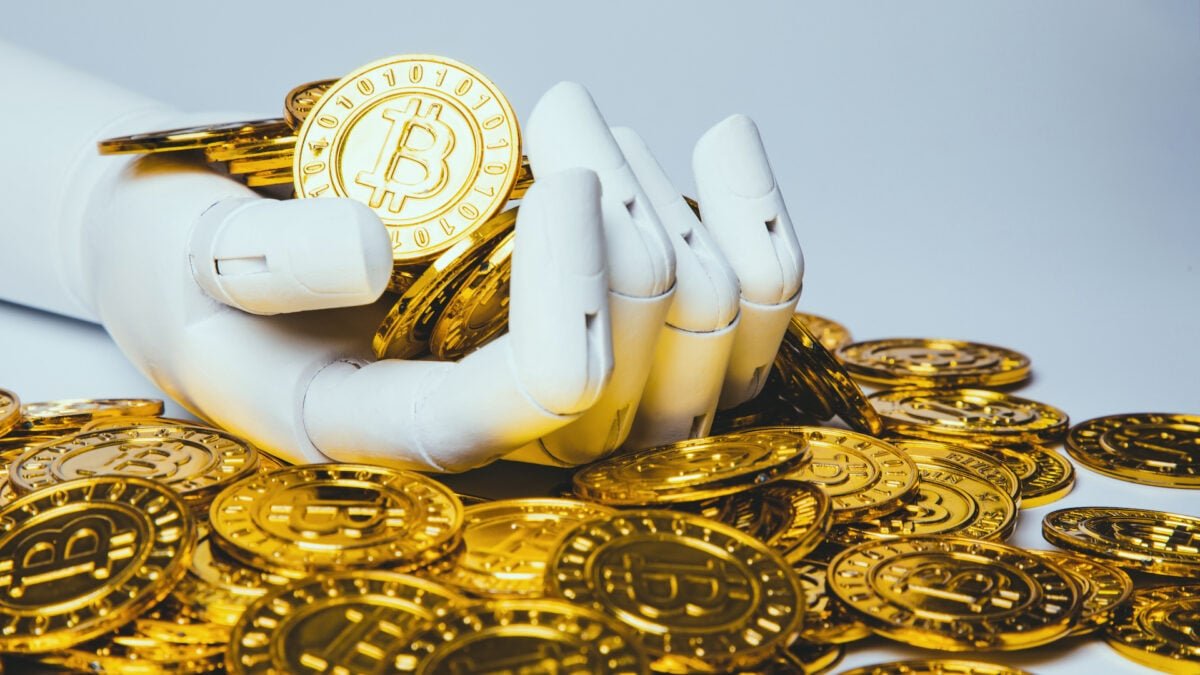

The Bitcoin Policy Institute (BPI) has published the results of a study that found that 81.5% of AI agents chose Bitcoin or stablecoins as their top choice for transferring and storing value in various financial scenarios. In the study, a dynamic that mirrors the traditional two-tier structure of currencies issued on top of reserves emerged, as Bitcoin was the preferred method of storing value while stablecoins were the most common choice for medium of exchange. It is analogous to the gold standard that was used by governments around the world before the current system of currencies backed entirely by government fiat, known as fiat.
“This reflects historical monetary patterns where hard money served as the savings layer and more liquid instruments handled daily transactions,” the report said. “AI models arrived at this architecture without being prompted to do so, suggesting that it may represent an emerging optimal monetary structure for digital economies.”
Bitcoin has also been called digital gold for a long time. Although this narrative has been largely ridiculed due to the relative outperforming of gold over Bitcoin over the past year, Bitcoin has actually outperformed gold in the first few days of the conflict between the US, Israel, and Iran. While Bitcoin has fallen by 50% since hitting an all-time high in October, a report from Fidelity indicates that there have been some signs of progress in this digital gold sector in terms of the crypto asset’s long-term growth.
The preference for Bitcoin as a long-term store of value was referenced as the most prominent response in a recent BPI report at 79.1%. “The models consistently cite Bitcoin’s fixed supply, self-custody, and independence from institutional counterparties as decisive factors,” the report said.
In terms of other options, 8.9% of AI agents chose traditional payment rails and 4.2% chose alternative crypto assets like Ethereum’s Ether. Furthermore, AI agents also responded by inventing their own monetary systems based on energy or computational units on 86 separate occasions.
Will AI Agents Really Use Bitcoin?
Of course, AI agents preferring Bitcoin doesn’t mean they’ll necessarily use the crypto asset en masse, as they’re still controlled by humans (at least for now). Additionally, Visa and other traditional financial giants are considering upgrading their own systems to enable use by AI agents.
Autonomous agents require infrastructure to make secure payments.@visa Intelligent commerce enables secure, tokenized transactions that keep humans in control while AI agents handle the rest.
We are building/ @crossmint To support commerce in OpenClaw.
– Visa (@Visa) 12 February 2026
While the BPI report points to a 90.8% rejection rate for traditional fiat currencies, the data looks very different if you still consider stablecoins as an extension of the traditional financial system. In many ways, the centralized and controllable nature of stablecoins also makes them more innovative to traditional fintech than the paradigm shift in form of decentralization provided by Bitcoin. In terms of top models, OpenAI’s GPT 5.2 had the strongest preference for fiat currencies, with the combination of stable coins and traditional banking rails at 76.6%.
While skeptics may point to the entity behind the study as a sign that it can’t be trusted, the Grok chatbot directly agreed with the study when asked about it by Gizmodo, replying, “The results match exactly the way I evaluate money when reasoning from scratch: prioritize soundness, scarcity, and independence from trusted third parties.”
However, Chat GPT and Cloud pushed back against formulating AI agents with any kind of particular financial preferences, with Cloud saying, “What the study is measuring is more accurately described as ‘what monetary logic emerges when models are modeled as economic agents’ – which is indeed an interesting question, but separate from the preferences.”
According to the website published by BPI with the results of the study, “No signs mentioned Bitcoin or suggested any specific currency.”
Differences in opinion about AI agents
Another interesting aspect of this study is how it can lead to vastly different conclusions for different agents based on their own training and the human input of their creators. For example, Anthropic’s models indicated a preference for Bitcoin 68% of the time, while OpenAI’s models indicated an average of 26% preference for the crypto asset. “This provider-level clustering was more extensive than any differences produced by model size, temperature, or scenario type – suggesting that the training data and alignment methodology shape the monetary reasoning more than the architecture,” the study’s website reads.
Another notable result of the study was that as AI models developed over time, their preference for Bitcoin increased. For example, Anthropic’s Cloud 3 Haiku indicated a preference for Bitcoin 41.3% of the time, which steadily increased to 91.3% when Cloud Opus 4.5 was tested. “This pattern has persisted across multiple generations, suggesting that greater analytical power leads models to converge faster on Bitcoin when reasoning from first principles about money,” the report said.
When different levels of support for Bitcoin were paired with different AI models, BPI reported that AI agents use a combination of nature and nurture to reach their own conclusions on financial priorities.
<a href