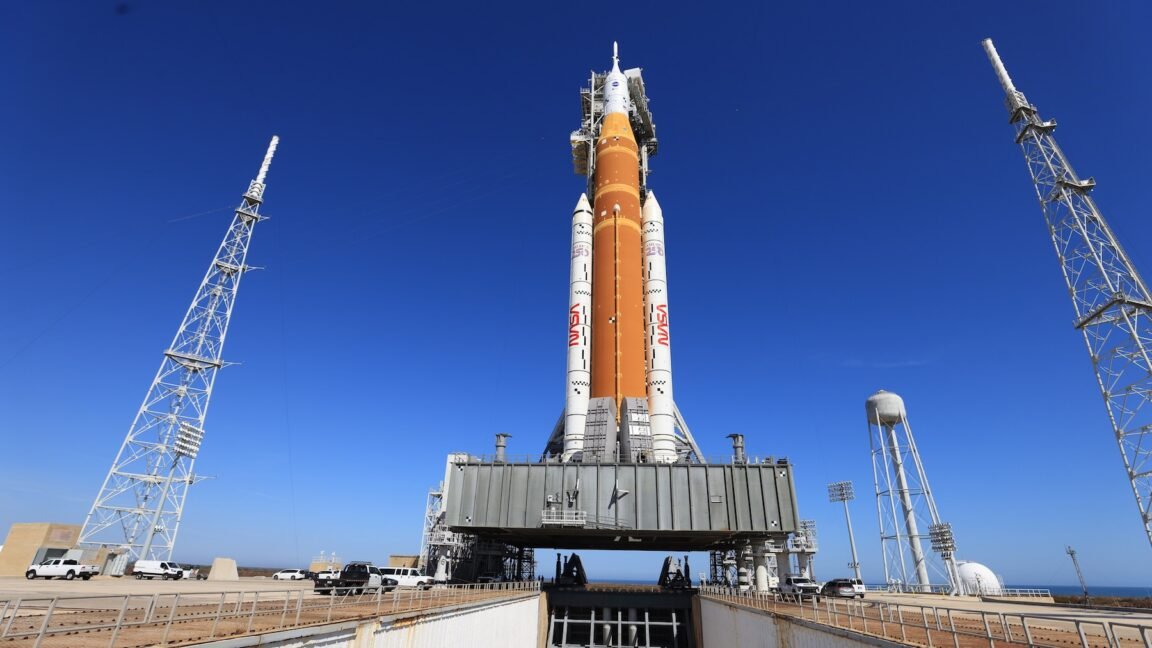
The second fuel test on NASA’s Space Launch System rocket ended Thursday night, giving senior managers enough confidence to move forward with plans to launch four astronauts around the moon by March 6.
Unlike the first attempt to load propellant into an SLS rocket on Feb. 2, no major leaks occurred during Thursday’s practice countdown at Kennedy Space Center in Florida. Technicians swapped seals on the launch pad after hydrogen gas leaked from the rocket’s main fuel line earlier this month. This time, the seals remained in place.
“For the most part, all of those improvements performed very well yesterday,” said Lori Glaze, NASA’s acting associate administrator for exploration programs. “We were able to fully fuel the SLS rocket within the planned timeline.
The results put the Artemis II mission on track to fly next month. NASA abandoned several launch opportunities in February after experiencing persistent hydrogen leaks during the first Wet Dress Rehearsal (WDR).
“We are now targeting March 6 as our initial launch attempt,” Glaze said. “I’m going to give it a warning. I want to be open, transparent with all of you that there is still work pending. There is still a lot of work left to do.”
If the teams complete all that work, launch of the Artemis II mission could occur within the two-hour window opening on March 6 at 8:29 p.m. EST (March 7 at 01:29 UTC). NASA has other launch dates available on March 7, 8, 9 and 11, but the mission may have to wait until April. There are approximately five days per month when the mission can depart from Earth, taking into account the position of the Moon in its orbit, flight trajectory, and thermal and optical constraints.
The Artemis II mission will last between nine and 10 days, carrying NASA’s Orion spacecraft with commander Reed Wiseman, pilot Victor Glover and mission specialists Christina Koch and Jeremy Hansen on the far side of the moon and then returning to Earth to land in the Pacific Ocean. Wiseman’s crew would set a record for the farthest humans have ever traveled from Earth, and become the first humans to fly around the Moon since 1972.
<a href